Intelligence Emerges When the Whole Brain Works as One
For decades, scientists hunted for the seat of human intelligence — a single neural address where the magic of thought, reason, and creativity resided. […]
Contributor
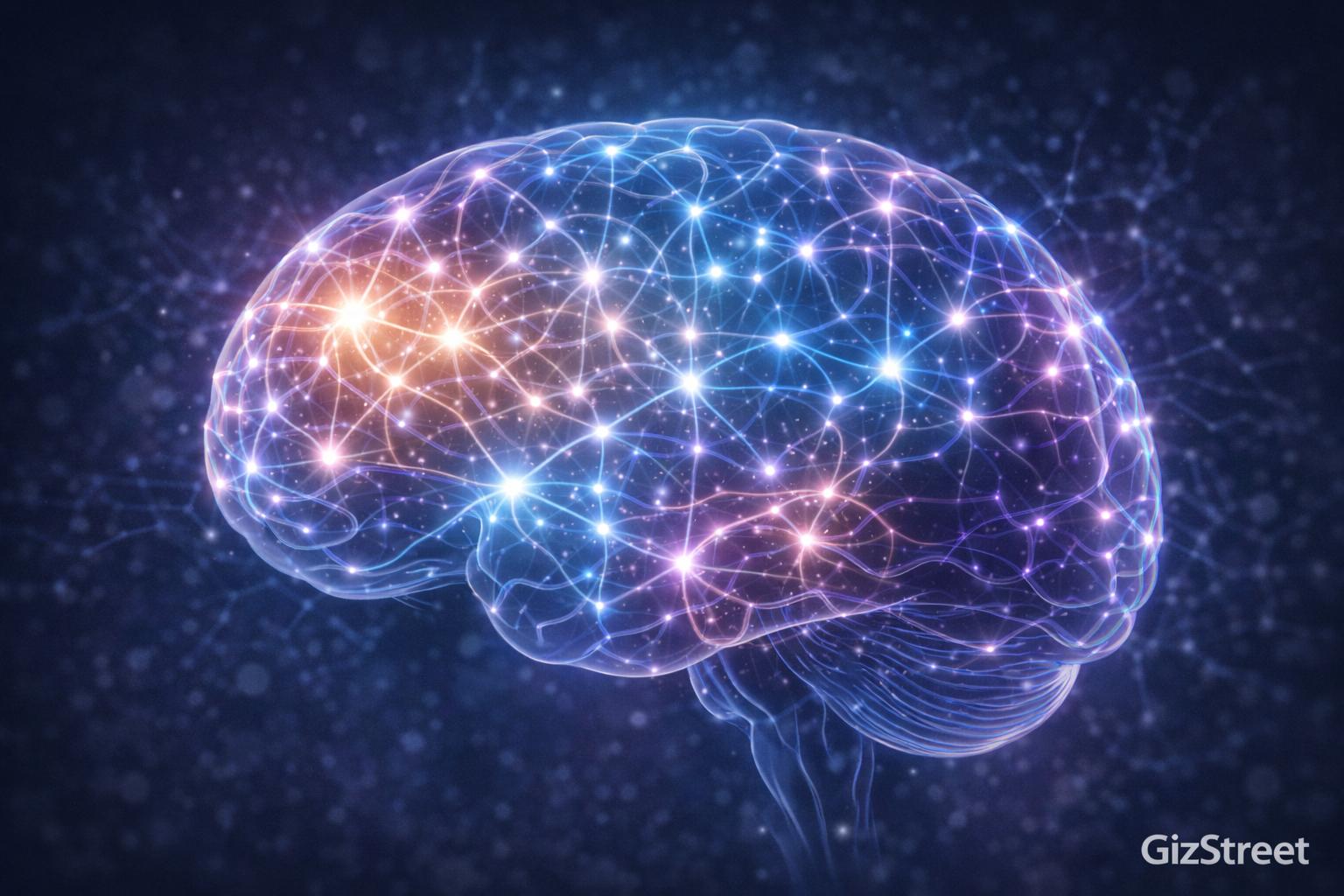
For decades, scientists hunted for the seat of human intelligence — a single neural address where the magic of thought, reason, and creativity resided. Many pointed to the prefrontal cortex. Others highlighted the parietal lobe or overall brain volume. But a growing body of neuroscience research is dismantling this tidy picture entirely.
Intelligence, it turns out, is not a fixed property of any one region. It is an emergent phenomenon — something that arises when billions of neurons across the entire brain communicate with remarkable speed, flexibility, and coordination. Think of it less like a single instrument playing a solo and more like a full symphony orchestra performing in perfect synchrony.
Modern neuroimaging technologies, particularly functional MRI (fMRI), now allow scientists to watch the brain in action — measuring not just which regions activate, but how efficiently they talk to each other. What these studies consistently reveal is striking: people who perform better on measures of intelligence tend to have brains whose networks cooperate more fluidly, switch between tasks more nimbly, and integrate information across longer distances.
This shift has profound implications — for how we teach children, design artificial intelligence, support recovery from brain injury, and understand the aging mind. It also raises a fascinating philosophical question: if intelligence is a whole-brain phenomenon, what does that mean for how we think about — and nurture — human potential?
The Traditional View of Intelligence in the Brain
The search for the biological roots of intelligence is nearly as old as neuroscience itself. Early researchers, working long before brain scanners existed, attempted to link cognitive ability to measurable physical features of the brain. Phrenology — the now-debunked practice of reading skull bumps — was an early, misguided expression of this instinct.
By the 20th century, the conversation had grown more sophisticated. Scientists began focusing on three primary candidates for the “intelligence center” of the brain.
The Prefrontal Cortex (PFC): Located at the very front of the brain, just behind the forehead, the PFC became the dominant candidate. Research consistently showed that damage to this region impaired planning, abstract reasoning, decision-making, and working memory — all abilities closely tied to general intelligence. It was easy to conclude that the PFC was where intelligence “lived.”
Brain Size and Gray Matter Volume: Another influential line of thinking correlated larger overall brain volume — and particularly more gray matter — with higher measured intelligence. Studies in the 1980s and 1990s found modest positive correlations between brain size and IQ scores, fueling speculation that bigger simply meant smarter.
The Parietal Lobe: Research also highlighted the parietal lobe — particularly the region where it meets the temporal and occipital lobes — as a key zone for mathematical reasoning, spatial processing, and logical thought.
IQ testing, introduced in the early 1900s, reinforced the idea that intelligence could be reduced to a single measurable number. This, in turn, encouraged the assumption that this single number must map onto a single neural substrate. If intelligence could be condensed into one score, surely it lived in one place.
But there were always cracks in this framework. People with damage to the PFC sometimes retained high-level reasoning in other domains. Brain size correlated with IQ only weakly, and the correlation did not hold across all populations. Most tellingly, intelligence tests that probed different cognitive domains activated different — and often overlapping — brain regions. Something more complex was clearly happening.
The Shift Toward Network Neuroscience
The revolution in understanding intelligence began with a revolution in tools. When functional MRI technology became widely available in the 1990s, it gave neuroscientists something they had never had before: the ability to watch a living, thinking brain in real time. Not just its structure, but its activity — which regions lit up, when, and in what patterns.
What emerged from thousands of fMRI studies over the following decades was a fundamentally different picture of the brain: not a collection of isolated modules, each performing its own task behind closed doors, but a richly interconnected network of networks — a dynamic, constantly reorganizing communication system.
What Is a Brain Network?
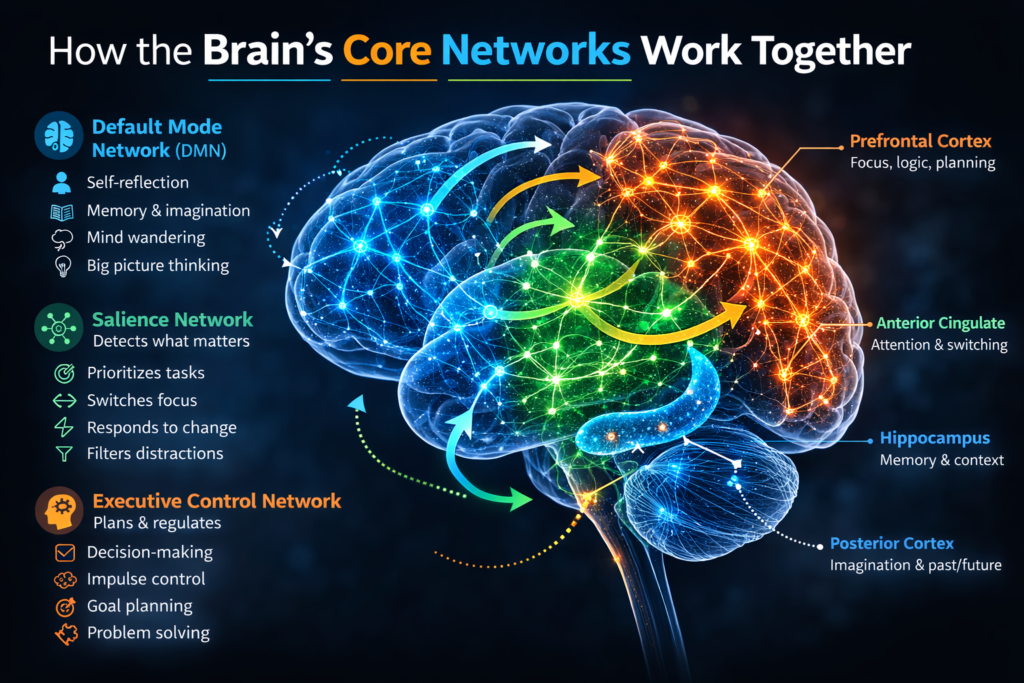
A brain network is a set of regions that tend to activate together and communicate with each other during particular types of cognitive tasks — or even at rest. Researchers have identified several major networks that are now central to understanding intelligence.
The Default Mode Network (DMN): Active when the mind is at rest, daydreaming, or engaged in self-referential thought. Contrary to earlier assumptions, the DMN is not idle — it is critical for creative thinking, memory consolidation, and imagining future scenarios.
The Executive Control Network (ECN): Engages during focused, goal-directed thinking. It includes the prefrontal and parietal cortex and is central to working memory, planning, and cognitive control.
The Salience Network: Acts as a gatekeeper — detecting the most relevant stimuli in the environment and signaling other networks to shift attention. It plays a key role in switching between the DMN and ECN.
These networks communicate through synchronized electrical oscillations. When two regions fire in rhythm, information flows between them efficiently. The degree to which regions are synchronized is called functional connectivity.
Functional Connectivity and Intelligence
Functional connectivity is measured by tracking how synchronously different brain regions activate over time during an fMRI scan. If two regions consistently rise and fall in activity together, they are said to be functionally connected — they are effectively “talking” to each other.
A landmark shift in intelligence research came when scientists began analyzing not individual regions, but patterns of functional connectivity across the whole brain. The results were compelling: individuals with stronger cross-network connectivity — especially between the executive control network and other brain regions — consistently performed better on standardized cognitive tests.
A major study using data from the Human Connectome Project, which mapped the brain activity of over 1,000 individuals, found that a single measure of “global brain efficiency” — how quickly information could theoretically travel between any two points in the brain — predicted cognitive performance more accurately than the size or activation of any single region.
Integration vs. Isolation
Perhaps the most transformative insight from network neuroscience is this: intelligence appears to emerge not from the raw processing power of any single region, but from the brain’s ability to integrate information across specialized regions into a coherent whole.
Isolated processing — each region solving its own small piece of a problem in isolation — is efficient for simple, routine tasks. But complex reasoning, creative problem-solving, and adaptive thinking all require different types of information to be combined, compared, and synthesized. That requires integration. And integration requires a brain whose networks are well-connected, well-coordinated, and capable of flexible reorganization.
What New Research Reveals About Whole-Brain Cooperation
Over the past fifteen years, a cascade of large-scale neuroimaging studies has transformed our understanding of what a high-functioning brain actually looks like. The picture that emerges is both more complex and more elegant than earlier models suggested.
Finding 1 — Global Efficiency Predicts Cognition: Researchers analyzing data from the Human Connectome Project found that participants’ performance on a battery of cognitive tasks — including memory, reasoning, and processing speed — was most accurately predicted not by any single brain region, but by a measure called “global efficiency”: how rapidly information can be routed between any two points in the brain’s network. Brains that process information through shorter, more direct pathways consistently outperform those that rely on longer, less efficient routes.
Finding 2 — Network Flexibility and Problem-Solving: A study published in Nature Neuroscience found that individuals who could fluidly shift their brain’s network configuration — essentially reorganizing which networks were talking to each other depending on the demands of the task — scored significantly higher on tests of fluid intelligence. Rigid brains, those that maintain the same network structure regardless of context, showed lower performance on novel problem-solving tasks.
Finding 3 — The Specialization-Integration Balance: High intelligence does not appear to be a product of having an unusually large or uniformly hyperactive brain. Instead, the most cognitively capable individuals show a specific pattern: high levels of specialization within individual networks (each network is very good at its particular job) combined with strong, flexible integration between those networks. It is, as one research team described it, the neural equivalent of having elite specialists who are also excellent team players.
Finding 4 — Resting-State Connectivity Matters Too: Strikingly, differences in brain network organization that predict intelligence are visible even when a person is doing nothing — lying still in a scanner with their eyes closed. The strength and efficiency of connections in the resting brain reflects something fundamental about its architecture, not just its momentary activity.
Taken together, these findings point toward a consistent principle: intelligence is less about raw computational power in a specific location, and more about the speed, efficiency, and adaptability of communication across the entire neural landscape.
The Role of the Prefrontal Cortex — Still Important?
With the rise of whole-brain network models, a reasonable question emerges: does the prefrontal cortex still matter? The answer is emphatically yes — but its role is now understood very differently.
Under the older localization model, the PFC was intelligence’s headquarters: the place where plans were formed, decisions were made, and abstract reasoning occurred. Under the network model, the PFC is better described as a critical hub — one of the most richly connected nodes in the brain’s communication network, but not a standalone processor.
Its importance has not diminished. The PFC remains central to executive function: the cluster of higher-order cognitive abilities that allow us to set goals, hold information in working memory, suppress distracting impulses, and shift strategies when circumstances change. These functions are indispensable to intelligent behavior.
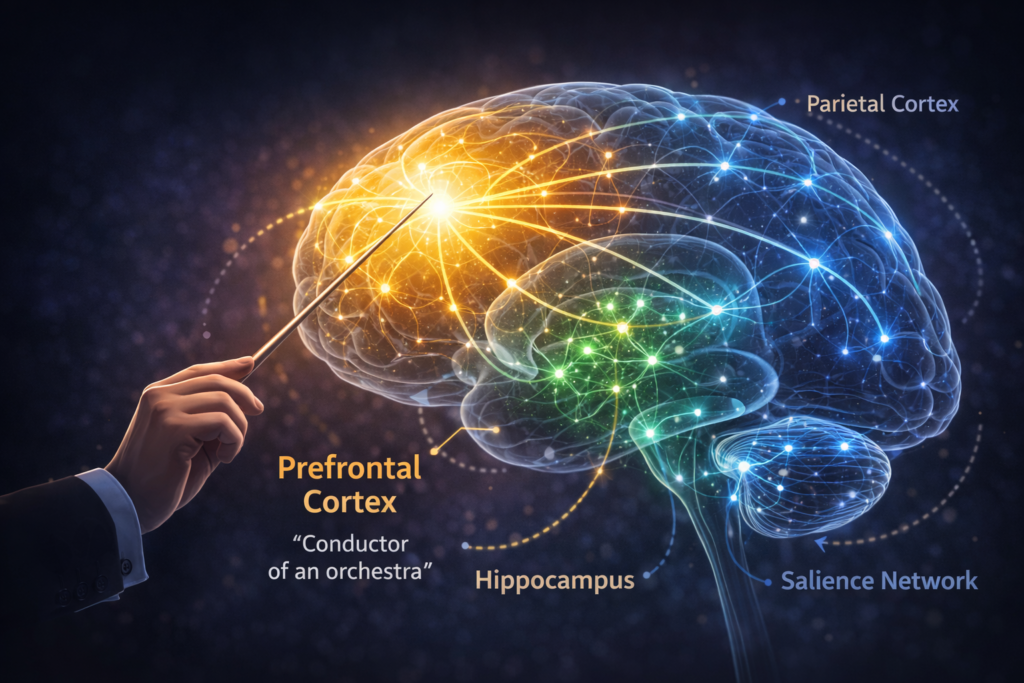
What has changed is the understanding of how the PFC exercises these functions. Research now shows that the PFC achieves its effects largely by regulating communication between other brain regions — essentially acting as an orchestrator rather than a solo performer. It modulates the salience network’s attention-switching, coordinates information flow between the executive control network and memory systems in the hippocampus, and helps determine when and how the default mode network is suppressed during demanding cognitive tasks.
In graph theory terms — the mathematical framework that network neuroscientists increasingly use — the PFC is a high-degree node with strong betweenness centrality. It lies on the shortest path between many other brain regions, making it indispensable to the brain’s communication efficiency. Damage to the PFC does not just impair one function; it disrupts the coordination of many.
This reframing is important for both clinical and educational practice. It suggests that interventions aimed at supporting cognitive function should not target the PFC in isolation, but consider how to support and strengthen the wider network in which it operates.
Why Intelligence Requires Balance Between Networks
If whole-brain cooperation drives intelligence, one might assume that maximizing connectivity — getting every brain region talking to every other — would maximize cognitive ability. But neuroscience reveals a more nuanced truth: intelligence is not just about connectivity; it is about the right kind of connectivity at the right time.
Think of the brain as a city’s traffic system. A city where every road connects directly to every other road sounds efficient — but in practice, it would create chaos. Intelligence emerges from a system more like a well-designed highway network: fast, direct routes between major hubs, with local roads handling neighborhood-level communication, and smart traffic management ensuring that rush-hour routes do not conflict with emergency vehicle pathways.
The Cost of Rigidity: Some individuals’ brains maintain highly stable, predictable network configurations — the same regions consistently talk to each other, regardless of what the task demands. This rigidity can support routine performance on well-practiced tasks. But it comes at a cost: limited creative problem-solving, reduced ability to approach novel challenges from new angles, and diminished capacity for what researchers call “insight” thinking — the sudden, reconfiguring leap that solves a problem from an unexpected direction.
The Cost of Randomness: On the opposite end, a brain whose network organization is too unstable — constantly shifting connections with no reliable structure — struggles to sustain focus, maintain working memory contents, or execute complex multi-step plans. Some research suggests that certain states associated with psychotic disorders involve excessive neural randomness, which impairs coherent thought.
The Intelligence Sweet Spot: High cognitive performance is associated with what researchers describe as a “critical” or “optimal” zone between these extremes: networks that are stable enough to support reliable, efficient processing, but flexible enough to reorganize rapidly when the cognitive demands change. This is what cognitive scientists call cognitive flexibility — the ability to fluidly shift mental strategies, inhibit old approaches, and adopt new ones.
Research using dynamic connectivity methods — which track how brain network configurations change from moment to moment, rather than averaging across a whole scan session — has found that individuals with higher fluid intelligence show greater moment-to-moment variability in their network configurations, suggesting their brains are constantly making micro-adjustments to optimize their communication architecture for the current task.
This finding has profound practical implications. Cognitive flexibility is not fixed. It can be developed through specific training approaches, which is why activities that require sustained, adaptive engagement — learning a new instrument, studying a second language, practicing strategic games — may benefit the brain’s network adaptability in ways that passive consumption of information does not.
Implications for Education and Learning
If intelligence emerges from whole-brain network cooperation rather than isolated regional strength, the implications for how we educate children — and how adults continue developing cognitively — are significant and, in some cases, counterintuitive.
From Memorization to Integration: Traditional education models often prioritize the retention and recall of information — the kind of knowledge that IQ tests can measure in a snapshot. But network neuroscience suggests that what the brain needs most is not more information to store, but more practice integrating across knowledge domains. Problem-based learning, Socratic questioning, and cross-disciplinary projects all challenge the brain to recruit and connect multiple networks simultaneously, which may strengthen the very architecture that underlies general intelligence.
Training Cognitive Flexibility: Given that cognitive flexibility is a core feature of high-intelligence brain function, educational approaches that deliberately require students to shift strategies, approach problems from multiple angles, and recover from being wrong — rather than rewarding only correct first attempts — may be building neural adaptability as much as they are building knowledge.
Growth Mindset and Network Plasticity: Research on growth mindset — the belief that abilities can be developed through effort — now has a neurological counterpart. Studies suggest that brains operating under a growth mindset show different error-processing patterns, with greater engagement of regions associated with learning from mistakes. This aligns with the network model: if intelligence is a property of dynamic system coordination, then it is, by definition, more malleable than a fixed regional capacity would be.
Interdisciplinary Learning: Education that crosses disciplinary boundaries — bringing mathematics into music, history into science, literature into ethics — may be particularly valuable from a network perspective, precisely because it forces the brain to build bridges between networks that might otherwise operate in relative isolation. The “connected curriculum” movement in modern pedagogy has intuitive alignment with what network neuroscience is discovering about how intelligence actually operates.
Importantly, these insights do not suggest abandoning all structured, foundational learning. Deep expertise within a domain builds the specialized networks that are one half of the intelligence equation. The goal is not to replace depth with breadth, but to ensure that depth and breadth develop together — in the brain as in the curriculum.

What This Means for Artificial Intelligence
The parallels between biological neural networks and artificial neural networks are more than metaphorical — they are historical. The architecture of modern deep learning was explicitly inspired by the layered, distributed processing observed in biological brains. The “neuron,” the basic computational unit of AI systems, takes its name and conceptual structure from the biological neuron.
But network neuroscience is now revealing aspects of biological intelligence that current AI systems do not replicate — and that may point toward the next generation of machine learning architectures.
Distributed Processing: Deep learning systems do process information in a distributed manner, spreading computation across many layers and nodes simultaneously. This mirrors, at a very high level of abstraction, the brain’s reliance on parallel processing across multiple networks.
The Integration Gap: Where current AI diverges sharply from biological intelligence is in flexible cross-domain integration. Large language models, for instance, can perform impressively within the domain of language and text. But they do not fluidly integrate linguistic reasoning with spatial processing, emotional context, and sensorimotor experience the way the human brain does, continuously and automatically, in service of navigating a complex world.
Dynamic Reconfiguration: Biological brains constantly reorganize their network configurations in response to changing demands. Current AI architectures, once trained, have fixed weights. Research into dynamic, adaptive neural architectures — networks that can restructure themselves during inference — is an active area of AI research, and neuroscience findings about cognitive flexibility may inform its direction.
The honest summary is this: AI has learned enormously from neuroscience, but the gap between machine learning and the whole-brain network intelligence described in contemporary neuroscience research remains substantial. The brain’s ability to achieve flexible, energy-efficient, cross-domain integration remains an aspiration for AI rather than an achievement.
Brain Injury, Aging, and Cognitive Resilience
One of the most practically significant insights from the network model of intelligence is what it reveals about cognitive resilience — the brain’s ability to maintain function in the face of damage, disease, or aging.
Under the older localized view, brain injury was a straightforward subtraction: damage the region that housed a function, and that function was lost. Recovery, if it occurred, was somewhat mysterious — and often attributed to vague ideas about “the brain healing itself.”
The network model offers a far richer and more accurate account.
Distributed Architecture as Insurance: Because intelligence depends on network-wide coordination rather than any single node, damage to one part of the network does not necessarily destroy the function. Other nodes can sometimes compensate, rerouting information through alternative pathways — much as internet traffic reroutes around a downed server. This is one reason why two people with lesions of similar size and location can have dramatically different cognitive outcomes: what matters is not just where the damage is, but how critical that node was to the wider network’s efficiency.
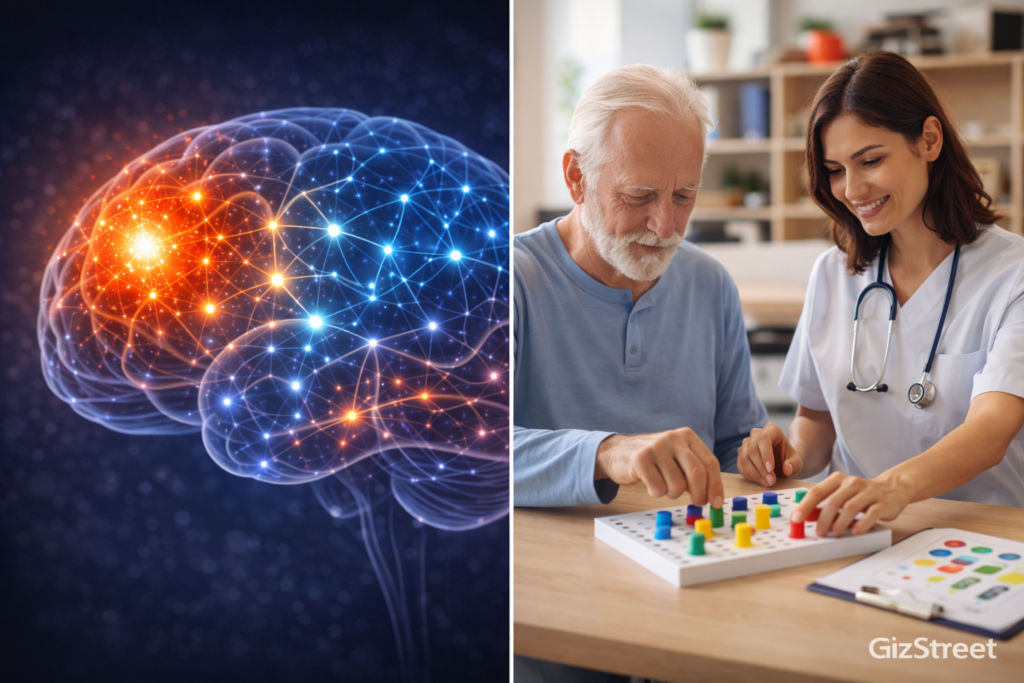
Neuroplasticity and Reorganization: The brain’s capacity for structural and functional reorganization — neuroplasticity — is the biological mechanism through which the network adapts to damage. In the weeks and months following injury, surviving regions can form new connections, strengthen existing pathways, and take on functions previously served by damaged areas. Rehabilitation that provides rich, multi-domain cognitive engagement appears to stimulate this network reorganization more effectively than narrowly targeted exercises.
Cognitive Reserve and Network Resilience: Research on cognitive reserve — the accumulated neural resources built over a lifetime of learning and mental engagement — aligns closely with the network model. Individuals with more cognitive reserve appear to have more robust, redundant neural networks. When aging or injury degrades network efficiency, those with more reserve have more alternative pathways to draw upon, which helps explain why highly educated individuals can sometimes sustain significant neurological changes while showing fewer outward cognitive symptoms.
Implications for Aging: Normal aging reduces white matter integrity — the physical connections between brain regions — which slows information transfer across networks. Interventions that support network health, including aerobic exercise (which supports white matter integrity), social engagement (which activates multiple networks simultaneously), and continued learning (which drives neuroplasticity), may help maintain cognitive function as the brain’s hardware ages.
Is There Still a Single "Intelligence Center"?
Given the weight of evidence from large-scale neuroimaging, network connectivity studies, and lesion research, the scientific consensus has shifted decisively away from the idea of a single “intelligence center” in the brain. The evidence suggests that such a center does not exist — at least not in the simple, localizable sense that earlier researchers envisioned.
Intelligence, as currently understood, is best described as a system-level property: something that emerges from the coordinated activity of multiple interacting networks, none of which is exclusively responsible for it. Removing any single node — even one as central as the prefrontal cortex — does not eliminate intelligence entirely; it degrades specific aspects of it while leaving others relatively intact.
That said, the scientific debate is not entirely closed. Some researchers argue for the importance of specific nodes or circuits more strongly than others. The “parieto-frontal integration theory” (P-FIT), proposed by Rex Jung and Richard Haier, identifies a specific fronto-parietal network as the most critical substrate of general intelligence. This view does not revive the idea of a single center, but it does argue for a more localized network within the broader whole.
Others argue that subcortical structures — the thalamus, basal ganglia, and cerebellum — play a larger role in intelligence than network models focusing purely on cortical connectivity acknowledge. Research on cerebellar contributions to cognitive function, for example, is an active and evolving area.
The honest position is this: the brain is complex enough that any model — including the whole-brain network model — is a simplification. What the evidence does clearly rule out is a single anatomical structure being the sole or primary substrate of human intelligence. The brain thinks as a system. Intelligence is what happens when that system works well.
Frequently Asked Questions
Q: Is intelligence located in one part of the brain?
No. Decades of neuroimaging research show that intelligence is not housed in any single brain region. Rather, it emerges from coordinated activity across multiple large-scale brain networks, including the executive control, default mode, and salience networks. Individuals with greater efficiency and flexibility in how these networks communicate with each other consistently perform better on cognitive tasks — regardless of any single region’s size or activation.
Q: What is brain connectivity?
Brain connectivity refers to the patterns of communication between different regions of the brain. Structural connectivity describes the physical white-matter pathways linking regions. Functional connectivity describes how synchronously different regions activate over time. Scientists measure functional connectivity using fMRI by tracking correlated activity patterns. Higher functional connectivity between key network hubs is associated with stronger cognitive performance across multiple domains, including memory, reasoning, and attention.
Q: How do scientists measure intelligence in the brain?
Researchers use functional MRI (fMRI) to observe brain activity during cognitive tasks and at rest. They analyze which regions activate, how strongly, and — crucially — how synchronously different regions activate together. More recently, scientists have developed metrics like “global brain efficiency,” derived from graph theory, which quantify how quickly information can travel between any two points in the brain’s network. These network-level measures predict cognitive performance more reliably than regional activation alone.
Q: Does higher IQ mean better brain integration?
Research supports a positive relationship between IQ scores and measures of brain network integration, particularly global efficiency and cross-network connectivity. However, IQ is an imperfect proxy for the full range of cognitive abilities. High IQ tends to correlate with both strong network integration and strong specialization within individual networks — the combination of these two properties, rather than either alone, appears to best characterize the high-functioning brain.
Q: Can intelligence increase by strengthening brain networks?
Evidence suggests brain networks can be strengthened through specific types of engagement. Aerobic exercise supports white matter integrity, improving signal transmission between regions. Sustained learning of new, challenging skills drives neuroplasticity and builds new network connections. Practices that train cognitive flexibility — such as learning a musical instrument, a second language, or strategic games — may improve the dynamic coordination between networks. These changes do not guarantee IQ score increases but may improve real-world cognitive performance.
Q: How does this research affect education?
Whole-brain network research suggests that educational approaches emphasizing cross-disciplinary thinking, collaborative problem-solving, and cognitive flexibility may be building the neural architecture of intelligence more effectively than pure memorization. Teaching students to integrate knowledge across domains, recover productively from errors, and approach problems from multiple angles may train the network coordination that underlies general intelligence — rather than simply filling networks with stored information.
Q: What happens to intelligence after brain injury?
Brain injury’s cognitive effects depend significantly on which networks are damaged and how central the damaged nodes are to the overall network. Because intelligence relies on distributed networks rather than a single region, some damage can be compensated by surviving pathways through neuroplasticity. Recovery varies widely based on the location and extent of injury, the person’s prior cognitive reserve, and the quality of rehabilitation. Rehabilitation that provides rich, varied cognitive engagement appears to support network reorganization most effectively.
Q: Is artificial intelligence modeled after human brain networks?
Artificial neural networks draw inspiration from the brain’s layered, distributed processing architecture. However, current AI systems are far simpler than biological neural networks and do not replicate the dynamic, flexible network reconfiguration that characterizes human intelligence. Human brains continuously reorganize their network configurations in response to changing demands and integrate information across sensory, emotional, and cognitive domains simultaneously — capabilities that remain aspirational goals for AI rather than current achievements.
Share this story
Related Articles

NASA Artemis IV: Astronauts to Build First Lunar Gateway Module
The upcoming mission will establish humanity's first permanent outpost in lunar orbit.

FAA Approves Nationwide Drone Delivery Expansion for Amazon and Wing
New regulations allow beyond-visual-line-of-sight operations in urban areas.

Why Do We Feel Starved for Time? New Research Offers Answers
You have a calendar app, a task manager, voice assistants, and automated reminders. Yet somehow, there are never enough hours in the day. If […]
Comments (0)