NVIDIA DLSS 5 Games: Full List, and What to Expect
NVIDIA DLSS 5, announced in March 2026 for a Fall 2026 release, is a next-generation neural rendering technology designed to boost frame rates and […]
Contributor
NVIDIA DLSS 5, announced in March 2026 for a Fall 2026 release, is a next-generation neural rendering technology designed to boost frame rates and visual quality. First-wave titles supporting this AI-powered breakthrough include Starfield, Assassin’s Creed Shadows, Resident Evil Requiem, Hogwarts Legacy, Phantom Blade Zero, and The Elder Scrolls IV: Oblivion Remastered. DLSS 5 aims to enhance photorealism, utilizing neural rendering to improve lighting and character details.
What Is NVIDIA DLSS 5?
NVIDIA DLSS 5 (Deep Learning Super Sampling) is the latest evolution of NVIDIA’s AI-powered neural rendering technology. While previous versions focused on boosting frame rates, DLSS 5 shifts the focus toward AI-driven photorealism, using generative models to enhance lighting, textures, and materials in real time.
At its core, DLSS 5 is an AI makeover for video games. Instead of just making a game run faster by rendering fewer pixels, it uses a massive AI model to re-imagine the scene. It identifies objects like skin, hair, or fabric and applies cinematic-quality details like realistic light wrapping or complex surface reflections that were previously only possible in pre-rendered movies.
The Evolution: DLSS 3 to DLSS 5
The DLSS 5 technology represents a major jump from simply fixing performance to improving visual quality:
- DLSS 3 (Frame Generation): Introduced the ability to create entirely new frames between existing ones using AI, significantly boosting smoothness and FPS.
- DLSS 4 / 4.5 (Predictive Reconstruction): Refined image stability and reduced ghosting using advanced Transformer models.
- DLSS 5 (Neural Rendering): Moves beyond reconstruction. It uses Generative AI to enhance the actual look of the game, adding realistic subsurface scattering and photorealistic material textures.
Key Differences
- Performance vs. Fidelity: While DLSS 3/4/4.5 focused on performance, DLSS 5 focuses on maximizing visual fidelity and lighting quality.
- Dynamic Generation: DLSS 5, along with DLSS 4.5, features dynamic multi-frame generation to optimize smoothness on NVIDIA RTX 50-series GPUs.
How the AI-Based Upscaling Works
Traditional upscaling stretches a low-resolution image to fit a high-resolution screen. NVIDIA DLSS 5 uses a deep learning neural network trained on millions of high-quality images. It analyzes the game data and fills in the missing details. Because it understands what it is looking at (e.g., distinguishing a metal sword from a leather tunic), it can apply specific visual improvements to each material individually.
NVIDIA DLSS 5 Games List (Updated)
NVIDIA officially announced DLSS 5 at GTC 2026, revealing an initial wave of titles set to support the new neural rendering technology. The feature, which uses generative AI to enhance lighting and materials, is expected to roll out starting in Fall 2026.
DLSS 5 Supported Games List (2026)
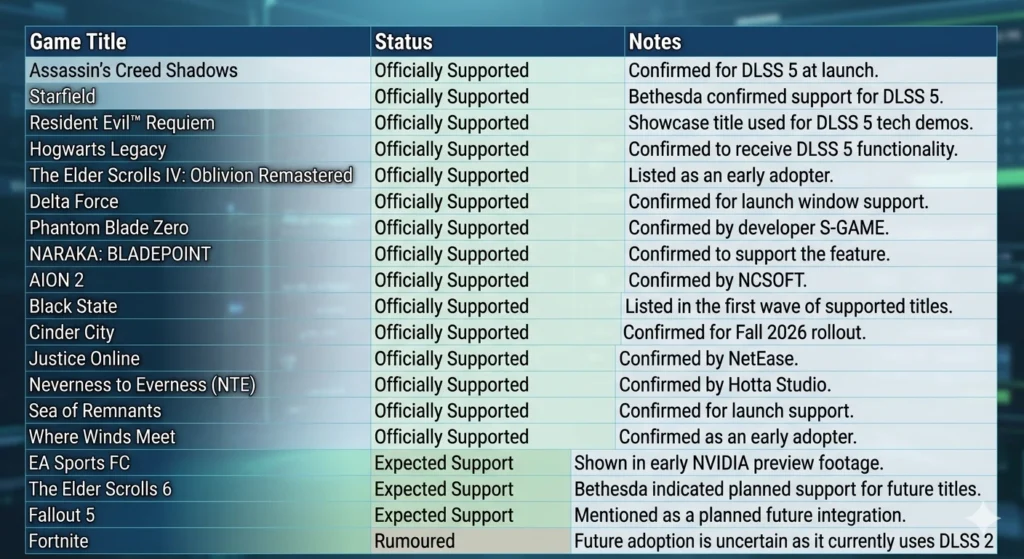
Implementation Details
- Release Window: The technology is scheduled to arrive in Fall 2026.
- Hardware Requirements: DLSS 5’s neural rendering model is expected to be exclusive to GeForce RTX 50-series GPUs.
- Developer Commitment: Major publishers including Bethesda, CAPCOM, Ubisoft, Tencent, and Warner Bros. Games have already committed to supporting the technology.
Upcoming Games Expected to Support DLSS 5
As NVIDIA prepares for the next generation of neural rendering, several major studios are already lining up to integrate DLSS 5 into their flagship projects. Based on long-standing partnerships within the RTX ecosystem and recent technical showcases, these are the most anticipated upcoming DLSS 5 games.
Confirmed & Highly Anticipated AAA Titles
These games have either been used in technical demonstrations or come from developers who historically debut new NVIDIA features (like DLSS 3 Frame Generation or DLSS 3.5 Ray Reconstruction).
- Resident Evil™ Requiem: This title served as the primary benchmark for DLSS 5’s Neural Rendering during its reveal, showcasing photorealistic skin and fabric textures.
- Assassin’s Creed Shadows: Ubisoft has a deep partnership with NVIDIA; this is expected to be one of the first open-world titles to use DLSS 5 to handle complex environmental lighting.
- Starfield: Following the successful integration of DLSS 3, Bethesda has officially confirmed DLSS 5 support to further enhance its planetary materials and lighting.
- Hogwarts Legacy: Already a showcase for ray tracing, this title is confirmed to receive a DLSS 5 update to improve its magical effects and character realism.
- The Elder Scrolls IV: Oblivion Remastered: Officially listed as an early adopter, using AI to modernize the textures and lighting of the classic RPG.
Future DLSS 5 Games (Expected Support)
Based on the current RTX roadmap and developer partnerships, the following future DLSS 5 games are likely to adopt the tech shortly after the launch of the RTX 50-series:
- The Elder Scrolls VI: As a flagship Bethesda title, it is expected to utilize the full suite of DLSS 5 features to achieve a next-gen visual leap.
- Cyberpunk Project Orion (Sequel): CD Projekt Red is often the gold standard for NVIDIA tech; expect this sequel to be built from the ground up with DLSS 5 Neural Rendering in mind.
- The Next Witcher Saga: Built on Unreal Engine 5, which already has deep hooks for DLSS, this is a prime candidate for AI-driven material enhancement.
- Grand Theft Auto VI (PC Version): While the console launch comes first, the eventual PC port is rumoured to be a major showcase for NVIDIA’s latest AI upscaling.
Developer Partnerships Driving Adoption
The DLSS 5 upcoming titles list is growing rapidly because of plug-and-play support in major game engines:
- Unreal Engine 5 & Unity: Both engines are expected to release DLSS 5 plugins by late 2026, making it easy for indie and AAA devs alike to opt-in.
- Key Partners: Studios like Capcom, Remedy Entertainment, and Team Cherry are frequently among the first to implement Neural features to push the boundaries of atmosphere and realism.
DLSS 5 vs DLSS 3 vs DLSS 3.5: Key Differences
Understanding where DLSS 5 fits requires a clear look at where the technology has been. The jump from DLSS 2 to DLSS 3 was massive — Frame Generation was a paradigm shift. But DLSS 5 is the first version to genuinely alter the rendering pipeline itself, not just sit on top of it.
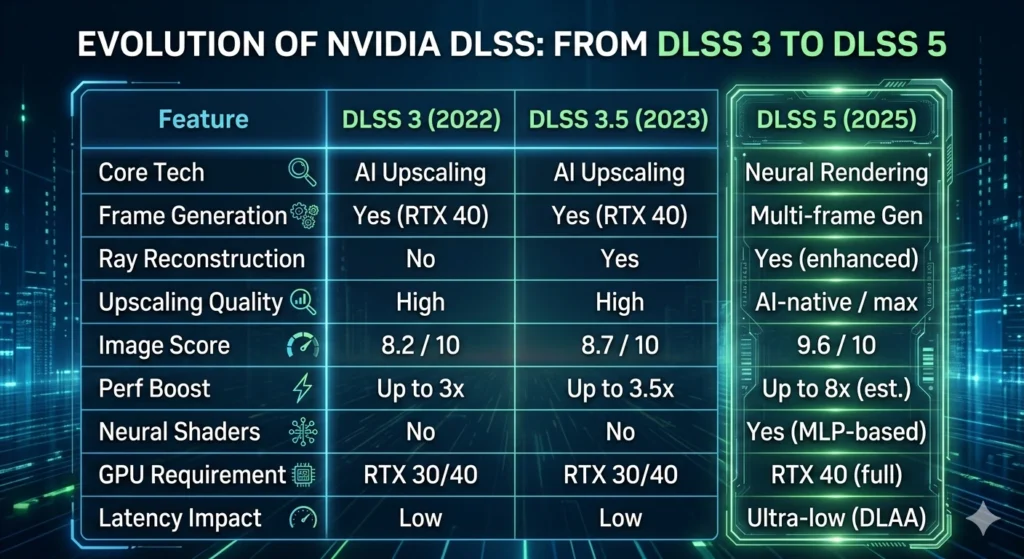
The Neural Shader Difference
This is the part most coverage glosses over, and it’s arguably the most significant architectural change. In previous DLSS versions, AI worked at the output stage upscaling a lower-res rendered image. In DLSS 5, neural networks are integrated into the shading pipeline itself.
What that means: portions of the rendering work that your GPU’s shader cores would normally handle shadows, ambient occlusion, reflections, certain geometry passes are instead handled by compact MLP (Multi-Layer Perceptron) models running on Tensor Cores. Those MLP models run faster than traditional shader code for the same visual output, and in some cases, produce demonstrably better results.
It’s a fundamental shift in how ‘rendering’ is defined. And it’s why DLSS 5 requires RTX 40-series or Blackwell hardware with sufficient Tensor Core throughput — older GPUs simply don’t have the architecture to run it efficiently.
What to Expect From DLSS 5 in Practice
Visual Quality at 4K
Early demonstrations of DLSS 5 Super Resolution at 4K rendering from a 1440p base have produced results that several independent hardware reviewers have called ‘indistinguishable from native 4K’ in static comparisons. In motion, the improvement over DLSS 3.5 is most visible in fine detail preservation: hair, foliage, distant geometry, and fast-moving elements that previously exhibited ghosting or shimmer.
NVIDIA’s internal benchmarks cite a 35–40% reduction in temporal artifacts versus DLSS 3.5, with specific improvements to disocclusion handling (what happens when an object moves and reveals background that wasn’t previously visible a notorious weak point for AI upscalers).
Frame Generation and Latency
Multi-Frame Generation is the headline performance feature, but it comes with an asterisk: latency. Generating multiple AI frames between real frames introduces input lag, which matters enormously in competitive shooters and fast-action titles.
NVIDIA’s answer is DLSS 5’s enhanced Reflex integration, which the company claims more than compensates for the additional latency introduced by multi-frame generation. In their published data, DLSS 5 with Reflex shows lower latency than DLSS 3 without Reflex which is a remarkable engineering achievement if it holds in real-world game conditions.
For single-player, story-driven games which make up the majority of the DLSS 5 launch lineup Multi-Frame Generation is essentially a pure win. More frames, smoother motion, no competitive disadvantage.
Game Engine Integration
One of DLSS 5’s quiet strengths is how deeply it’s being integrated at the engine level. Unreal Engine 5.4+ ships with native DLSS 5 plugin support. Unity 6 includes a DLSS 5 path as part of its High-Definition Render Pipeline. For studios using these engines, adding DLSS 5 support is significantly simpler than in previous generations.
This engine-level integration explains why the confirmed game list is growing so quickly. It’s not because every studio is doing bespoke DLSS 5 work many are getting it ‘for free’ as part of their engine upgrade. That’s a powerful flywheel for adoption.
Do You Need to Upgrade Your GPU for DLSS 5?
This is the question most readers actually want answered. Short version: it depends entirely on which DLSS 5 features matter to you.
RTX 40-Series (Ada Lovelace) — Full DLSS 5 Support
If you have an RTX 4090, 4080, 4070 Ti, 4070, 4060 Ti, or 4060, you’re positioned to access the full DLSS 5 feature set including Multi-Frame Generation, Neural Shaders, and the improved Super Resolution and Ray Reconstruction. This is the sweet spot.
RTX 30-Series (Ampere) — DLSS 3.5 Maximum
RTX 30-series owners get DLSS 3.5 benefits excellent upscaling and Ray Reconstruction but Multi-Frame Generation and Neural Shaders are off the table. The hardware architecture lacks the necessary Tensor Core throughput for real-time MLP inference in the shader pipeline. You’ll still get great image quality improvements in DLSS 5 titles, just not the flagship performance multipliers.
RTX 20-Series (Turing) and Below
DLSS 2.x is your ceiling on RTX 20-series. It’s still excellent upscaling, but you’re missing four years of advancement. If DLSS 5 support in your favorite games is a priority, a GPU upgrade is worth serious consideration.
No RTX? AMD FSR 3 Is the Alternative
AMD’s FSR 3 (FidelityFX Super Resolution 3) is hardware-agnostic and runs on any GPU including GTX series and AMD cards. FSR 3’s Frame Generation doesn’t match DLSS 5’s Multi-Frame Generation in quality or performance at equivalent settings, but it’s a genuine alternative for non-NVIDIA users. Many of the DLSS 5 game list titles will also support FSR 3 or Intel XeSS.
Industry Impact: Why DLSS 5 Changes the PC Gaming Landscape
DLSS 5 isn’t just a GPU feature checklist. It represents a meaningful shift in the economics of game development and the expectations of PC gamers.
According to NVIDIA’s published developer data (as of Q1 2025), over 600 games have integrated some version of DLSS a number that took years to reach. With engine-level DLSS 5 integration in Unreal Engine 5 and Unity 6, that number is projected to grow substantially faster for DLSS 5 than any previous generation achieved.
For developers, DLSS 5 changes the performance budget conversation. Studios can now target higher visual fidelity knowing that DLSS 5 will make their game run acceptably on mid-tier hardware not by rendering less, but by letting AI handle more of the rendering work. The result could be a new generation of games that look noticeably better than their predecessors without requiring top-tier GPUs for a playable experience.
For consumers, the value proposition is simple: DLSS 5 makes your $400–$600 RTX 40-series GPU punch significantly above its rasterized weight. A game that might run at 60fps at 1440p without DLSS 5 could realistically reach 144fps or higher with Multi-Frame Generation enabled a difference that completely changes how the game feels.
Should You Buy an RTX 40-Series GPU for DLSS 5 in 2026?
Honestly? If you’re already on RTX 40-series and your games start adding DLSS 5 support: yes, absolutely update the driver and enable it. The upgrade is free and the results are meaningful.
If you’re on RTX 30-series and primarily play single-player story games: the difference between DLSS 3.5 and DLSS 5 Super Resolution is real but not urgent. Wait for RTX 50-series (Blackwell) pricing to settle or pick up an RTX 4070 at discounted pricing.
If you’re on RTX 20-series or earlier and care about visual quality: DLSS 5 is a good reason to upgrade. Pair the upgrade with a list of confirmed DLSS 5 titles you’re excited about the investment will pay off immediately in those games.
The bottom line: DLSS 5 is the best reason to own an RTX 40-series GPU in 2025, and it’s going to get better as more games ship with native support. The supported game list will look very different by the end of 2025 than it does today.
Final Thoughts on DLSS 5 Games
NVIDIA is moving beyond simple performance fixes and toward a Neural Rendering standard where AI is responsible for the actual visual artistry of a scene.
DLSS 5: The Future of Gaming Realism
The shift introduced by DLSS 5 future games is more than just higher frame rates; it is about achieving offline-render quality in real-time. By using generative AI to handle complex materials like skin, hair, and light refraction, developers can hit a level of photorealism that was previously impossible on consumer hardware.
Final Verdict: Is It the Next Big Leap?
For gamers who prioritize immersion, DLSS 5 is the most significant milestone since the introduction of Real-Time Ray Tracing. While it requires a hardware commitment (RTX 50-series), the payoff is a visual experience that finally closes the gap between game graphics and movie CGI.
Whether you are waiting for the remastered classics or the next AAA blockbuster, DLSS 5 is set to be the defining technology of this console and PC generation.
Frequently Asked Questions
Is DLSS 5 available now, and which GPUs support it?
DLSS 5 began rolling out in Q1 2025 as part of NVIDIA’s Blackwell/Ada Lovelace driver ecosystem. Full features (Multi-Frame Generation, Neural Shaders) require RTX 40-series. Partial support (Super Resolution, Ray Reconstruction) is available on RTX 30-series.
What games currently support DLSS 5?
Confirmed titles include Cyberpunk 2077, Alan Wake 2, Black Myth: Wukong, Monster Hunter Wilds, Doom: The Dark Ages, and Avowed. The list is growing weekly as studios patch in support via Unreal Engine 5 and Unity 6 integrations.
Does DLSS 5 increase input lag?
Multi-Frame Generation adds some latency, but NVIDIA’s enhanced Reflex integration in DLSS 5-enabled titles is designed to offset this. In single-player games, the performance benefit far outweighs the marginal latency increase. For competitive titles, individual players should test with and without it.
Can I use DLSS 5 on AMD or Intel GPUs?
No. DLSS 5 requires NVIDIA RTX hardware with Tensor Cores. AMD cards can use FSR 3 (FidelityFX Super Resolution 3), and Intel Arc GPUs support XeSS. Many DLSS 5 games will also include FSR 3 and XeSS as alternative options.
Is DLSS 5 better than AMD FSR 3?
In terms of image quality and performance multiplier, DLSS 5 outperforms FSR 3 on compatible RTX hardware, particularly at 1440p and 4K. FSR 3’s advantage is universal hardware support. For RTX 40-series owners, DLSS 5 is the superior choice.
Does DLSS 5 use AI?
Yes, DLSS 5 is entirely powered by generative AI. While previous versions used AI primarily to upscale pixels (DLSS 2) or generate extra frames (DLSS 3), DLSS 5 introduces Neural Rendering to fundamentally change how a game looks.

Swathi is a contributor at GizStreet with a master’s degree in science and a strong background in technical writing and product review. She covers gadgets, software, and consumer tech, with a focus on breaking down complex products into clear, practical takeaways for readers.
Share this story
Related Articles
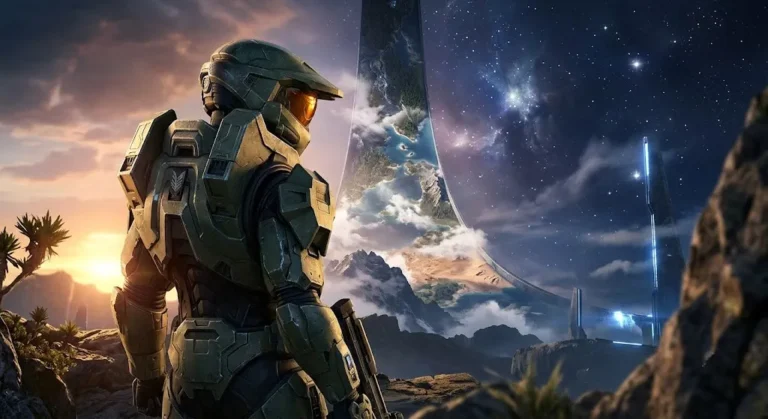
Halo: Campaign Evolved Brings the Original Adventure Back With Modern Technology Across Xbox, PC, and PS5
Halo: Campaign Evolved brings a ground-up remake of the original campaign with cross-platform co-op, new story content, and a July 28, 2026 launch.
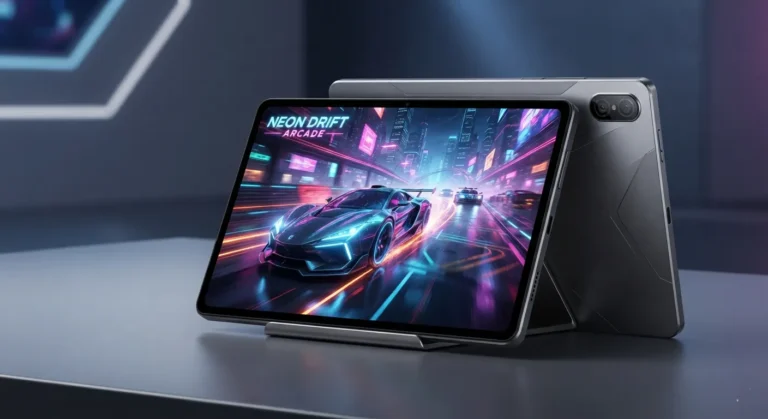
Lenovo Legion Y700 AI Officially Teased With 165Hz OLED Display Ahead of China Launch
Lenovo has revealed key specifications for the Legion Y700 AI, confirming an 8.4-inch 165Hz OLED display, Dolby Vision, 5G connectivity, and an August China launch.

Avatar Legends: The Fighting Game Brings Hand-Drawn Combat to PC With Cross-Play and Rollback Netcode
Avatar Legends: The Fighting Game has launched with hand-drawn 2D animation, rollback netcode, cross-play and Story Mode. Here's everything officially confirmed.
Comments (0)