Meta’s Space Solar Project: Powering AI Data Centers with Orbiting Lasers
What if the most powerful AI data centers on the planet were charged not by coal plants or solar farms baking in the desert, […]
Contributor
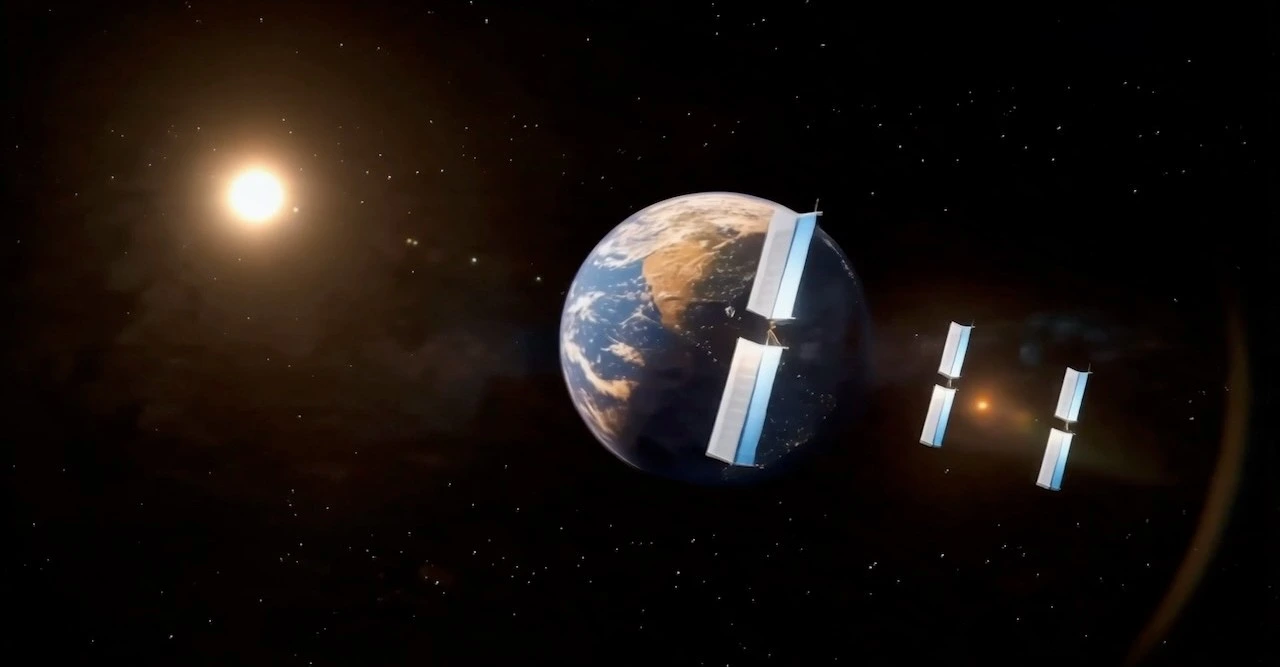
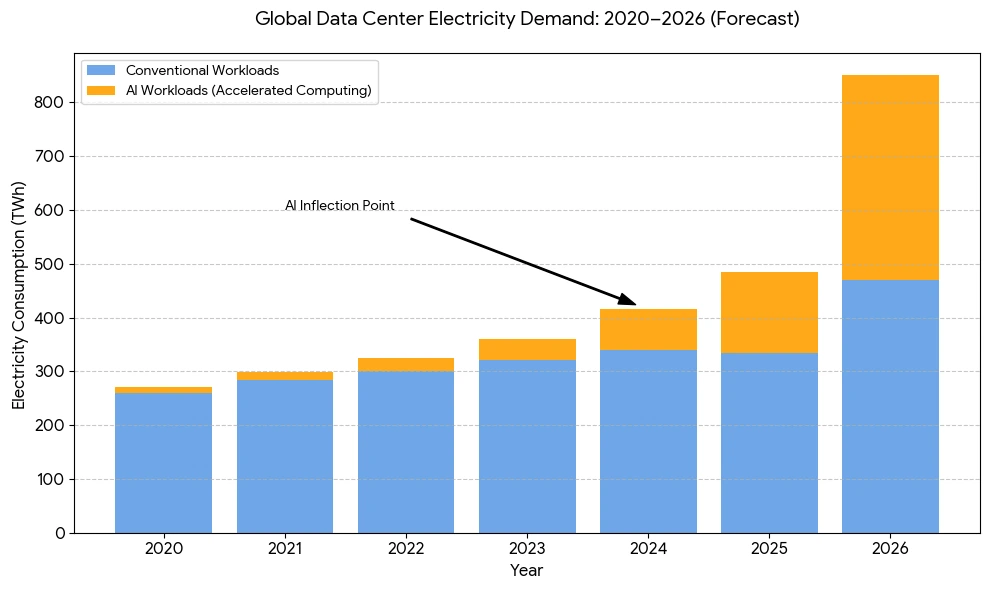
What if the most powerful AI data centers on the planet were charged not by coal plants or solar farms baking in the desert, but by satellites beaming energy down from orbit? That is exactly audacious but Meta is now making with its Space Solar project. The company has quietly partnered with startup Overview Energy to explore beaming up to 1 gigawatt of electricity to Earth via laser or microwave, a concept so sci-fi it once lived only in game menus. Now it is moving from blueprint to pilot. This isn’t sci-fi, it’s a 2026 deal tackling AI’s massive energy hunger, projected to hit 1,000 TWh globally by 2026 per IEA stats. Why now? With data centers consuming 2-3% of world electricity, Meta’s move could slash reliance on fossil fuels and unstable grids.
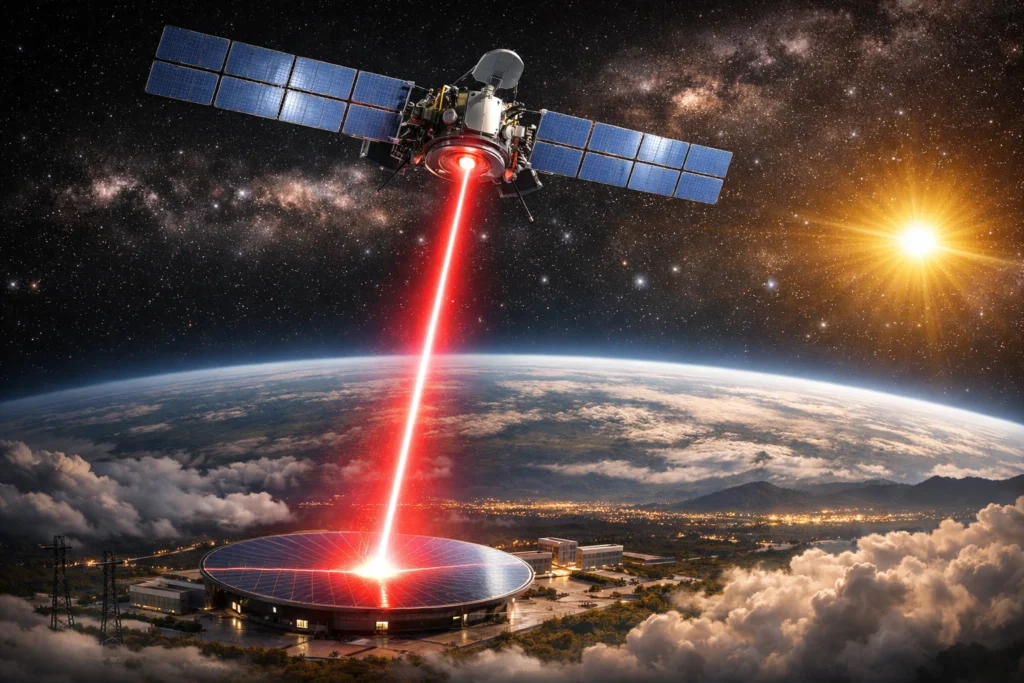
How Meta and Overview Energy Plan to Beam 1 GW of Power
Meta’s Space Solar data center strategy centers on a formal partnership with Overview Energy, a US-based startup specializing in space-based power transmission. The goal: deploy a constellation of satellites equipped with large photovoltaic arrays into geosynchronous or low Earth orbit, collect unfiltered solar energy 24 hours a day, and transmit it wirelessly to ground receivers.
The Power Transmission Pipeline
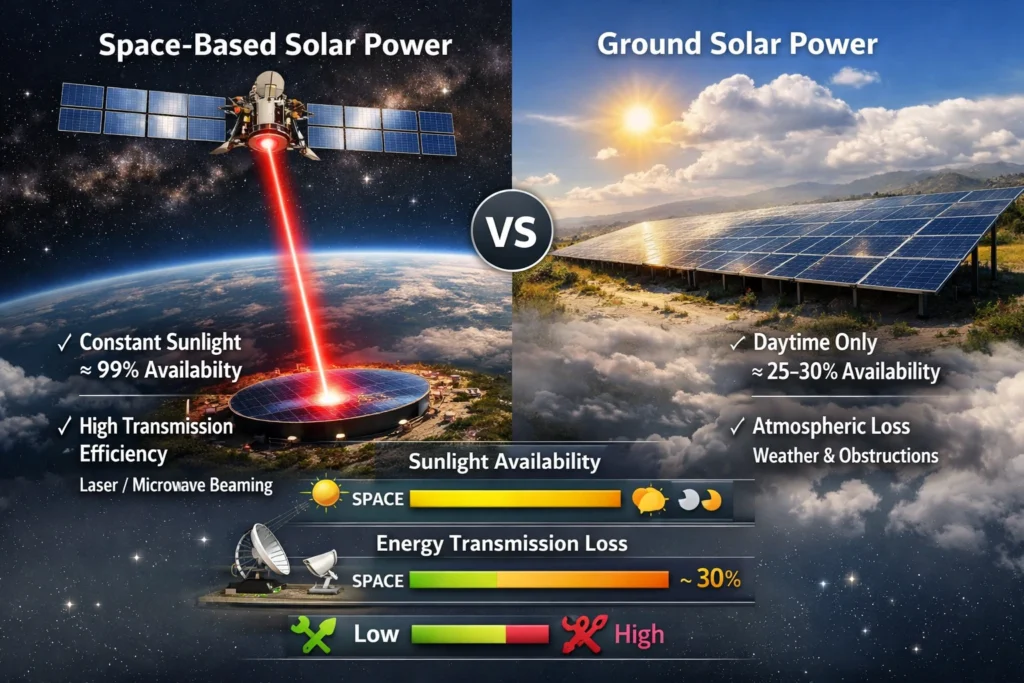
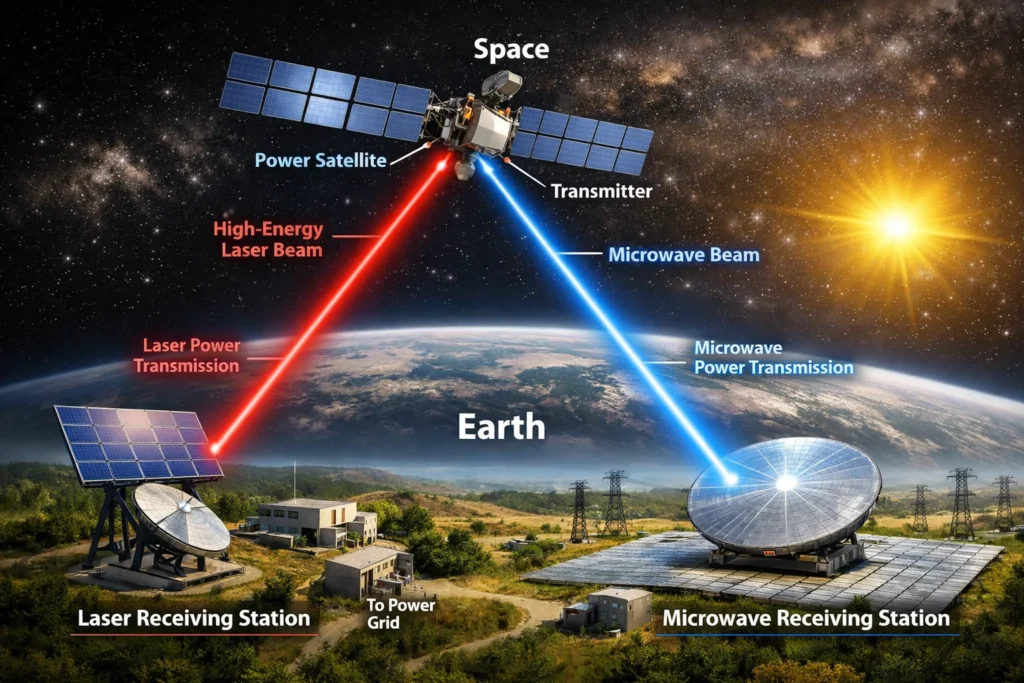
Solar panels in space operate with roughly 40% efficiency versus 15–22% for the best ground-based panels today, because there is no atmosphere, cloud cover, or night cycle to contend with. The collected energy is converted into either a concentrated laser beam (photonic energy) or a directed microwave signal, then beamed to a rectenna array, a ground-based receiver, co-located with Meta’s AI data centers.
The ambition is enormous. One gigawatt is roughly the output of a nuclear power plant, and it would comfortably power several of Meta’s hyperscale AI training facilities. To put that in perspective, a single NVIDIA H100 server cluster running at full bore can consume upwards of 700 kW; 1 GW could sustain more than 1,400 such clusters simultaneously.
Why Overview Energy?
Overview Energy was founded specifically to commercialize space-based solar power (SBSP) for industrial customers. The startup has raised seed funding from climate-tech investors and has run lab-scale demonstrations of its laser transmission hardware. Meta’s backing, reportedly including both equity investment and a long-term power purchase agreement, gives Overview the runway to move from prototype to orbital pilot.
Quick Stat: The International Energy Agency (IEA) projects global data center electricity consumption will reach 1,000 TWh by 2026 – double the 2022 figure. AI workloads are the primary driver. (Source: IEA, 2024)
Metric | Ground Solar | Space Solar (SBSP) |
|---|---|---|
Panel Efficiency |
15–22% |
~40% |
Availability |
~8 hrs/day avg. |
~24 hrs/day |
Land Requirement |
Very High |
None (orbital) |
Transmission Loss |
None |
~10–20% (beam) |
CO2 Footprint |
Low |
Near-zero (operational) |
Cost per kWh (est.) |
$0.03–$0.05 |
$0.08–$0.15 (2025 est.) |
Why Space Solar Energy Is More Efficient Than Ground-Based Solar
The physics here are unambiguous. Earth’s atmosphere absorbs and scatters roughly 30% of incoming solar radiation before it ever reaches a ground-based panel. Clouds, dust, seasonal tilt, and the simple fact of nighttime mean the average US solar farm operates at a capacity factor of only 20–25%. A satellite in geosynchronous orbit experiences none of these losses.
The Numbers That Make Engineers Excited
Research from the European Space Agency (ESA) and the California Institute of Technology (Caltech), which demonstrated a 1.8 kW space-to-Earth microwave transmission in 2023, confirms that SBSP could deliver 4–6x more energy per unit area than equivalent ground installations over a year. For an AI hyperscaler like Meta, burning through gigawatts around the clock, that multiplier is transformative.
Carbon Math
Meta has pledged net-zero emissions across its value chain by 2030. Its Scope to electricity emissions, the carbon from powering its servers are the hardest to eliminate as AI workloads explode. Space solar, once launch costs are amortized, has near-zero operational carbon. That makes it strategically attractive beyond simple economics.
For context: Meta’s total data center energy consumption exceeded 10 TWh in 2023, according to its own sustainability report. Replacing even 10% of that with space solar would eliminate roughly 2 million tonnes of CO2-equivalent annually, depending on the grid mix displaced.
The 'SimCity 2000' Inspiration: How Microwave and Laser Power Work
Here is a detail that will make any millennial engineer grin: one Meta executive reportedly cited SimCity 2000, the 1993 city-building game that included a microwave power plant beaming energy from space, as early conceptual inspiration. Life imitating art. Or at least, life imitating 16-bit pixel art.
Microwave Power Transmission (MPT)
In MPT, the satellite converts solar-generated DC electricity into microwave energy using magnetrons or solid-state transmitters, then directs a coherent beam, typically around 2.45 GHz, toward a ground rectenna array. The rectenna (rectifying antenna) converts the microwaves back into DC power with efficiencies of 80–85%.
The beam footprint at ground level can be several kilometers wide, which actually makes it safer than it sounds, the power density (typically < 23 mW/cm²) is well below thresholds that cause biological harm. The main engineering challenges are precise beam steering and preventing interference with other communication bands.
Laser Power Transmission (LPT)
The alternative and Overview Energy’s apparent preference is high-energy laser transmission, likely in the near-infrared spectrum. Lasers enable a much tighter beam, meaning smaller and potentially co-located ground receivers, which is ideal for a private data center campus. The tradeoff: clouds and atmospheric turbulence can disrupt laser beams, requiring adaptive optics and potentially multiple redundant satellite passes.
Caltech’s Space Solar Power Project (SSPP), which beamed power to Earth from the MAPLE experiment aboard its SSPD-1 satellite in 2023, used phased-array photovoltaic cells and demonstrated the core technology works in orbit — a landmark validation.
Parameter | Microwave (MPT) | Laser (LPT) |
|---|---|---|
Frequency / Wavelength |
~2.45 GHz |
Near-IR (~1550 nm) |
Beam Footprint |
Kilometers wide |
Meters to tens of meters |
Receiver Size |
Large (km-scale rectenna) |
Small (rooftop-scale) |
Weather Sensitivity |
Low (microwaves penetrate clouds) |
High (laser disrupted by cloud/fog) |
Safety Profile |
Well-studied, low risk |
Requires exclusion zone |
TRL (2025) |
TRL 5–6 |
TRL 4–5 |
Elon Musk's Criticism of Space Solar: Is Meta Making a Mistake?
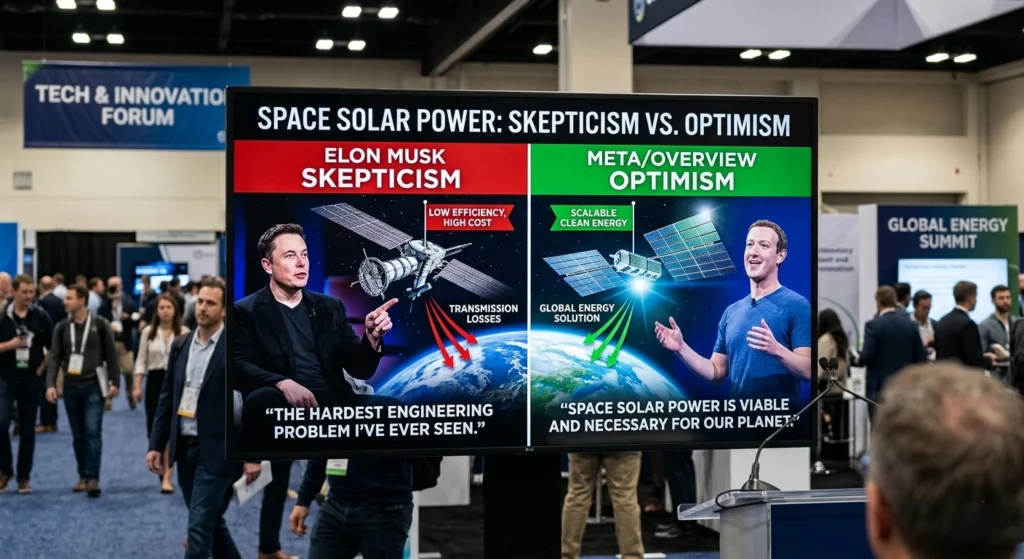
Not everyone is cheering. Elon Musk has publicly dismissed space-based solar power as “the stupidest idea of all time”, a characteristically blunt take. His argument: launch costs and mass-to-orbit economics make SBSP permanently uncompetitive versus ground solar, especially as terrestrial panel prices keep falling.
The Steel-Manning Case Against Space Solar
Musk’s criticism has teeth. As of 2025, launching a kilogram of payload to geosynchronous orbit still costs roughly $2,000–$5,000 even with SpaceX’s Falcon 9. A 1 GW SBSP system would require thousands of tonnes of solar panel hardware in orbit. Basic back-of-envelope math produces a capital cost that dwarfs comparable ground installations by an order of magnitude.
Additionally, maintenance is essentially impossible. A ground solar farm can have a technician swap a faulty inverter in an afternoon. A malfunctioning satellite panel stays broken, and replacing it requires another expensive launch. The operational risk profile is severe.
The Counter-Arguments Meta and Overview Are Banking On
Meta and Overview are betting on three structural shifts:
- SpaceX Starship brings fully reusable super-heavy lift — potentially reducing launch costs to $100–$200/kg by the late 2020s. That changes the economics fundamentally.
- Thin-film and perovskite solar cells are dramatically reducing the mass-per-watt of space-deployable panels.
- AI data center energy demand is growing so fast that no single ground-based solution scales quickly enough. SBSP is a supplemental hedge, not a wholesale replacement.
Key Quote: “The question isn’t whether space solar is cheaper than ground solar today. It’s whether it’s cheaper than not having power when you need it.” — Overview Energy CEO, Axios interview, 2025 |
Argument | Musk / Skeptics | Meta / Overview |
|---|---|---|
Launch Economics |
Too expensive at $2K–5K/kg |
Starship could cut to $100–200/kg |
Maintenance |
Impossible in orbit |
Modular, self-correcting arrays |
Competition |
Ground solar costs falling fast |
SBSP offers 24/7 uninterrupted power |
Timeline |
Decades away commercially |
Pilot launch by 2027 |
Risk |
High technical + financial risk |
Hedge against grid constraints |
When Will the First Space Solar Pilot Launch?
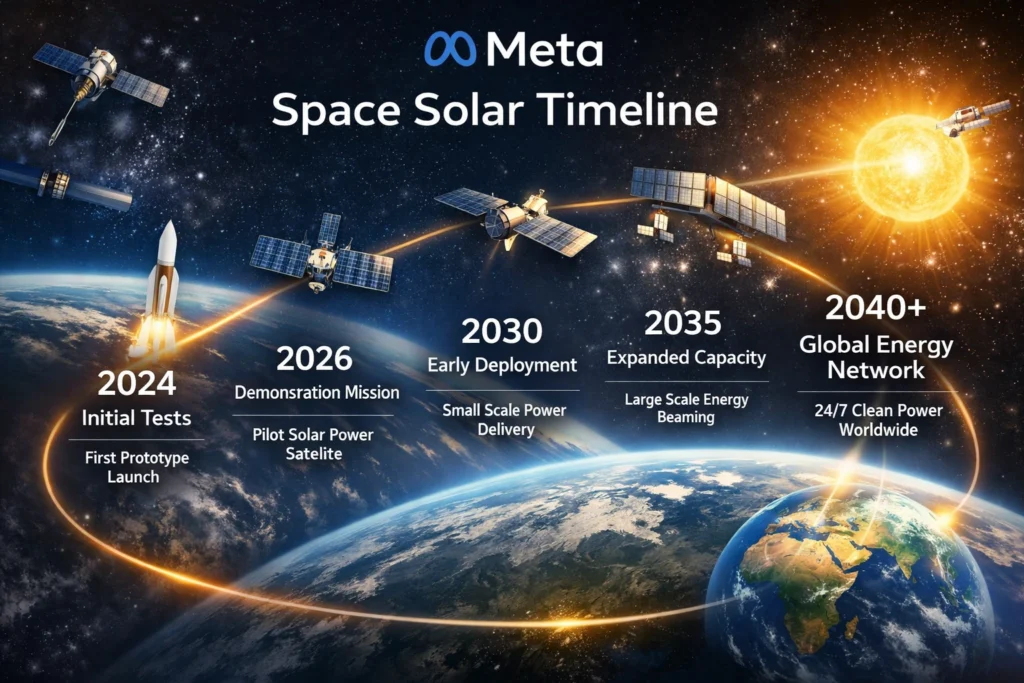
The first small-scale Meta Space Solar pilot is currently targeting a launch window in 2026–2027, according to sources familiar with the program. This would be a proof-of-concept satellite designed to validate beam-pointing accuracy, ground receiver efficiency, and power quality — not to deliver commercial-scale electricity.
Phase 1: Proof of Concept (2026–2027)
The initial satellite will likely be a 100–500 kW demonstrator — enough to power a small office building rather than a hyperscale data hall. The primary goal is de-risking the end-to-end transmission chain: orbital panel → power electronics → beam former → atmospheric traverse → ground rectenna/receiver → grid interconnect.
If successful, this phase unlocks Series B funding for Overview Energy and triggers the next phase of engineering design for a utility-scale system.
Phase 2: Utility-Scale Deployment (2030–2035)
A commercial 100 MW to 1 GW system would require a constellation of multiple satellites and could begin serving one of Meta’s major data center campuses — most likely in the continental US, close to SpaceX launch facilities and existing fiber corridors. Meta has major data centers in DeKalb (Illinois), Papillion (Nebraska), and Eagle Mountain (Utah), all of which are under significant grid capacity pressure.
Regulatory and Safety Milestones
The FCC would need to allocate spectrum for the transmission frequency, and the FAA would be involved in ground safety exclusion zones for any laser-based system. The ITU’s space spectrum regulations add another layer. These are not trivial obstacles, and regulatory approval timelines could push commercial operation well into the 2030s.
The Bottom Line: Audacious, Risky, and Possibly Inevitable
Meta’s Space Solar data center project is one of the most ambitious infrastructure plays in tech history. The physics works. The technology is advancing. The economics are still challengingbut the same was said about commercial LEO satellites a decade ago, before SpaceX rewrote the cost curve. What makes this moment different is urgency: AI’s voracious appetite for electricity is colliding with grid constraints and carbon commitments on a timeline that makes bold bets necessary.
Whether space solar becomes a pillar of the global AI energy stack or an expensive science experiment depends on the next 36 months of pilot data. Either way, the fact that a Silicon Valley giant is putting real money behind orbiting lasers tells you everything about where the AI energy crisis is headed.
Frequently Asked Questions
1. How does Meta get power from space?
Meta is partnering with Overview Energy to use satellites that beam near-infrared laser energy to solar farms on Earth.
2. Why is Meta using space solar?
It allows solar farms to produce energy 24/7, even at night, to power massive AI data centers.
3. Is space solar energy safe?
Overview Energy uses invisible lasers and ensures safety protocols are in place to prevent the “SimCity” scenario of accidental fires.
4. How much power can Meta get from space?
The goal is to transmit up to 1 gigawatt of energy.
5. What did Elon Musk say about space solar?
Musk has criticized the idea, calling it inefficient compared to ground-based solar panels.
6. When will Meta start using space solar?
A pilot program is scheduled for 2028, with full scale-up by 2030.

Swathi is a contributor at GizStreet with a master’s degree in science and a strong background in technical writing and product review. She covers gadgets, software, and consumer tech, with a focus on breaking down complex products into clear, practical takeaways for readers.
Share this story
Related Articles
Lenovo Legion Y700 AI Officially Teased With 165Hz OLED Display Ahead of China Launch
Lenovo has revealed key specifications for the Legion Y700 AI, confirming an 8.4-inch 165Hz OLED display, Dolby Vision, 5G connectivity, and an August China launch.
The Amicool BT686 External DVD Drive Shows Why Optical Media Still Has a Place in the USB-C Era
The Amicool BT686 external DVD drive restores CD and DVD functionality to modern laptops with USB-C support, plug-and-play operation and broad operating system compatibility.

Sony Bravia 9 II and Bravia 7 II Arrive in India: Sony Pushes Premium LED TVs Forward With True RGB Technology
Sony has launched the Bravia 9 II and Bravia 7 II in India with True RGB LED technology, Google TV, Cognitive Processor XR and premium home theatre features.
Comments (0)