Home / Why Do We Feel Starved for Time? New Research Offers Answers
Why Do We Feel Starved for Time? New Research Offers Answers
sarankk | March 16, 2026 | 25 min read
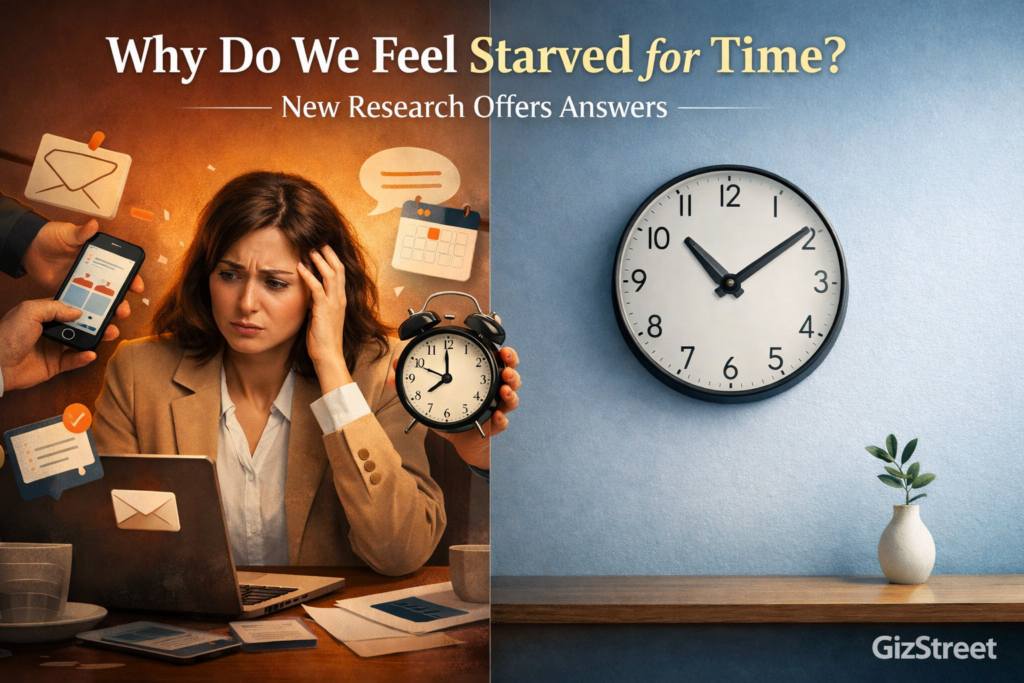
Table of Contents
You have a calendar app, a task manager, voice assistants, and automated reminders. Yet somehow, there are never enough hours in the day. If that contradiction feels familiar, science says you are not imagining it — and you are certainly not alone.
A growing body of psychological and sociological research has begun to untangle what economists call the ‘time famine’ — the widespread sense of being perpetually rushed, overextended, and behind. Studies from Harvard Business School, Princeton University, and the American Psychological Association consistently show that subjective time pressure has intensified over the past two decades, even as objective working hours in many sectors have remained stable or declined.
This is the central paradox of modern life: we live in the most productivity-optimized era in human history, surrounded by tools designed to save time, yet a 2023 Gallup survey found that nearly 60% of adults in developed economies report feeling ‘constantly rushed.’ The technologies meant to free us appear, in practice, to tighten the clock’s grip.
The answer to why this happens lies at the intersection of neuroscience, behavioral economics, and social psychology. It is not simply about how many tasks fill your day. It is about how your brain perceives, values, and experiences time — and how the architecture of modern work and social culture systematically skews that perception toward scarcity.
This article draws on the latest research to explain the mechanisms behind time famine, the structural and psychological forces that fuel it, and what evidence-based strategies can genuinely help. Whether you are a working professional, a student, or a parent juggling competing demands, understanding the science of time perception may be the first step toward feeling less trapped by the clock.
What Does It Mean to Feel "Starved for Time"?
Time scarcity, in its psychological sense, is not simply the condition of having too many tasks on your plate. Researchers define it more precisely as a subjective sense of insufficient time — a perceived gap between the time you believe you have and the time you feel you need. This distinction is critical: two people with identical workloads can experience dramatically different levels of time stress, depending on their perceptions, values, and cognitive patterns.
The term ‘time famine’ was notably explored by Professors Leslie Perlow and Jessica Porter in their research on high-pressure work environments. They described it as the chronic experience of having too much to do and not enough time to do it — a condition that persists regardless of whether objective workload warrants such urgency. What makes it particularly insidious is that it often operates below the level of conscious analysis.
Subjective time pressure differs from actual busyness in several important ways. It is modulated by attention (how much mental bandwidth is consumed by pending tasks), emotional state (anxiety amplifies perceived time demands), and social context (seeing others appear productive can intensify your own sense of inadequacy and urgency).
Researchers also distinguish between ‘cognitive load’ — the total mental burden of ongoing tasks, decisions, and worries — and actual task volume. Someone managing three complex projects while anxious about a health issue may experience far greater time scarcity than someone with ten straightforward tasks and a calm emotional baseline. For parents balancing childcare logistics with professional demands, or students navigating academic performance alongside social pressures, the cognitive load compounds the experience of time famine far beyond what a simple hours-and-tasks calculation would predict.
“Time scarcity is as much a state of mind as a state of calendar. The perception of not having enough time can be just as limiting — and just as real in its consequences — as an actual deficit.” — Cassie Mogilner Holmes, UCLA Anderson School of Management
The Science of Time Perception
Before exploring why modern life distorts our relationship with time, it is worth understanding how the brain constructs the experience of time in the first place. Unlike vision or hearing, humans have no dedicated sensory organ for time. Instead, the brain infers temporal experience from multiple systems — memory, attention, emotion, and arousal — which means each of these can bend our perception of how quickly or slowly time passes.
How the Brain Processes Time
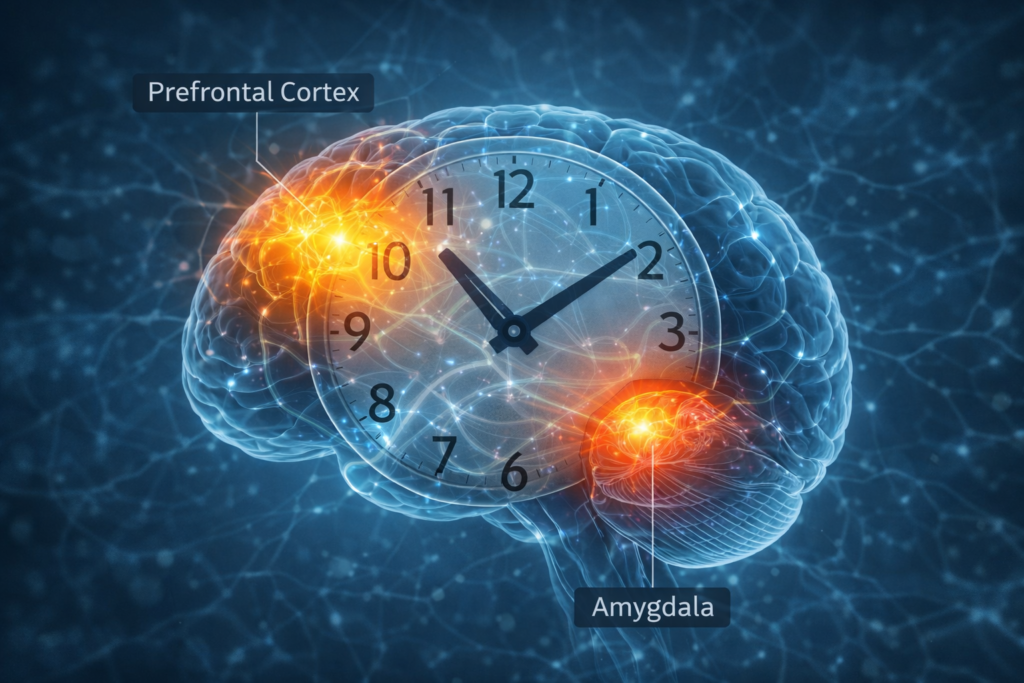
The neuroscience of time perception is complex, but three systems are especially relevant to time famine. The first is attention: the more attentional resources consumed by a task or worry, the faster subjective time appears to pass. This is the ‘flow state’ phenomenon in reverse — when we are anxious and hyper-alert to pending demands, time appears to accelerate uncomfortably.
The second is memory-based reconstruction. When we look back on a period — say, a busy work week — our brain constructs a sense of its duration from the number of distinct memories it can retrieve. Weeks filled with novel, varied, or emotionally salient events feel longer in retrospect. Weeks consumed by repetitive, screen-based tasks leave few retrieval markers, making them feel compressed and ‘lost.’
The third system involves the prefrontal cortex and its role in prospective time estimation: when we consider how long a future task will take, or how much time remains before a deadline, we rely on a working memory process that is highly susceptible to emotional interference. Stress consistently causes people to underestimate available time and overestimate the urgency of incoming demands.
Why Busy Days Feel Shorter
There is a well-documented psychological effect called cognitive compression — and it helps explain why a day spent switching between emails, meetings, messages, and micro-decisions feels simultaneously exhausting and abbreviated. When the day is dominated by reactive, interruption-driven activity, the brain generates few distinct, memory-rich episodes. Instead, it encodes the period as a blurry cluster of undifferentiated activity.
A landmark study published in Psychological Science found that task-switching — moving rapidly between unrelated activities — significantly reduces what researchers call ‘temporal landmarks’: memorable reference points that help the brain demarcate the passage of time. Without these landmarks, hours collapse together, creating the disorienting sensation that the day vanished before you had the chance to inhabit it.
“When every hour is filled with reactive tasks, you are not living through time — you are surviving it. The brain has no memorable moments to anchor to, so the whole day dissolves.”
This is not merely a philosophical inconvenience. When people perceive that time is slipping away without meaningful output, it triggers a feedback loop of urgency that intensifies time scarcity. They rush harder, plan less thoughtfully, and become even more susceptible to interruption — compounding the very problem they are trying to escape.
The Role of Stress Hormones
Cortisol — the body’s primary stress hormone — plays a direct and measurable role in time perception. When cortisol levels are elevated, as they are during periods of sustained psychological stress, the brain’s threat-detection systems become hyperactivated. This shifts cognitive resources away from long-range planning and toward immediate, reactive responses.
Research published in the journal Psychoneuroendocrinology found that elevated cortisol reduces individuals’ perceived sense of control over their time, making even manageable workloads feel overwhelming. Crucially, this effect is cyclical: feeling time-starved triggers cortisol release, which in turn deepens the perception of time scarcity, creating a self-reinforcing stress loop that is difficult to interrupt through willpower alone.
↑ 37% Increase in perceived time pressure reported by adults in developed nations between 2003 and 2023 (Gallup / HBS combined data) |
Modern Life and the Illusion of Productivity
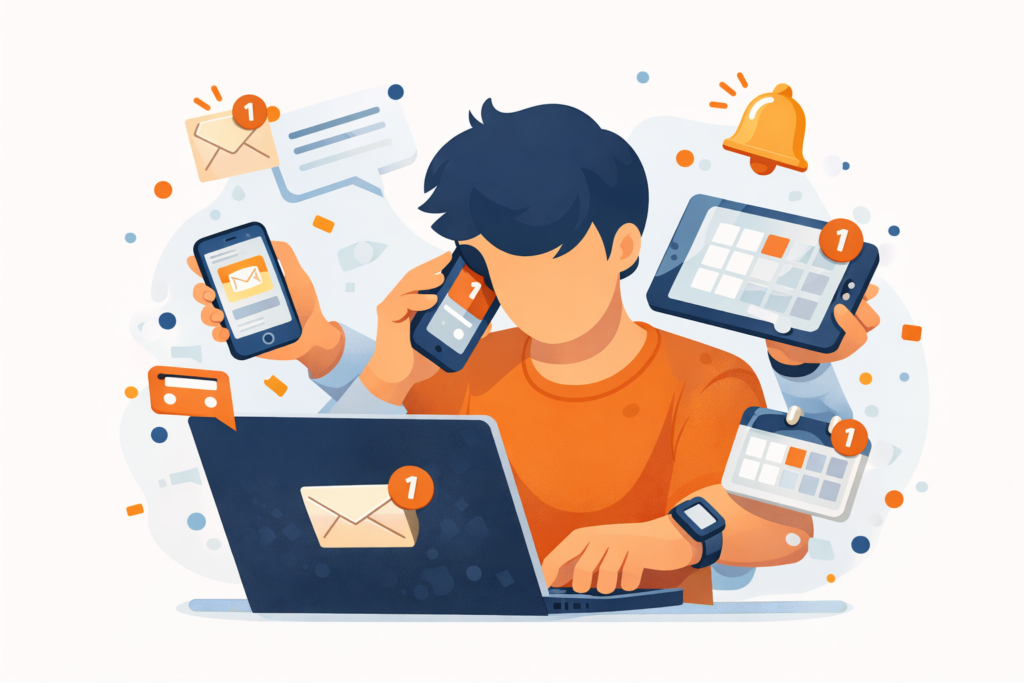
If time famine were simply a matter of having too many responsibilities, the solution would be obvious: do fewer things. But the modern experience of time stress is driven less by objective task volume than by the architecture of digital work culture — an environment deliberately engineered for constant engagement, and accidentally engineered for chronic urgency.
Smartphones transformed the social contract around availability. Where professionals once occupied clearly bounded work periods punctuated by genuine off-time, the always-connected model has dissolved these boundaries. Research from Microsoft and Stanford both indicate that the average knowledge worker now checks their communication channels — email, messaging apps, and social platforms — upward of 77 times per day. Each check, whether or not it surfaces an urgent message, re-engages the brain’s threat-monitoring system and reinforces the neurological habit of vigilance.
This ‘always-on’ culture creates what sociologist Judy Wajcman calls ‘connected time’ — time that is technically personal but cognitively colonized by work-related cognition. The feeling of never being fully off produces a particularly corrosive form of time stress, because the individual never achieves the cognitive restoration associated with genuine leisure.
Social comparison mechanisms intensify this effect significantly. Platforms like LinkedIn are effectively productivity theaters: curated streams of others’ achievements, launches, promotions, and ‘hustle highlights.’ Research by Mogilner and Norton at Harvard found that exposure to high-achievement social content reliably increases reported time pressure in viewers, even when their own workload is unchanged. Watching others appear to accomplish more in the same twenty-four hours triggers a cognitive recalibration — your own time use suddenly feels wasteful and insufficient by comparison.
Hustle culture adds an ideological layer: the valorization of busyness as a virtue. Being ‘slammed,’ ‘swamped,’ or ‘heads-down’ has become social currency in many professional contexts. Research by Silvia Bellezza at Columbia Business School found that signaling busyness correlates with perceived status in American culture — meaning individuals are socially incentivized to frame themselves as overwhelmed, even when they are not. This cultural script further blurs the boundary between genuine time scarcity and performed time scarcity.
Multitasking is perhaps the most consequential myth in this ecosystem. Despite widespread belief that working on multiple streams simultaneously increases efficiency, neuroscience is unequivocal: the human brain does not multitask. It rapidly switches attention between tasks, and each switch carries a cognitive cost — a ‘switch tax’ of attentional recovery time that studies estimate consumes 20–40% of productive capacity. The net result is that multitasking creates the sensation of extraordinary busyness while measurably reducing output — a perfect recipe for time famine.
Technology Was Supposed to Save Time — So Why Doesn’t It?
The answer lies in what economists call the ‘productivity paradox’ and what technology researchers describe as the ‘rebound effect.’ When any tool increases efficiency, the typical organizational response is not to reduce workload — it is to increase throughput expectations. Email made communication faster; the expectation of response time collapsed from days to minutes. Automation removed routine tasks; it created bandwidth for more complex, higher-volume work. Project management tools like Slack and Asana didn’t reduce the number of projects — they made it logistically feasible to run more of them simultaneously.
A 2022 Harvard Business Review analysis found that as enterprise communication tools proliferated, the average time workers spent reading and responding to communications actually increased by 28% over the prior decade — not because people received more emails, but because the ease of digital communication lowered the threshold for sending one. Every tool that increases ease simultaneously increases volume. The net effect on available time is, at best, neutral — and in many cases, negative.
Economic and Social Factors Behind Time Scarcity

While psychological and neurological factors shape how we experience time pressure, the roots of modern time scarcity are also deeply structural. A range of economic and social forces systematically reduce the quantity of discretionary time available to individuals, regardless of their cognitive patterns.
Commuting remains a significant, often underestimated, drain on time capital. Despite the remote work expansion post-2020, millions of workers globally continue to spend one to three hours daily in transit. A landmark study by the National Bureau of Economic Research found that each additional ten minutes of commute time correlates with a measurable decline in life satisfaction, leisure time, and sleep quality — all of which compound feelings of time deprivation.
Dual-income households, now the economic norm in most developed nations, face what sociologists call a ‘time double bind.’ Both partners carry professional demands alongside domestic and caregiving responsibilities. Research published in the Journal of Marriage and Family consistently finds that despite shifting gender norms, women in dual-income households disproportionately bear the mental load of household coordination — tracking appointments, managing school schedules, and planning logistics — even when paid work hours are equivalent. This invisible labor intensifies the subjective experience of time scarcity without appearing in any formal workload accounting.
The gig economy has introduced a distinctive form of time anxiety for the roughly 15–20% of workers in platform-based or freelance arrangements. Without guaranteed income, gig workers face pressure to remain perpetually available to maximize earnings. The structural absence of defined work hours means that off-time is never fully secure — any period of rest carries the implicit cost of forgone earning. Research from UC Berkeley found that gig workers report significantly higher levels of time-related anxiety than salaried employees, even when their actual working hours are comparable.
Job insecurity, amplified by technological disruption and economic volatility, creates its own temporal distortion. When employment feels fragile, workers tend to overwork preventively — extending hours, reducing vacation usage, and maintaining higher levels of vigilance. A 2023 McKinsey Global Institute report noted that job insecurity correlates strongly with both reduced actual leisure time and heightened subjective time pressure, a combination that produces chronic time famine even in periods of economic stability.
Economic insecurity doesn’t just threaten financial wellbeing — it colonizes time itself, transforming potential rest into anxious productivity.
Psychological Drivers of Feeling Rushed
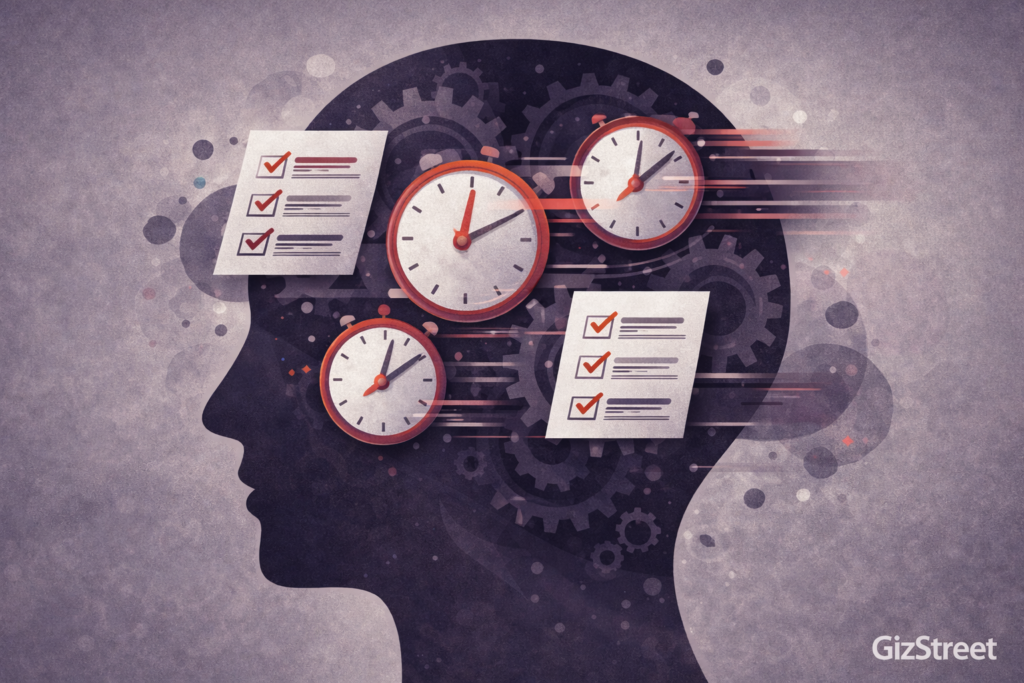
Beyond external workloads and structural pressures, a set of deeply internalized psychological patterns dramatically amplifies the experience of time scarcity. Understanding these internal drivers is essential, because they operate independently of actual task volume — meaning that addressing workload alone will not resolve the feeling of being chronically rushed.
Perfectionism and Overcommitment
Perfectionism is one of the most powerful internal engines of time famine. Perfectionists systematically underestimate task completion times because they unconsciously apply standards that extend the work beyond what any reasonable definition of ‘done’ would require. Research by Dr. Gordon Flett at York University found that maladaptive perfectionism — characterized by fear of failure and self-critical evaluation — is one of the strongest predictors of subjective time pressure, independent of actual workload.
Closely linked is the fear of missing out, or FOMO: the anxiety that declining opportunities, projects, or invitations will result in falling behind in some ill-defined but deeply felt competitive race. This drives overcommitment — the accumulation of more obligations than one’s time architecture can sustainably support. The result is a calendar in permanent crisis mode, where every day begins with the knowledge that you will end it having failed to complete everything you promised.
Fear of Falling Behind
In competitive professional and academic environments, relative standing becomes a driver of time behavior independent of absolute workload. When peers appear to be producing, learning, and advancing at pace, the cognitive pressure to match that visible activity — regardless of whether it actually serves one’s own goals — is intense. Social comparison research by psychologist Leon Festinger established that humans instinctively benchmark their own performance against visible peers, and in digital environments, those benchmarks are updated continuously.
This dynamic is particularly pronounced among younger professionals navigating early career stages, where credentials, portfolio items, and visible output serve as proxies for potential. The fear of being perceived as insufficiently productive generates a form of time stress that is socially constructed rather than task-derived — you are not running out of time to complete your work; you are running out of time to appear as productive as others seem to be.
Decision Fatigue
Every conscious decision — from what to eat for breakfast to how to phrase a difficult email — draws on a finite cognitive resource. Research by psychologist Roy Baumeister established the concept of ‘ego depletion’: the finding that willpower and deliberate decision-making capacity diminish with repeated use. As the day progresses and micro-decisions accumulate, the brain’s executive function degrades, making each subsequent decision feel more effortful and time-consuming.
In modern life, the volume of daily decisions has expanded dramatically: choice-heavy subscription platforms, notification management, content algorithms offering infinite selection, and the constant stream of communication requiring routing decisions all contribute to a decision load far exceeding historical norms. The cumulative mental drain accelerates perceived time scarcity — a depleted brain experiences even modest task lists as overwhelming.
What New Research Says About Time Affluence

If time famine is shaped by perception as much as by objective workload, then a compelling research question emerges: can people learn to perceive time differently? The answer, according to a growing body of research centered on the concept of ‘time affluence,’ appears to be yes — with meaningful consequences for wellbeing.
Time affluence is defined as the subjective experience of having sufficient time — feeling unhurried, in control of one’s schedule, and able to engage meaningfully with chosen activities. Crucially, research by Cassie Mogilner Holmes, a leading expert on time and happiness at UCLA Anderson, consistently shows that time affluence is a stronger predictor of life satisfaction and reported happiness than income level for most individuals above a moderate income threshold.
A landmark 2016 study published in Social Psychological and Personality Science found that people who spent 30 minutes weekly performing an act of ‘giving time’ — volunteering, helping a colleague, or assisting a stranger — subsequently reported feeling that they had more time, not less. The paradox: giving time away expanded the subjective sense of temporal abundance. The researchers attributed this to the effect of perceived efficacy — using time in ways that feel meaningful increases the sense that time is within one’s control, which expands subjective time supply.
Value-based scheduling is the practical application of time affluence research. Rather than organizing time around urgency (what is most pressing) or volume (what fills the inbox), value-based scheduling prioritizes activities according to personal meaning and stated priorities. Research published in the Journal of Consumer Research found that people who regularly engage in personally meaningful activities report lower time pressure even when their schedules are objectively as full as their peers’. The key mechanism is what researchers call ‘temporal orientation’ — a shift from experiencing time as something that passes at you to something you actively inhabit.
Reducing low-value commitments — meetings that could be emails, social obligations accepted out of guilt rather than genuine interest, digital content consumption that produces no nourishment — is a consistently evidence-backed strategy for increasing time affluence. Research suggests that the relief is not merely practical (fewer things to do) but psychological: each eliminated low-value commitment signals to the brain that time is under volitional control, which itself reduces the stress response associated with scarcity.
Health and Mental Consequences of Chronic Time Pressure
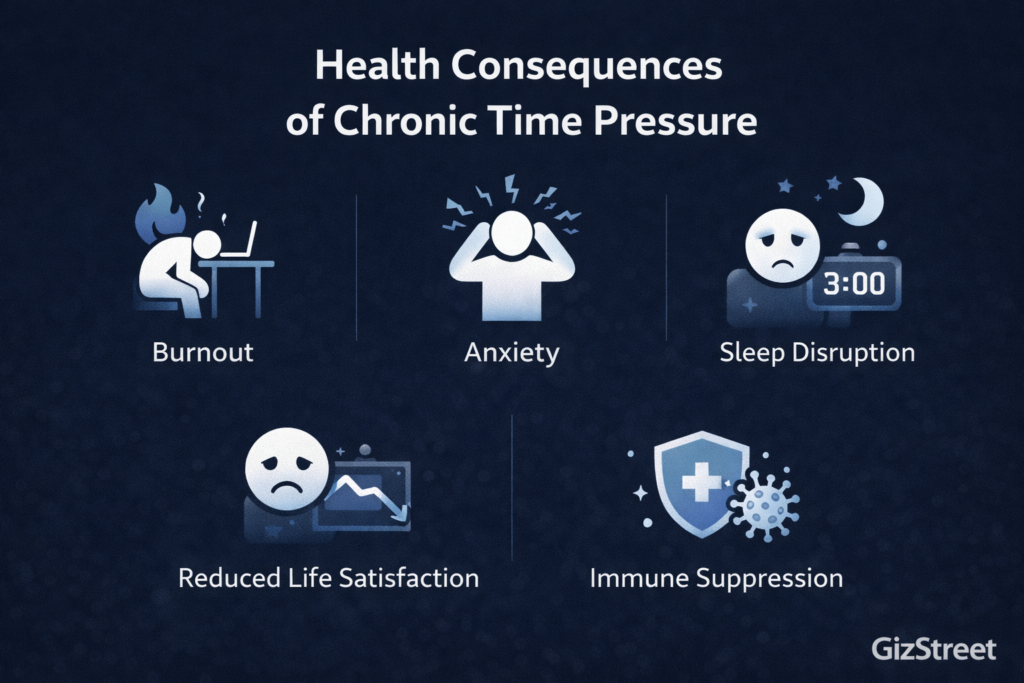
The consequences of chronic time famine extend well beyond the inconvenience of a busy schedule. When the subjective sense of time scarcity becomes persistent — a default state rather than a situational response — it triggers a cascade of physiological and psychological effects that represent genuine health risks.
Burnout is perhaps the most widely recognized consequence. The World Health Organization formally classified burnout as an occupational phenomenon in 2019, defining it as a syndrome of chronic workplace stress that has not been successfully managed. Researchers at the University of Copenhagen found time pressure to be among the three strongest predictors of burnout across professions, alongside emotional demands and lack of autonomy. Burnout is not simply exhaustion — it involves a fundamental erosion of engagement, efficacy, and purpose that can take months or years to reverse.
Anxiety disorders and chronic time stress share a bidirectional relationship. Time scarcity activates the same neurological alarm systems as other perceived threats: elevated cortisol, heightened amygdala activity, and reduced prefrontal cortex regulation. Over time, this sustained activation can reinforce generalized anxiety, lower the threshold for stress responses, and reduce cognitive flexibility. A 2022 meta-analysis in the journal Clinical Psychology Review found that individuals reporting high levels of time pressure were 1.8 times more likely to also report clinically meaningful anxiety symptoms.
Life satisfaction research consistently identifies subjective time autonomy — the sense that one’s time use reflects genuine choices rather than external impositions — as a critical determinant of wellbeing. Nobel Prize-winning economist Daniel Kahneman’s research on the ‘day reconstruction method’ found that commuting, passive communication management, and reactive work activities are among the experiences humans rate as least pleasurable — yet these are precisely the activities that dominate time-pressured schedules.
Sleep is profoundly disrupted by time pressure. Feeling behind on tasks inhibits the psychological ‘offloading’ necessary for sleep onset, and it commonly triggers early waking as the brain begins pre-emptively planning for tomorrow’s demands. A 2023 study from the American Academy of Sleep Medicine found that perceived time pressure was a stronger predictor of sleep quality than actual working hours — confirming that it is the cognitive experience of time scarcity, not the objective workload, that most disrupts rest.
1.8× Higher likelihood of anxiety symptoms among people reporting chronic time pressure (Clinical Psychology Review, 2022) |
Practical Strategies to Reduce the Feeling of Time Scarcity

The research reviewed throughout this article converges on a crucial insight: because time famine is largely a perceptual and cognitive phenomenon, the most effective interventions target the mind rather than the calendar. The following strategies are not productivity hacks — they are evidence-based techniques for restructuring how you relate to time.
Reframing Time Narratives
Cognitive reframing involves consciously changing the interpretive lens through which you view your time situation. Research by Alia Crum at Stanford’s Mind and Body Lab has demonstrated that the narrative you apply to stress — including time stress — directly affects its physiological impact. Rather than framing a full schedule as evidence of being overwhelmed, reframing it as evidence of engagement and purposeful activity measurably reduces cortisol response and subjective pressure. Practically, this means replacing the habitual statement ‘I don’t have enough time’ with the more accurate and empowering ‘I am choosing how to use my time.’ The difference may sound semantic; the neurological effect is not.
Single-Tasking Over Multitasking
The neuroscience case against multitasking is overwhelming. Studies from Stanford, MIT, and the University of London consistently show that single-tasking — completing one defined task to a natural stopping point before beginning the next — produces higher quality output, reduces subjective time pressure, and generates more distinct, satisfying memory traces (the temporal landmarks that make time feel well-used). Implementing single-tasking requires designing deliberate blocks of uninterrupted focus time. Research by Cal Newport and others on ‘deep work’ suggests that even 60–90-minute single-task blocks, practiced consistently, can dramatically shift both productivity and time affluence.
Digital Boundaries
Structuring your relationship with digital notifications is among the most directly evidence-supported interventions for time famine. A notable study from the University of California Irvine found that it takes an average of 23 minutes to fully return to focused work following a digital interruption. Given that the average worker is interrupted every 11 minutes, this arithmetic makes sustained productive engagement nearly impossible in a default notification environment. Designating specific checking windows for email and messaging — for instance, three fixed times daily — and physically removing devices from designated rest spaces have both been shown to measurably reduce subjective time pressure and improve focus quality.
Value-Based Scheduling
Rather than filling time with whatever surfaces as urgent, value-based scheduling involves explicitly identifying your top two or three priorities for the week and ensuring they receive protected time before reactive work fills the calendar. Research by Adam Grant at Wharton and others on ‘proactive time management’ demonstrates that individuals who schedule meaningful work first — before attending to communications and requests — report significantly higher time satisfaction and lower end-of-day stress than those who manage time reactively. The insight is simple but counterintuitive: feeling time-rich is not about having fewer commitments; it is about having alignment between how you use your time and what you actually value.
Is Society Moving Toward More or Less Time Pressure?

The trajectory of time pressure in modern society is genuinely uncertain — and the factors shaping it are pulling in opposite directions. Several structural shifts hold real promise for reducing time famine; others threaten to intensify it.
Hybrid and remote work, where sustained, has produced mixed outcomes for time pressure. On the positive side, the elimination of commuting for remote workers recaptures significant time capital — often 1–2 hours daily — and enables greater flexibility in scheduling. However, research from the International Labour Organization and others indicates that remote work also blurs boundaries between work and personal life more severely than office-based work, and that always-on availability expectations have intensified rather than diminished. The net effect on time pressure depends heavily on whether organizations actively protect employee recovery time or simply expand accessibility expectations.
The emergence of AI-powered tools — from large language models to automated scheduling, writing, and data analysis systems — represents the most significant potential time-saver since the internet. Early workplace studies suggest that AI assistance can reduce time on research, communication drafting, and routine analysis by 30–50%. Whether this translates into more leisure and lower time stress, or simply enables greater task volume at the same pace, will depend on organizational culture and individual choices about how to deploy recovered time.
Shorter workweek experiments — particularly the widely-studied four-day workweek trials in Iceland, the United Kingdom, and New Zealand — have produced consistently positive outcomes for time affluence, wellbeing, and, notably, productivity. Microsoft Japan’s four-day week trial reported a 40% increase in output, suggesting that constraint can improve focus and reduce time waste. If such models become mainstream, they represent a structural remedy for time famine that operates at the systemic level, beyond individual behavior change.
The more cautious perspective notes that every previous wave of productivity technology generated equivalent waves of expanded expectation. The industrial revolution did not reduce working hours — worker movements and legislation had to compel that outcome. The personal computing revolution did not reduce the working day — it extended it. If AI follows the same pattern, without deliberate cultural and policy intervention, it may intensify time pressure rather than relieve it. The outcome will ultimately be determined not by the technology itself, but by the social and economic choices made about how to distribute the time it recovers.
Frequently Asked Questions
Q: Why do I feel busy even when I’m not doing much?
A: Feeling busy without an objectively heavy workload is a well-documented psychological phenomenon linked to cognitive load rather than actual task volume. If your mind is occupied with pending worries, unresolved decisions, or ambient digital stimulation, your brain activates the same urgency systems it would under genuine time pressure. Anxiety, decision fatigue, and habitual phone-checking all generate a subjective sense of busyness that can be entirely disconnected from what you are actually doing.
Q: What is time famine?
A: Time famine is a psychological term describing the chronic feeling of having too much to do and too little time to do it, regardless of whether one’s actual workload warrants such urgency. Coined and studied extensively in workplace research, it captures the modern experience of persistent time scarcity — a condition linked to burnout, anxiety, and reduced life satisfaction. Importantly, it is driven as much by perception and cognitive patterns as by objective task volume.
Q: Does technology make us feel more rushed?
A: Research consistently suggests that technology amplifies rather than reduces time pressure for most users. While productivity tools theoretically save time, they also raise throughput expectations and increase the volume of communications requiring response. Constant notifications retrain the brain toward vigilance and interrupt recovery. Studies show that the average knowledge worker loses significant productive capacity to digital interruptions daily, and that always-on digital culture prevents the genuine psychological rest that makes time feel regenerative.
Q: Can stress change how we perceive time?
A: Yes — stress directly alters time perception through multiple mechanisms. Elevated cortisol reduces perceived control over time and heightens urgency. Attentional narrowing under stress causes the brain to overestimate demands and underestimate available time. Emotional arousal accelerates the subjective pace of time, making periods of high stress feel simultaneously fast-moving and oppressive. These are not metaphorical experiences — they reflect measurable changes in how the brain’s timing and threat-assessment systems interact under stress.
Q: What is time affluence?
A: Time affluence is the subjective feeling of having enough time — of being unhurried and in control of how your hours are spent. Research by Harvard and UCLA scholars shows that time affluence is a stronger predictor of happiness and life satisfaction than income for most people above a basic comfort level. It can be cultivated through value-based scheduling, single-tasking, digital boundary-setting, and deliberate engagement in personally meaningful activities, even without reducing total workload.
Q: How can I stop feeling constantly rushed?
A: Evidence-based strategies include cognitive reframing (shifting from ‘I have no time’ to ‘I am choosing how to use my time’), single-tasking in protected focus blocks, limiting notification exposure to designated checking windows, and practicing value-based scheduling. Research also shows that spending time on genuinely meaningful activities — even briefly — expands the subjective sense of time availability. The goal is not to do less, but to reduce the cognitive static that makes any amount of activity feel overwhelming.
Q: Is feeling busy linked to anxiety?
A: Yes, the relationship is bidirectional and well-established in research. Anxiety amplifies time pressure by activating threat-detection systems that make demands feel more urgent and available time feel more scarce. Conversely, chronic time pressure is a significant predictor of anxiety disorders — sustained cortisol elevation from time stress recalibrates the nervous system’s baseline arousal level upward. A 2022 meta-analysis found that individuals reporting high time pressure were nearly twice as likely to report clinically meaningful anxiety symptoms.
Q: Are younger generations more time-stressed than older ones?
A: Research suggests a nuanced picture. Younger adults — particularly Millennials and Gen Z — report higher levels of time pressure than their predecessors at equivalent life stages, driven by heightened economic precarity, digital platform engagement, and intensified social comparison. However, objective time use studies show that younger adults often have more discretionary time than they perceive. The gap between actual time availability and perceived time scarcity appears to be growing — suggesting that generational time stress is increasingly a perceptual and cultural phenomenon, not just a structural one.