How AR and VR Technology Is Changing Gaming, Shopping, and Work in 2026
Introduction: The Year Immersive Tech Stopped Being a Gimmick AR VR technology 2026 is no longer a curiosity at tech expos, it is quietly […]
Contributor
Introduction: The Year Immersive Tech Stopped Being a Gimmick
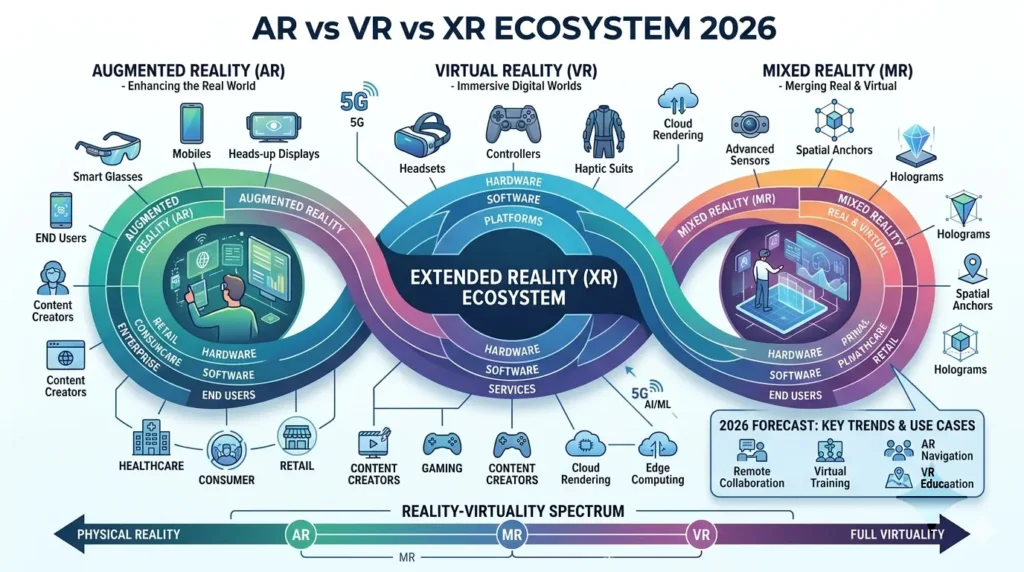
AR VR technology 2026 is no longer a curiosity at tech expos, it is quietly embedded in how we game, how we buy a sofa, and how a surgeon in Mumbai practices a complex procedure before ever picking up a scalpel.
The numbers tell a compelling story. According to IDC, global spending on AR and VR reached $72.8 billion in 2024, and analysts at Goldman Sachs project the market will surpass $150 billion by the end of 2026. That is a seismic shift in how humans interact with digital information.
In this deep-dive, we will unpack exactly how extended reality is reshaping three massive sectors , gaming, retail, and the workplace with real use cases, hard data, and a clear-eyed look at what still needs fixing.
What Exactly Are AR and VR? (And Why Does XR Matter Too?)
Let’s level-set quickly, because these acronyms get misused constantly even by people who should know better.
Augmented Reality (AR)
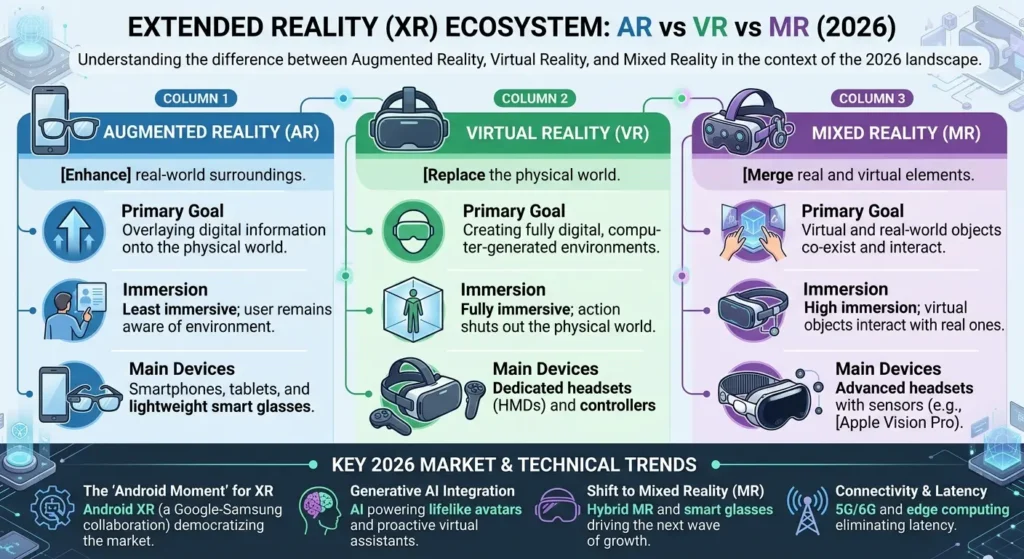
AR layers digital content over the real world. Your phone’s camera stays open; virtual objects appear on top of what you see. Think Pokemon GO, IKEA Place, or the yellow first-down line you see during an NFL broadcast. AR does not replace reality, it enhances it.
Virtual Reality (VR)
VR replaces your physical environment entirely. You wear a headset, and the real world disappears. You are inside a game, a virtual meeting room, or a digital showroom. Devices like the Meta Quest 3S, Apple Vision Pro, and Sony PlayStation VR2 drive this category.
Extended Reality (XR) — The Umbrella Term
Extended reality is the catch-all for AR, VR, and Mixed Reality (MR). When industry analysts say the ‘XR market,’ they mean all three. Mixed Reality, where virtual objects interact with real ones (your virtual coffee mug casts a shadow on your actual desk) is the fastest-growing sub-segment heading into 2027.
Gaming: Where AR VR Technology 2026 Is Delivering Its Most Dramatic Results
Gaming is where XR has always felt most natural. But 2026 is different from 2022 in one critical way: the games are actually good now.
The Hardware Leap That Changed Everything
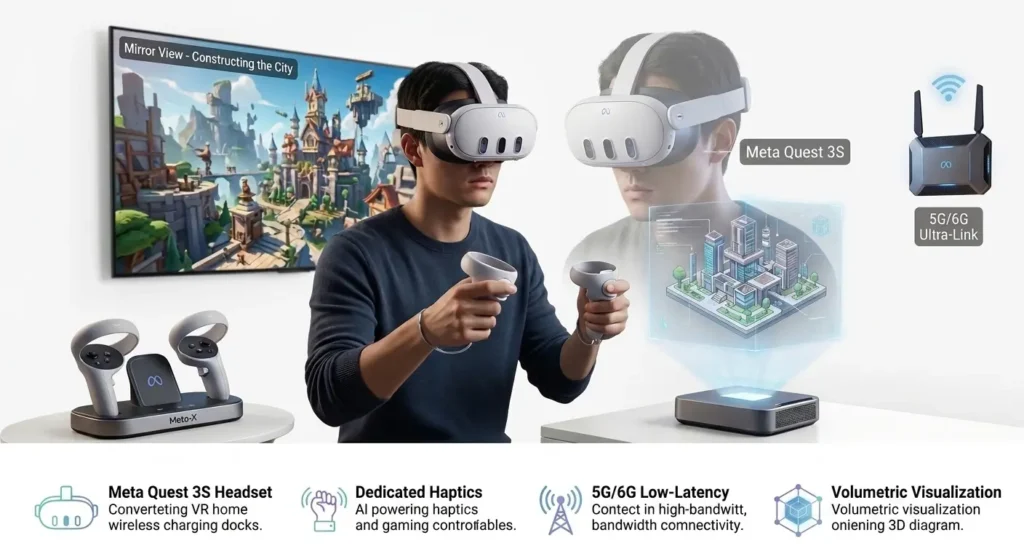
The Meta Quest 3S, launched at $299 in late 2024, brought passthrough color mixed-reality to a mainstream price point. Sony’s PS VR2 sold over 4 million units by Q1 2025 (IDC data), while Apple Vision Pro, despite its $3,499 price tag — demonstrated what spatial computing could look like at the premium end.
The result? A Gartner survey in late 2025 found that 38% of Gen Z gamers had used a VR headset in the past three months. That is nearly double the figure from 2022.
Games That Are Genuinely Moving the Needle
The gaming catalogue is no longer an afterthought. In 2025–2026, several AAA studios committed serious resources to VR-native titles:
- Ubisoft’s Assassin’s Creed: Nexus VR became the first open-world VR game to ship over 3 million copies.
- Valve’s Half-Life: Alyx (originally 2020) remains the gold standard for immersive narrative design, and its player base actually grew 41% in 2025 as headset adoption expanded.
- Horizon Worlds 2.0 from Meta introduced creator monetisation tools, enabling indie developers to generate revenue inside virtual spaces similar to Roblox but for adults.
AR Gaming: Beyond Pokemon GO
Mobile AR gaming has matured significantly. Niantic’s platform now powers dozens of games beyond Pokemon GO, including Peridot, a virtual pet AR game that uses LiDAR sensors on newer iPhones to create genuinely convincing creature interactions on real surfaces.
Meanwhile, Snapchat’s AR-powered gaming layer, Snap Games with AR lets friends play multiplayer experiences where characters appear in their actual room. It sounds gimmicky. It is not; retention data shows sessions averaging 22 minutes, well above industry benchmarks for casual mobile games.
Shopping: How AR Is Quietly Eliminating the Need for Physical Try-Ons
Here is a stat that should give every brick-and-mortar retailer pause: Shopify reported in 2024 that merchants using 3D/AR product visualisation saw a 94% increase in conversion rates compared to static images. Nearly double the sales. That is not a marginal improvement that is a different business model.
Virtual Try-On: From Glasses to Sofas
IKEA’s AR app, IKEA Place, has been downloaded over 40 million times and lets you place photorealistic 3D furniture models in your actual room using your phone camera. The dimensions are accurate to the centimetre. Returns on IKEA products viewed via the AR app are 27% lower than those purchased without it (IKEA, 2025 sustainability report).
In fashion, Warby Parker’s virtual try-on (glasses), Nike’s virtual shoe fitting app, and Sephora’s Virtual Artist (makeup) have collectively handled over 600 million virtual try-on sessions in 2025 alone. L’Oreal acquired Modiface, a pioneering AR beauty tech company back in 2018, and that investment is now delivering measurable ROI across 70+ of its brands.
The AR-Powered Supply Chain
It is not just the customer-facing side of retail that benefits. Warehouse workers at DHL and Amazon now use AR smart glasses (powered by Honeywell and Google Glass Enterprise Edition 2, respectively) to fulfil orders faster. DHL’s trials showed a 25% improvement in picking accuracy and a 15% reduction in training time for new employees.
Work: Enterprise Is Where the Real Money Is Going in Extended Reality
Consumer AR and VR capture the headlines. Enterprise XR captures the budgets. According to IDC’s Worldwide AR/VR Spending Guide (2025), enterprise and commercial use cases account for 68% of total XR spending globally. Manufacturing, healthcare, and real estate are leading the charge.
Training and Simulation: The Killer Use Case
Walmart trained over one million associates using VR headsets (developed in partnership with Strivr) for scenarios ranging from Black Friday crowd management to handling difficult customer interactions. The results, published in Walmart’s 2024 associate development report: VR-trained employees demonstrated 10–15% higher assessment scores than those trained via traditional e-learning.
In healthcare, Fundamental Surgery, a VR surgical simulation platform, is now used in 90+ medical schools across Europe and North America. Surgeons who trained with the platform showed a 230% improvement in procedural accuracy compared to cadaver-only training (peer-reviewed study, Journal of Surgical Education, 2024).
Remote Collaboration: After the Zoom Fatigue
The pandemic normalised remote work. Zoom fatigue made clear that 2D video calls were a poor substitute for in-person meetings. Spatial computing platforms like Horizon Workrooms (Meta), Microsoft Mesh, and Spatial.io are trying to solve this with VR apps that place remote team members as avatars around a shared virtual table.
Microsoft Mesh was rolled into Teams in 2024, and early adoption data from enterprise clients including Accenture and Johnson & Johnson showed that 3D avatar-based meetings improved participant engagement scores by 26% compared to standard video calls (Microsoft Work Trend Index, 2025).
Challenges and Controversies: What Still Needs to Be Fixed
Honesty demands we acknowledge that AR VR technology 2026 is not without serious friction points. Three problems in particular deserve attention.
1. Cost and Accessibility
The Apple Vision Pro at $3,499 is aspirational hardware for most people. Even the Meta Quest 3 at $499 is not an impulse purchase. While the Quest 3S brought the floor down to $299, meaningful penetration in lower-income demographics remains limited. A Pew Research Center report (2025) found that VR headset ownership in US households earning under $40,000 per year is under 4%.
Enterprise hardware faces similar dynamics. Microsoft HoloLens 2 costs $3,500 per unit. For a factory floor of 500 workers, that is a $1.75 million hardware investment before you even consider software licensing and IT infrastructure.
2. Health and Safety Concerns
Motion sickness (cybersickness) affects approximately 40–70% of VR users to some degree, according to a University of Minnesota study (2024). While developers have made significant progress with techniques like dynamic foveated rendering and artificial horizon cues, the issue has not been eliminated. Extended VR sessions, particularly for children also raise unresolved questions around eye development and attention span.
The American Academy of Ophthalmology currently recommends limiting VR use to under one hour for children under 13, a guideline that is difficult to enforce in educational deployments.
3. Privacy and Data Sovereignty
AR and VR devices are exceptionally data-hungry. They map your physical environment, track your eye movements, record your voice, and in some cases monitor biometric signals like heart rate. In 2025, the FTC issued its first enforcement action specifically targeting AR data practices, fining an unnamed VR platform $12.5 million for collecting children’s biometric data without adequate parental consent.
The EU’s AI Act and GDPR extensions being debated in the European Parliament as of Q1 2026 will impose new obligations on XR developers requirements that many startups are not yet prepared to meet.
Future Outlook: Where AR VR Technology Is Headed Next
The trajectory is clear, even if the exact timeline remains debated. Here is where the smartest money in tech is betting on XR going over the next three to five years.
Smart Glasses Go Mainstream
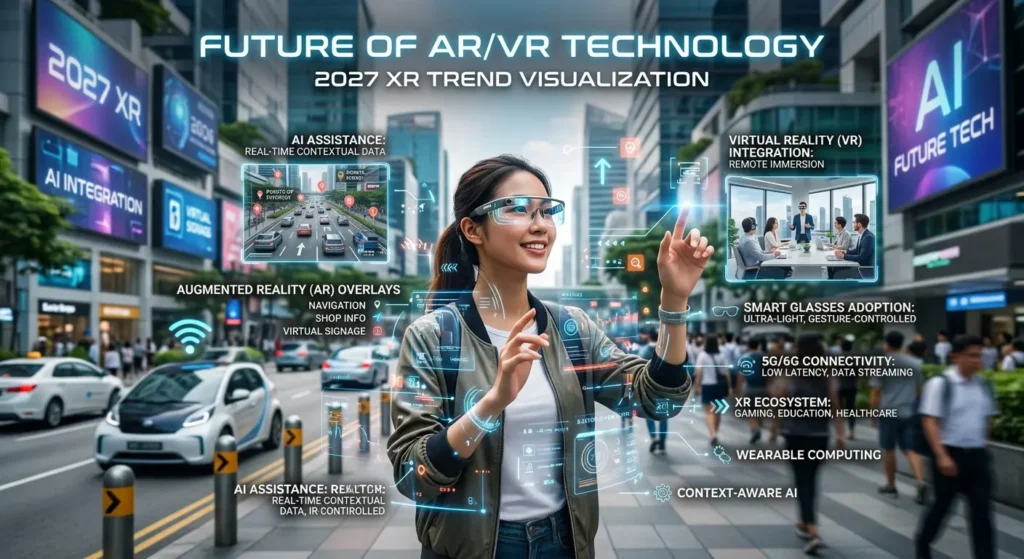
Meta’s Ray-Ban smart glasses which sold faster than any previous Meta hardware product represent the thin end of a very large wedge. The next generation, reportedly featuring a micro-display for AR overlays, is expected in late 2026 or early 2027. Apple is rumoured to be developing a lighter, cheaper successor to Vision Pro specifically targeting the smart glasses form factor.
The shift from headsets to glasses will be the moment AR truly becomes ubiquitous. When the hardware fits in your shirt pocket and looks like a normal accessory, adoption curves will look very different.
AI + XR: The Convergence That Changes Everything
The integration of large language models and generative AI into XR experiences is moving quickly. Imagine a VR training simulation where a virtual instructor responds to your actual questions in natural language, or an AR shopping assistant that not only shows you a sofa in your room but knows your room’s measurements and suggests complementary pieces from across the retailer’s catalogue.
Meta has already integrated its Llama-powered AI assistant into its Quest headsets. Microsoft’s Copilot is embedded in Mesh. The combination of spatial awareness and conversational AI is genuinely new territory and it is where the most interesting metaverse tech development is happening right now.
The 6G Connection
AR and VR are bandwidth hogs. Cloud rendering, where processing happens in a data centre and only the rendered frame is streamed to your headset requires ultra-low latency that 5G delivers inconsistently. 6G, currently in early trials by NTT DoCoMo, Ericsson, and Samsung, promises sub-1ms latency and multi-Gbps speeds. Full commercial 6G rollout is expected 2028–2030. When it arrives, it will remove the biggest remaining infrastructure constraint on truly untethered, cloud-rendered XR experiences.
Conclusion: AR VR Technology 2026 Is Not the Future — It Is the Present
The narrative around AR and VR has shifted decisively. This is no longer a technology waiting to find its moment. The moment is here, in operating theatres and warehouse floors, in living rooms and virtual fitting rooms, in the games we play and the meetings we attend.
Will every challenge be solved overnight? No. Motion sickness, privacy regulation, cost barriers — these are real problems. But the trajectory is unmistakable. Extended reality is becoming infrastructure, as foundational to digital interaction as the smartphone became a decade ago.
Whether you are a consumer wondering if a VR headset is worth the investment, a retailer weighing AR integration into your commerce stack, or an enterprise decision-maker evaluating XR training platforms, the evidence in 2026 is clear: the ROI is real, the technology is ready, and the question is no longer if — it is how fast.
Frequently Asked Questions About AR VR Technology 2026
What is AR and VR?
Augmented Reality (AR) overlays digital content on the real world, you can see both simultaneously through your phone camera or AR glasses. Virtual Reality (VR) replaces the real world entirely with a computer-generated environment viewed through a headset. Both are forms of extended reality (XR), a broader term that also includes Mixed Reality (MR), where virtual and real objects interact.
What are the main uses of AR VR technology in 2026?
The three dominant use cases in 2026 are: (1) Gaming, immersive VR-native titles and social virtual worlds; (2) Retail, virtual try-on, AR product visualisation, and virtual showrooms; and (3) Enterprise, employee training, remote collaboration via VR apps, surgical simulation, and construction site verification. Healthcare, education, and real estate are also growing rapidly.
Is VR expensive in 2026?
Entry-level VR has become significantly more affordable. The Meta Quest 3S starts at $299, making quality standalone VR accessible to a mainstream audience. However, premium devices like Apple Vision Pro ($3,499) and enterprise hardware like Microsoft HoloLens 2 ($3,500) remain expensive. Costs are expected to continue falling as the market scales.
What is the difference between AR and VR?
The key difference is immersion. AR adds to your real environment (you still see the real world), while VR replaces it (you see only the virtual environment). AR is typically experienced on a smartphone or lightweight glasses; VR requires a dedicated headset. AR is more widely used , but VR delivers deeper immersive experiences.
What is the future of AR VR technology?
The near-term future points towards: lighter smart glasses replacing bulky headsets, deep integration of generative AI into XR experiences, WebXR making immersive content accessible without apps, and 6G networks enabling cloud-rendered VR streaming. Most analysts expect XR to be as pervasive as smartphones by 2035, with the global market potentially exceeding $1 trillion.

Swathi is a contributor at GizStreet with a master’s degree in science and a strong background in technical writing and product review. She covers gadgets, software, and consumer tech, with a focus on breaking down complex products into clear, practical takeaways for readers.
Share this story
Related Articles
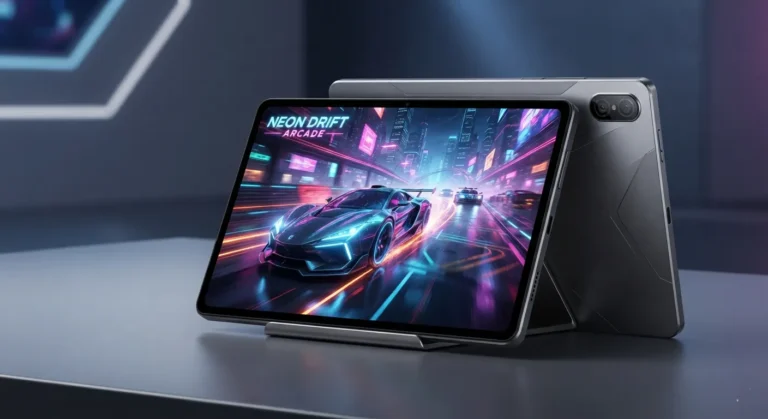
Lenovo Legion Y700 AI Officially Teased With 165Hz OLED Display Ahead of China Launch
Lenovo has revealed key specifications for the Legion Y700 AI, confirming an 8.4-inch 165Hz OLED display, Dolby Vision, 5G connectivity, and an August China launch.
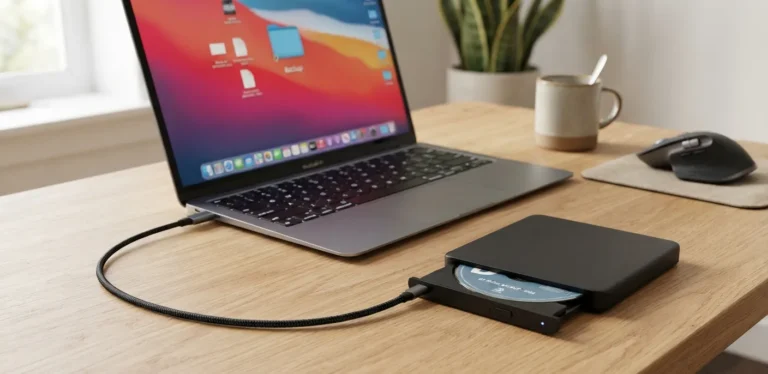
The Amicool BT686 External DVD Drive Shows Why Optical Media Still Has a Place in the USB-C Era
The Amicool BT686 external DVD drive restores CD and DVD functionality to modern laptops with USB-C support, plug-and-play operation and broad operating system compatibility.

Sony Bravia 9 II and Bravia 7 II Arrive in India: Sony Pushes Premium LED TVs Forward With True RGB Technology
Sony has launched the Bravia 9 II and Bravia 7 II in India with True RGB LED technology, Google TV, Cognitive Processor XR and premium home theatre features.
Comments (0)