The Future of Quantum Computing: How It Will Transform Industries by 2030
The race for quantum supremacy is no longer a silent laboratory experiment; it’s a multi-billion-dollar geopolitical sprint. As we stand at the threshold of […]
Contributor
The race for quantum supremacy is no longer a silent laboratory experiment; it’s a multi-billion-dollar geopolitical sprint. As we stand at the threshold of 2030, the quantum computing future is transitioning from theoretical magic to a tangible industrial engine.
But why does this matter to you today? Because the very foundations of our digital world from the encryption that protects your bank account to the AI hardware powering your smartphone are about to be rewritten. In late 2024, Google’s Willow chip solved a calculation in five minutes that would take a classical supercomputer 10 septillion years. That isn’t just a faster processor; it’s an entirely different dimension of possibility.
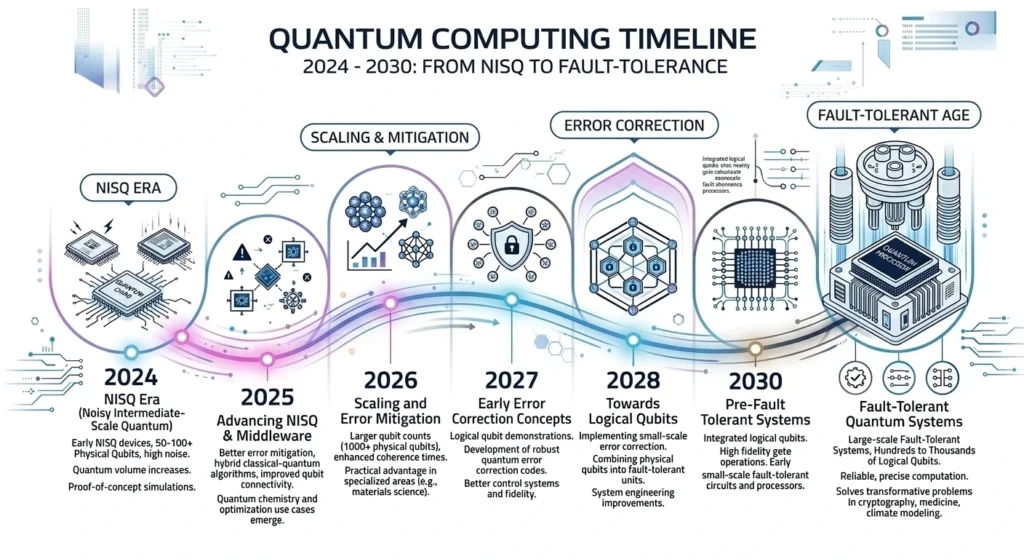
Breaking the Qubit Barrier: Where We Stand in 2026
As of April 2026, the quantum computing industry has officially transitioned from the Noisy Intermediate-Scale Quantum (NISQ) era into the Fault-Tolerant Foundation Era. The field has moved past purely theoretical research, achieving significant breakthroughs in error correction and scaling that bring practical, industrial-scale quantum computing closer to reality.
Recent data from the MIT Quantum Index Report 2025 highlights that quantum processor performance is now doubling every 12 to 18 months. While we aren’t yet running 1-million-qubit machines, the efficiency of error correction has improved by 100x since 2023. This error correction revolution is the secret sauce that will make the quantum computing future viable for every major corporation.
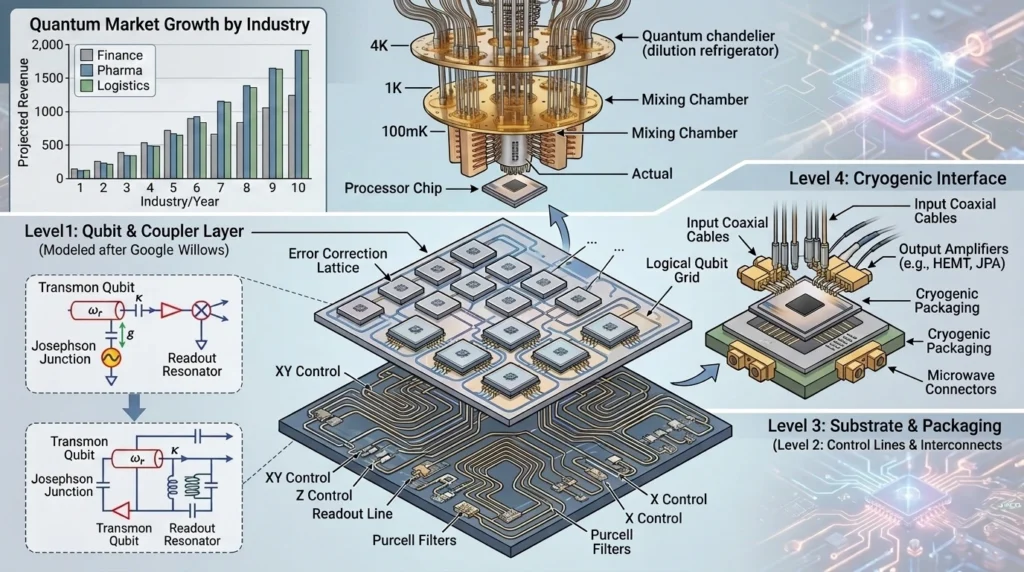
Industry Transformation: Who Wins the Quantum Race?
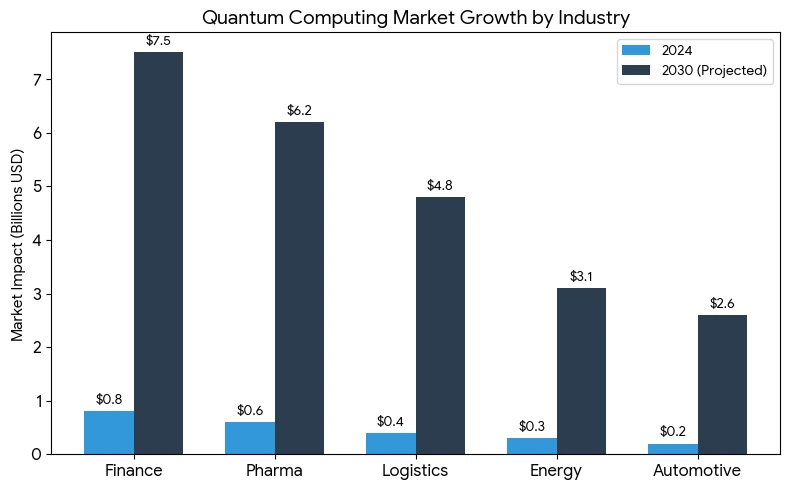
The 2026 Quantum Race has officially moved from the chalkboard to the boardroom. It is no longer a someday technology; it is a high-stakes competition for commercial dominance and national security. The winners aren’t just those with the most qubits, but those turning quantum physics into verifiable business value.By 2030, the global quantum market is projected to skyrocket to $20.2 billion, growing at a staggering CAGR of 41.8% according to MarketsandMarkets. But the real value isn’t just in the hardware, it’s in the industry specific future computing applications.
Finance: The Precision Leaders
Currently dominating the market with a 26% share, banking is the first sector to see a massive return on investment.
- The Strategy: Giants like HSBC and JPMorgan Chase have moved beyond experimentation. They are deploying quantum-enhanced algorithms to handle massive data sets for real-time portfolio optimization and hyper-accurate risk modelling.
- The Impact: By calculating market shifts faster than classical computers, these firms are finding alpha (market advantage) that was previously invisible.
Pharmaceuticals: The Molecule Architects
While finance leads in volume, Pharma is the heavyweight for long-term growth.
- The Strategy: The industry is shifting toward Simulated Drug Trials. Instead of years of physical lab testing, quantum computers simulate molecular interactions at an atomic level.
- The Impact: We are seeing the potential to compress pre-clinical discovery timelines from several years down to just a few days, bringing life-saving treatments to market at a fraction of the cost.
Logistics: The Efficiency Experts
For global trade, quantum is the ultimate math hack for the Traveling Salesman problem.
- The Strategy: Ford Otosan provides a blueprint for success. By using D-Wave’s quantum annealing technology, they tackled combinatorial explosions tasks where the number of variables is too high for standard chips.
- The Impact: Complex production and delivery scheduling that used to take 30 minutes of heavy computing is now solved in under five, optimizing global supply chains in near real-time.
The Cybersecurity Q-Day: Are Your Passwords Obsolete?
There is a dark side to this future computing power. Most of today’s encryption (RSA and ECC) relies on the fact that classical computers are terrible at factoring large prime numbers. A sufficiently powerful quantum computer can crack this in minutes.
Cybersecurity experts call this Q-Day. According to a 2025 Gartner report, most conventional asymmetric cryptography will be unsafe by 2029.
- The Harvest Now, Decrypt Later Threat: Adversaries are currently stealing encrypted data with the intent to unlock it once quantum hardware matures.
- The Solution: Post-Quantum Cryptography (PQC). NIST finalized new encryption standards (ML-KEM, ML-DSA) in late 2024. If your business hasn’t started its cryptographic inventory yet, you are already behind.
Quantum-AI Synergy: Redefining AI Hardware
We often talk about AI and Quantum as separate trends, but by 2030, they will be inseparable. Current AI hardware (like NVIDIA’s GPUs) is hitting a physical wall in terms of energy efficiency and processing density.Quantum-enhanced machine learning (QML) will allow AI to process multidimensional datasets that would choke a standard neural network. Imagine an AI that doesn’t just recognize a face, but can simulate the physics of a hurricane or the structural integrity of a new skyscraper in real-time.
The synergy between Quantum Computing and Artificial Intelligence (Quantum AI) is actively redefining AI hardware by moving beyond classical transistor-based limitations to create hybrid systems that are faster, more efficient, and capable of solving previously intractable problems. This convergence merges quantum mechanics utilizing qubits, superposition, and entanglement with AI’s pattern recognition, driving a paradigm shift in computational power.
Key Aspects of the Quantum-AI Hardware Revolution
- Hybrid Quantum-Classical Systems: The immediate future of AI hardware lies in hybrid models that integrate quantum processors with classical, high-performance computing (HPC) systems. The classical system handles routine tasks, while the quantum processor is called upon for complex optimization and training.
- Accelerated Training and Optimization: Quantum computing speeds up the training of deep learning networks, cutting timeframes from weeks to hours or minutes, according to CybraneX. Quantum algorithms, such as Quantum Approximate Optimization Algorithm (QAOA), are specifically designed to optimize complex AI workloads.
- Overcoming Data Bottlenecks: Quantum processors can handle high-dimensional data, managing massive datasets that often overwhelm classical AI architectures.
Challenges: Why Don't We Have One in Our Pocket?
If the quantum computing future is so bright, why aren’t we buying Quantum iPhones?
The Deep Freeze: Most qubits only work at temperatures colder than outer space (-273°C). Unless you want a refrigerator the size of a car in your pocket, the hardware just won’t fit.
The Toddler Problem (Fragility): Qubits are incredibly sensitive. A tiny vibration, a stray radio wave, or even a speck of dust can cause decoherence basically, the computer forgets, what it’s doing and crashes.
The Error Gap: Quantum computers make a lot of mistakes. To get one perfect answer, you need thousands of extra qubits just to double-check the work. We haven’t figured out how to shrink that massive cleanup crew into a handheld chip yet.
Wrong Tool for the Job: Quantum computers are specialists, not generalists. They are amazing at simulating molecules or cracking codes, but for scrolling TikTok or sending emails? Your current smartphone is actually faster and more efficient.
The Talent Gap: McKinsey estimates that by 2030, the world will need 250,000 quantum professionals, but only a fraction currently exists.
Cost: A single industrial-grade quantum computer can cost upwards of $15 million.
Future Outlook: Life in 2030
By 2030, you likely won’t own a quantum computer. Instead, you’ll use Quantum-as-a-Service (QaaS). Major platforms like Microsoft Azure Quantum and Amazon Braket are already democratizing access.
Your GPS will be powered by quantum sensors, your medications will be personalized to your DNA, and your city’s traffic grid will be optimized by a quantum brain.

FAQs
1. What is quantum computing?
It is a type of computing that uses quantum mechanics—specifically superposition and entanglement to perform calculations that are too complex for traditional computers.
2. How does it work?
Unlike classical bits (0 or 1), quantum computers use qubits which can exist in multiple states at once, allowing them to process vast amounts of data simultaneously.
3. Is it available today?
Yes, via the cloud. Companies like IBM, Google, and IonQ offer cloud-based access for researchers and businesses.
4. What are the benefits?
Unprecedented speed for specific tasks, ability to simulate nature/molecules, and solving optimization problems (like logistics) that are currently impossible.
5. What are the future applications?
Personalized medicine, unhackable communication networks, ultra-efficient batteries, and advanced weather prediction.

Swathi is a contributor at GizStreet with a master’s degree in science and a strong background in technical writing and product review. She covers gadgets, software, and consumer tech, with a focus on breaking down complex products into clear, practical takeaways for readers.
Share this story
Related Articles

Haier HQLED P7 Pro Series Arrives in India With Built-In 50W Audio, Google TV and Gemini Integration
Haier's HQLED P7 Pro Series arrives in India with Google TV, Gemini integration, Dolby Atmos, gaming features and prices starting at ₹35,990.
AMD’s Next-Generation EPYC “Venice” Explained: How Zen 6 and 256 Cores Push the Data Center Forward
AMD has unveiled the EPYC 9006 server platform based on Zen 6 with up to 256 cores, PCIe Gen 6 and TSMC's 2nm process. Here's what the official announcements reveal.
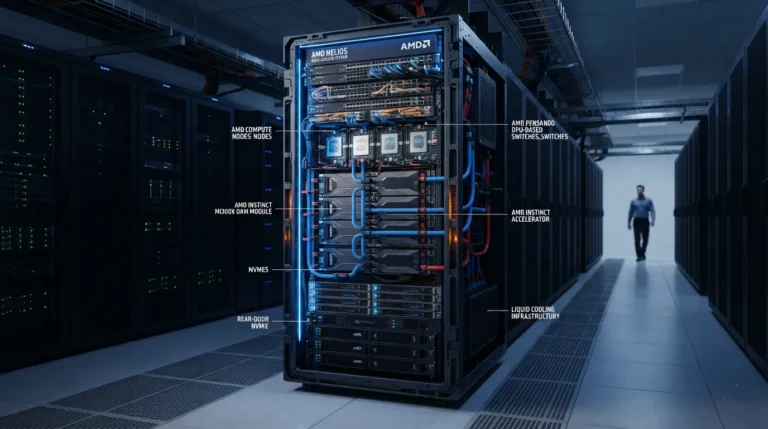
AMD Helios AI Rack: Why AMD Is Moving the AI Race Beyond Individual Chips
AMD Helios is a rack-scale AI infrastructure solution designed for frontier AI workloads, combining AMD GPUs, CPUs, networking, and ROCm software.
Comments (0)