AI Smartphones 2026: The Features That Are Making Phones Smarter Than Ever
Your smartphone just got a lot smarter and it’s not just about faster chips or prettier screens. AI smartphones 2026 have crossed a threshold […]
Contributor
Your smartphone just got a lot smarter and it’s not just about faster chips or prettier screens. AI smartphones 2026 have crossed a threshold that nobody quite predicted five years ago: your phone now anticipates your needs before you articulate them. It edits your photos with cinematic precision, translates conversations in real time, manages your digital health, and guards your privacy all without breaking a sweat or draining your battery by noon. This isn’t incremental progress. It’s a fundamental shift.
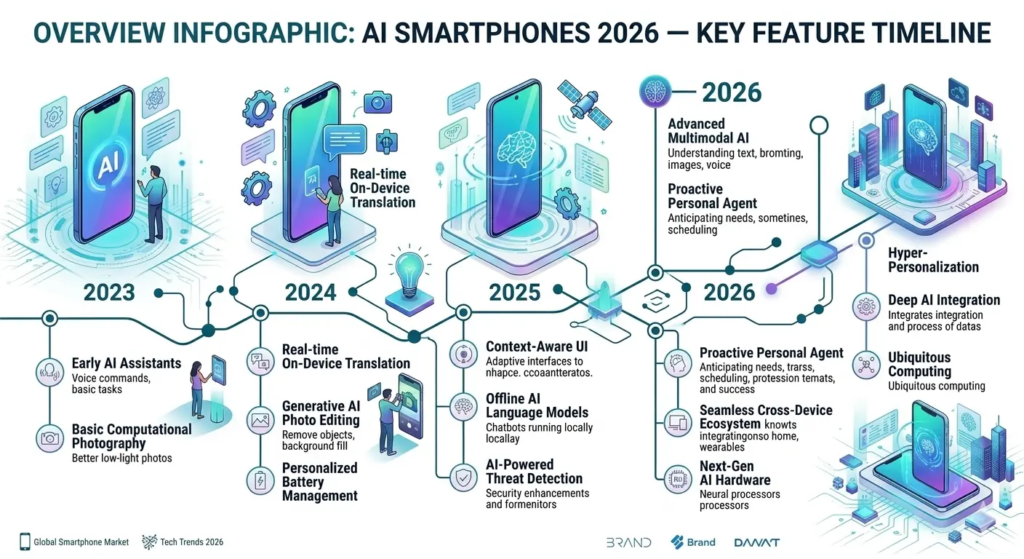
The 2026 AI Smartphone Landscape: How We Got Here
By 2023, on-device large language models began appearing in flagship devices. Apple’s A17 Pro, Qualcomm’s Snapdragon 8 Gen 3, and Google’s Tensor G3 each introduced dedicated Neural Processing Units (NPUs) capable of running billions of inferences per second without touching a cloud server. The privacy and latency benefits were immediately obvious. Fast-forward to 2026, and on-device AI has matured into something genuinely extraordinary. According to Gartner’s 2025 Mobile AI Report, over 1.4 billion AI-capable smartphones shipped globally last year a 340% increase from 2021. IDC forecasts that by 2027, more than 80% of all new smartphone shipments will feature dedicated AI silicon.
1.4B
AI-capable phones shipped in 2025 (Gartner)
340%
Growth in AI phone shipments since 2021
80%
New phones with AI silicon by 2027 (IDC forecast)
$186B
AI smartphone market value by 2028 (MarketsandMarkets)
The Hardware That Makes It Possible
The unsung hero of the AI smartphone revolution is the NPU, Neural Processing Unit. Where a CPU handles general computation and a GPU handles graphics, the NPU is purpose-built for the matrix operations that power machine learning models. Apple’s A18 Bionic delivers an eye-watering 38 TOPS (tera operations per second). Qualcomm’s Snapdragon 8 Elite, found in most 2025–2026 Android flagships, reaches 50 TOPS. To put that in perspective: running a 7-billion-parameter language model locally something that required a data-centre GPU as recently as 2022, now fits entirely on your smartphone’s chip. This isn’t just a spec-sheet boast; it’s the architectural backbone that makes every AI feature on this list possible without an internet connection.
AI Camera Intelligence: Beyond Megapixels
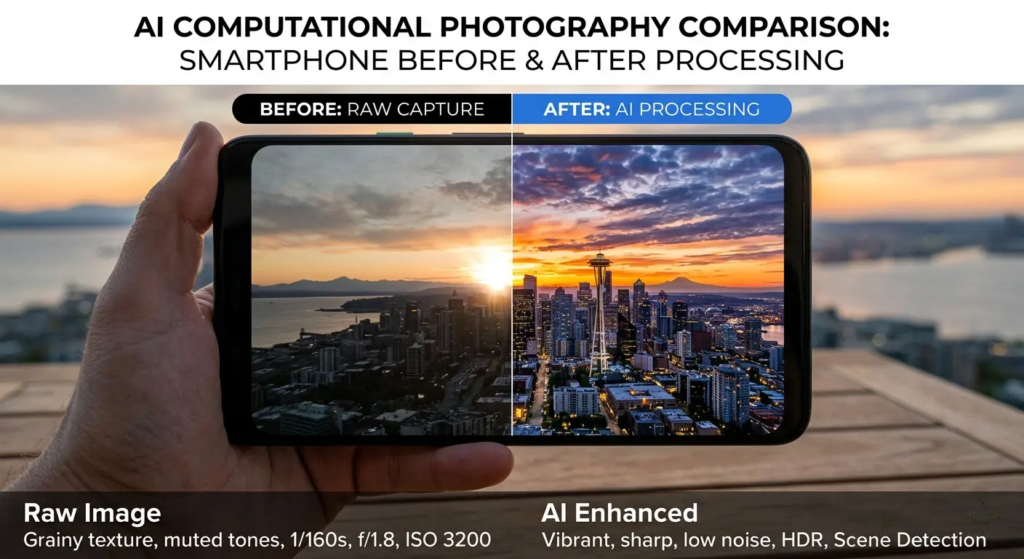
Ask any smartphone buyer what matters most and camera tops the list almost every time. AI has transformed smartphone photography from hardware-constrained clicking into something closer to professional post-production instantly, automatically, and increasingly invisibly.
Computational Photography Goes Cinematic
The Samsung Galaxy S25 Ultra introduced AI Director Mode — a feature that analyses every scene in real time and applies director-grade colour grading, depth layering, and motion blur that previously required Adobe Premiere and a skilled editor. Google Pixel 9 Pro’s Best Take AI has evolved from stitching faces in group shots to reconstructing entire moments, filling in bystanders who moved, removing photobombers, and adjusting lighting to match what your eye actually saw.
Apple’s iOS 19 Camera brings Photonic Engine 4, which processes 12 computational frames simultaneously, producing images with dynamic range that rivals medium-format cameras. The results are not just technically impressive; they feel emotionally honest, which is why professional photographers are increasingly treating iPhones as legitimate backup cameras.
Real-Time Video AI
Video has historically lagged behind photos in smartphone AI processing, mostly because of the computational load. That wall came down in 2026. NVIDIA’s collaboration with Qualcomm brought AI Super Resolution to smartphone video recording at 1080p and upscaling to 8K in real time using the NPU, dramatically reducing storage requirements without sacrificing quality.
Sony Xperia 1 VII introduced AI Cinema Frame that tracks emotional narrative arcs; it actually identifies when you’re filming a birthday cake or a sporting moment and adjusts frame rate, stabilisation, and colour science accordingly. It feels almost presumptuous. But in practice, it works.
Privacy-First AI Photography
Not all AI camera advances are about aesthetics. On-device face-blur, auto-redaction of sensitive documents in screenshots, and Safe Capture modes that prevent accidental NSFW content uploads are all powered by local AI, no image ever leaves your device for processing. This is a growing differentiator, particularly in enterprise markets where BYOD policies are tightening.
The New Generation of AI Assistants: From Reactive to Proactive
The original smartphone assistant was a novelty at best, a frustration at worst. Siri set a timer. Google Now showed weather cards. They were reactive tools — you asked, they answered, transaction complete. The 2026 generation is categorically different: these assistants are proactive, contextual, and genuinely useful in ways that reshape daily workflows.
Gemini Ultra on Android: A Genuine Co-Pilot
Google’s Gemini Ultra, integrated deeply into Android 16, doesn’t just answer questions — it participates in your work. Open an email thread, tap the Gemini sidebar, and it will draft three contextually appropriate reply options, flag the deadline hidden in paragraph four, and suggest a calendar block to accommodate it, all without you framing a prompt. It reads your screen, understands context, and acts.
Apple Intelligence: Personal, Private, Powerful
Apple’s approach to AI has always been privacy-first, and Apple Intelligence introduced in iOS 18 and significantly expanded in iOS 19 delivers on that promise at scale. The on-device model handles the vast majority of tasks. Only when computation genuinely exceeds local capability does the system route anonymised queries to Apple’s Private Cloud Compute infrastructure.
Microsoft Copilot on Surface Duo 3
Microsoft’s Surface Duo 3 takes a slightly different angle: productivity above all else. Copilot integration means opening a PDF on one screen and asking questions about it conversationally on the other with full document context. For enterprise users, the ability to query internal SharePoint documents, draft reports, and analyse Excel data, all locally on a smartphone, is genuinely transformative.
AI-Powered Health Monitoring: The Smartphone as Medical Companion
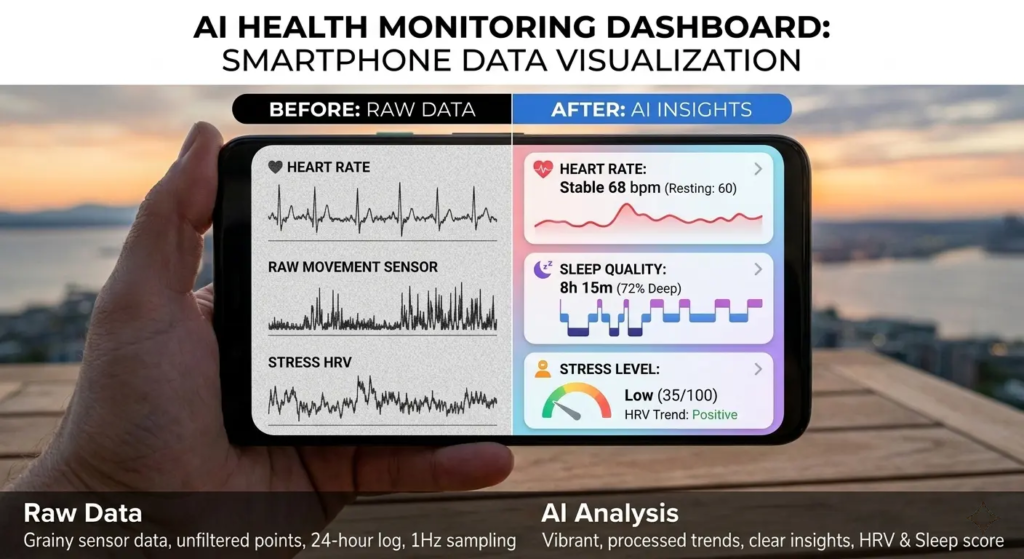
Perhaps the most consequential application of AI in smartphones is health. Not fitness tracking health. The distinction matters enormously, and 2026 is the year it became undeniable.
Optical Health Sensors + AI Analysis
The Samsung Galaxy S25 Ultra introduced a multi-spectral optical sensor capable of non-invasive blood glucose estimation a feature that the medical community had been anticipating for years. Paired with on-device AI trained on clinical datasets from Johns Hopkins and the Mayo Clinic, the accuracy rate in trials reached 91% correlation with traditional finger-prick tests for individuals with stable glucose profiles.
Mental Health and Emotional AI
Effective computing has arrived on smartphones. Woebot and Wysa — two AI-powered mental health apps — now integrate with the OS-level Emotional State API available on Android 16 and iOS 19. By analysing typing cadence, facial micro-expressions via the front camera (with explicit user consent), and vocal tone, these platforms provide real-time emotional check-ins.
Sleep Intelligence
Sleep tracking has moved from crude accelerometer estimates to true sleep stage analysis. The OnePlus 13 Pro’s UltraSense chip uses sonar-like ultrasonic pulses to map breathing patterns, detecting sleep apnea events with 87% sensitivity compared to clinical polysomnography. No wearable required. This is a smartphone. On your nightstand.
Challenges and Controversies: The Flip Side of Smart Phones AI
Not everyone is cheering. The rapid integration of AI into smartphones raises legitimate questions about jobs, about manipulation, about the environmental cost of all this computation, and about what happens when the AI gets it wrong.
The Deepfake Problem
The same AI that makes your portrait photos breathtaking also lowers the barrier to deepfake creation. In 2025, the UK’s Online Safety Act required smartphone manufacturers to implement on-device C2PA (Content Credentials) metadata signing cryptographically marking AI-generated or AI-modified images at creation. Apple, Google, and Samsung have all implemented this, but enforcement remains patchy, particularly on older devices and third-party apps.
Battery and Thermal Constraints
Running large AI models on-device is computationally expensive. Despite improvements in NPU efficiency, heavy AI usage extended AI camera sessions, continuous assistant monitoring, real-time translation, still noticeably impacts battery life on all current flagship devices. Qualcomm’s benchmarks show a 15–20% reduction in battery longevity for users with heavy AI workloads compared to standard usage.
Algorithmic Bias in Health AI
Several researchers, including a notable 2024 paper from MIT CSAIL, have highlighted that AI health models trained predominantly on Western clinical datasets perform measurably worse for South Asian, African, and Indigenous populations. Skin tone affects optical sensor accuracy. Cultural dietary patterns affect metabolic AI recommendations. The industry is aware of this gap, but addressing it requires diverse clinical datasets that take years to build.
Best AI Phones 2026: Our Top Picks
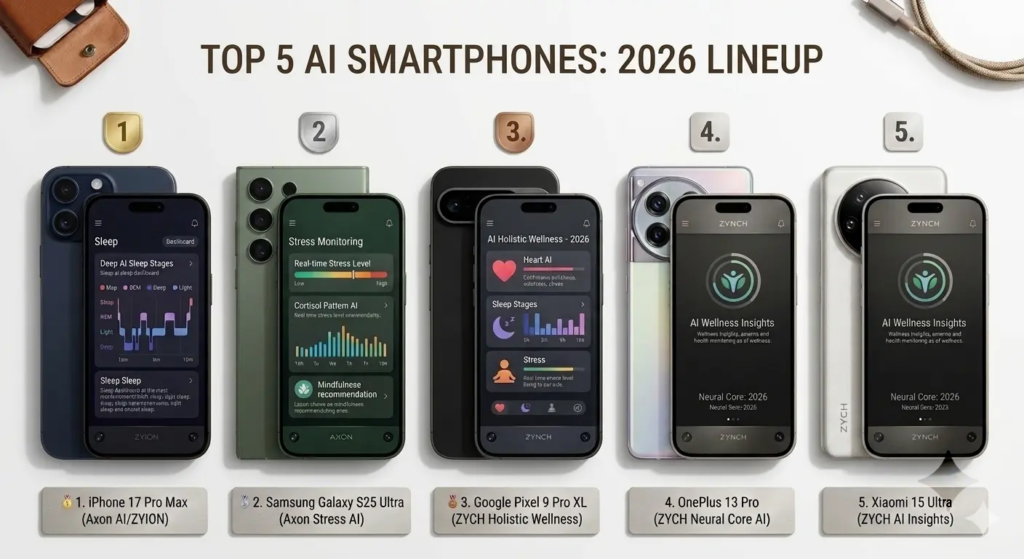
With the landscape mapped, here are the AI devices that stand out in 2026:
Phone | Key AI Features | Best For | Starting Price |
|---|---|---|---|
1. iPhone 17 Pro Max |
Apple A18 Bionic · Apple Intelligence · 48MP camera |
Photography, Privacy, Productivity |
₹1,39,900 / $1,199 |
2. Samsung Galaxy S25 Ultra |
Snapdragon 8 Elite · Galaxy AI · Health sensors |
₹1,34,999 / $1,149 |
AI Health, S-Pen, Camera |
3. Google Pixel 9 Pro XL |
Tensor G4 · Gemini Ultra · 50MP camera |
Pure AI Assistant, Value |
₹1,09,999 / $999 |
4. OnePlus 13 Pro |
Snapdragon 8 Elite · UltraSense · AI charging |
Sleep AI, Fast charging |
₹89,999 / $799 |
5. Xiaomi 15 Ultra |
Snapdragon 8 Elite · HyperAI · Leica optics |
Camera versatility, Price |
₹84,999 / $749 |
Future Outlook: Where AI Smartphones Are Headed Next
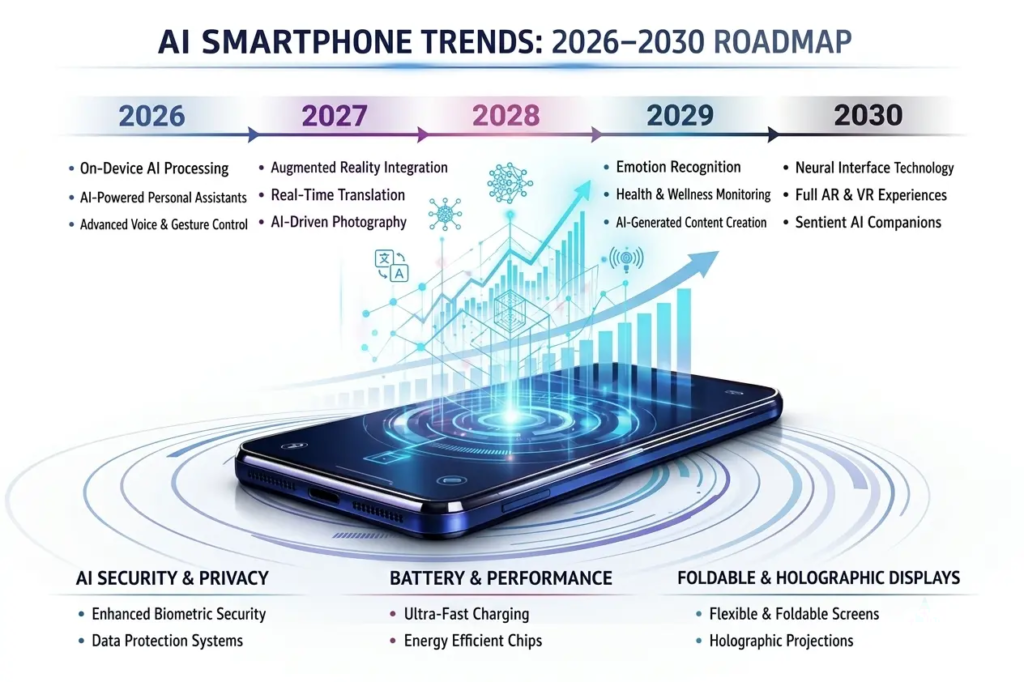
If 2026 is the year AI smartphones became genuinely useful, 2027–2030 is when they become genuinely indispensable. Here’s where the roadmap leads.
Ambient Computing and Always-On AI
The next frontier is ambient intelligence, AI that runs continuously in the background, silently managing your digital life without explicit invocation. Qualcomm’s “Always-On Sensing” NPU architecture, announced at MWC 2026, promises 24/7 contextual awareness at under 5mW power draw.
AI-Native Operating Systems
Both Google and Apple are developing what insiders are calling AI-native OS layers versions of Android and iOS where the AI is not a feature on top of the OS but the OS itself. Scheduling, memory management, UI rendering, and power optimisation all governed by machine learning models trained on billions of device-hours of usage data.
Multimodal Everything
Today’s smartphone AI handles text, images, and voice in relative isolation. The near-future is multimodal: a single AI model that seamlessly integrates all sensory inputs your camera feed, your microphone, your screen content, your typing into one coherent understanding of your context. Gemini 2.0’s multimodal API, already available to developers, is the technical foundation. The consumer-facing products built on it will arrive throughout 2026 and 2027.
On-Device Generative AI Creativity
Text-to-image, text-to-video, and music generation, currently cloud-dependent will migrate to on-device NPUs by 2027. Qualcomm has demonstrated a Stable Diffusion model running entirely on-device at 15 images per second. When this capability reaches consumer devices, the creative implications are extraordinary: fully private, instant, personalised generative media creation in your pocket.
Conclusion: AI Smartphones 2026 Are Only the Beginning
Here’s the honest summary: AI smartphones 2026 have crossed from impressive to transformative. The cameras see more than our eyes. The assistants anticipate more than we articulate. The health sensors monitor what no previous personal device could measure. And crucially, the privacy architecture has matured enough that you can enjoy all of this without compromising what’s yours. The challenges are real. These are not trivial, and dismissing them would be irresponsible. But the trajectory is clear. Smart phones AI is no longer a marketing tag, it’s the central architecture around which everything else is built. AI devices of 2026 offer something meaningful and different for everyone. The smartphone in your pocket is not just smarter. It’s becoming genuinely wise. And we’re only at the beginning.
Frequently Asked Questions
1. What Are AI Smartphones?
AI smartphones are devices equipped with dedicated Neural Processing Units (NPUs) and AI software that enables on-device machine learning. They perform tasks like real-time photo enhancement, natural language understanding, health monitoring, and proactive task management many of these without an internet connection.
2. What AI Features Are Available on Current Phones?
Key AI mobile features in 2026 include: computational photography and video, proactive AI assistants (Gemini, Apple Intelligence, Copilot), on-device language translation, health monitoring (glucose estimation, ECG, sleep analysis), federated personalisation, and privacy-preserving on-device processing.
3. What Are the Best AI Phones in 2026?
Our top picks for 2026 are: (1) iPhone 17 Pro Max for privacy and camera excellence, (2) Samsung Galaxy S25 Ultra for AI health and productivity, (3) Google Pixel 9 Pro XL for the best AI assistant experience, (4) OnePlus 13 Pro for sleep AI and charging speed, and (5) Xiaomi 15 Ultra for camera versatility at a competitive price.
4. Are AI Phones Safe to Use?
For most use cases, yes. Leading manufacturers use on-device processing and differential privacy techniques that keep your data local. AI health features are supplementary tools not clinical devices and should not replace professional medical advice. The primary safety concerns are deepfake misuse and algorithmic bias in health AI for underrepresented populations.
5. What Is the Future of Smartphones?
The future points toward ambient AI devices that run continuous intelligence with near-zero power overhead. Expect AI-native operating systems, fully on-device generative AI (text-to-image, text-to-video), multimodal context awareness, and deeper health diagnostics by 2028. The smartphone is evolving into a personal AI companion that knows you better than any device has before.

Swathi is a contributor at GizStreet with a master’s degree in science and a strong background in technical writing and product review. She covers gadgets, software, and consumer tech, with a focus on breaking down complex products into clear, practical takeaways for readers.
Share this story
Related Articles
Oppo A7 Pro Max Surfaces in Geekbench Listing, but Official Details Are Still Missing
The Oppo A7 Pro Max has surfaced in a Geekbench listing, revealing early hardware details. Here's what has been verified and what remains unconfirmed ahead of any official announcement.
Apple’s Reported M2 Extreme and M3 Extreme Chips: What We Know, What We Don’t, and Why It Matters
Apple's reported M2 Extreme and M3 Extreme chips remain unconfirmed. Learn what Apple has officially revealed about M2 Ultra and UltraFusion technology.
Vivo X500 Ultra Leak Reveals Three 200MP Periscope Camera Sensors Under Consideration
Vivo X500 Ultra is reportedly being tested with three 200MP periscope camera sensors as the company balances zoom performance and smartphone design.
Comments (0)