Samsung Galaxy Glasses Design Leak: First Look at Samsung’s XR Wearables
The wearable tech world is buzzing as the Samsung Galaxy Glasses leak finally pulls back the curtain on the tech giant’s first serious foray […]
Contributor
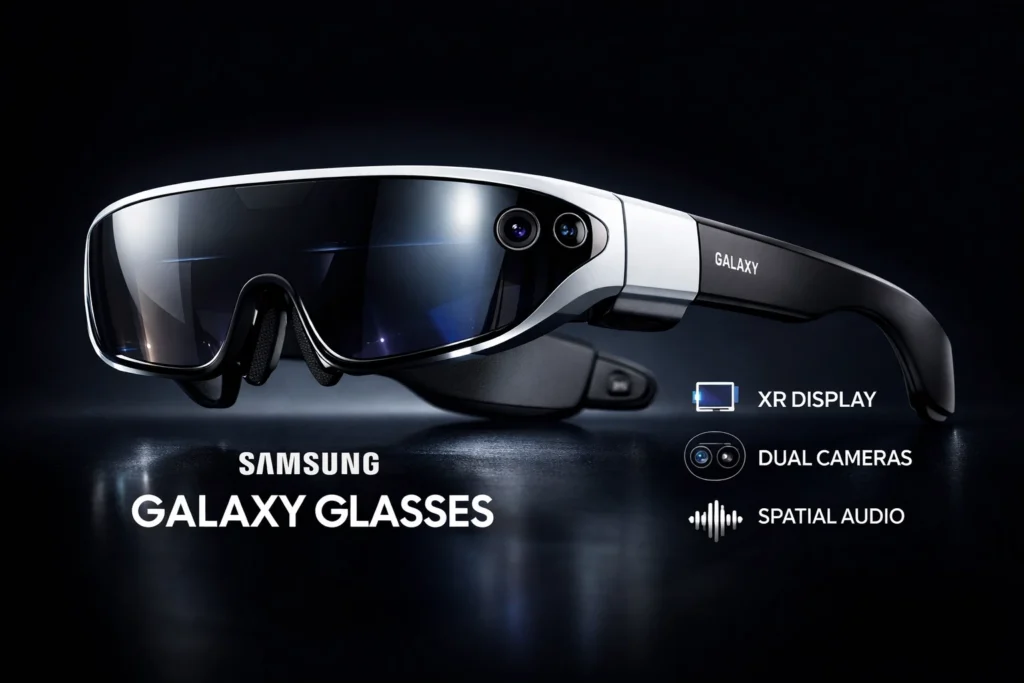
The wearable tech world is buzzing as the Samsung Galaxy Glasses leak finally pulls back the curtain on the tech giant’s first serious foray into smart eyewear. For years, readers have watched from the sidelines as Meta and Ray-Ban dominated the “smart frames” market, but Samsung is no longer content to wait. Collaborating with heavy hitters like Google and Qualcomm, Samsung is reportedly preparing a lightweight, AI-driven wearable codenamed “Jinju” that aims to redefine daily interactions. This isn’t just another gadget; it’s the cornerstone of the new Android XR ecosystem. Whether a die-hard Galaxy fan or a curious tech enthusiast, these glasses represent a pivotal shift toward ambient computing where AI, specifically Google Gemini, is always at eye level, ready to assist without ever reaching for a phone.
Key Design Observations from the Leak
- Thin titanium-alloy frame with reinforced hinges
- Subtle front-facing camera module embedded in the right temple arm
- Micro-projector lens housing in each lens corner (waveguide display)
- USB-C / magnetic charging port hidden in the left arm
- Two discrete open-ear speaker grilles along the temple
- Weight estimated at 45–55 grams — close to standard eyewear
What’s striking is how understated everything looks. Unlike the Meta Quest 3 or even the Apple Vision Pro, these are designed to be worn all day, in public, without looking like you’ve strapped a computer to your head. That’s a significant design philosophy shift, and it signals Samsung’s intent to go after the lifestyle/fashion market, not just the tech-early-adopter crowd. With global AR glasses shipments projected to hit 10 million units by 2027 (Statista), Samsung’s entry signals a pivotal shift toward ambient computing—where AI is always at eye level, ready to assist without ever reaching for a phone.
Are the Samsung Galaxy Glasses Standalone or Phone-Dependent?
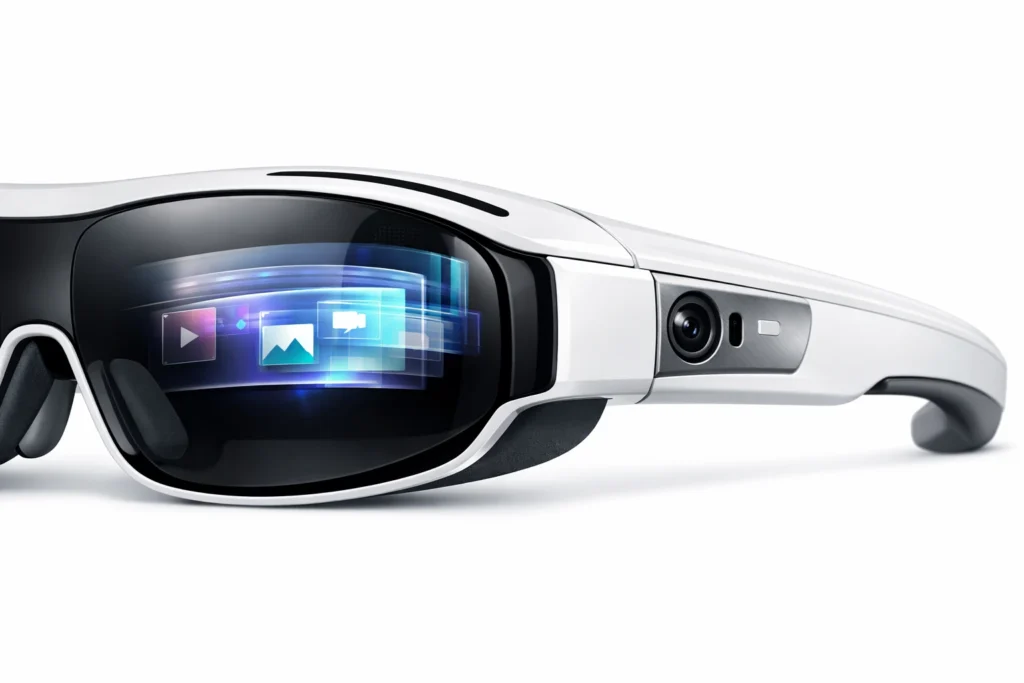
Based on current leaks and patent filings, Samsung Galaxy Glasses are expected to support a hybrid operational model, meaning they can function standalone for core AR tasks but also tether to a Galaxy smartphone for heavier processing workloads. This positions them uniquely between fully tethered devices like the current Ray-Ban glasses and fully independent headsets like the Meta Quest 3.
Hybrid Architecture: The Best of Both Worlds?
Leaked documentation referencing Samsung’s ‘Galaxy XR Link’ protocol suggests the glasses will communicate with Galaxy phones via Ultra-Wideband (UWB) and Wi-Fi 6E. When paired, the phone handles AI processing, navigation rendering, and real-time language translation, tasks that would otherwise drain a small battery fast.
In standalone mode, the glasses are expected to handle:
- Basic notification display and call management
- Real-time clock, weather, and fitness data overlays
- Voice command processing via on-device Bixby
- Music and podcast playback through Bluetooth
When tethered to a Galaxy S25 Ultra or Galaxy Z Fold 7, the system could unlock:
- Live AR navigation with turn-by-turn overlays
- Real-time object recognition and AI-powered search
- Video calling with AR spatial presence
- Samsung DeX integration for desktop projection
This hybrid approach is smart, pragmatic engineering. Keeping the glasses light and independent for everyday use while enabling phone-boosted power for demanding scenarios is exactly the kind of flexible architecture that could win over mainstream consumers who don’t want to carry a separate compute puck everywhere they go.
Samsung Galaxy Glasses vs. Meta Ray-Ban: Features and AR Capabilities
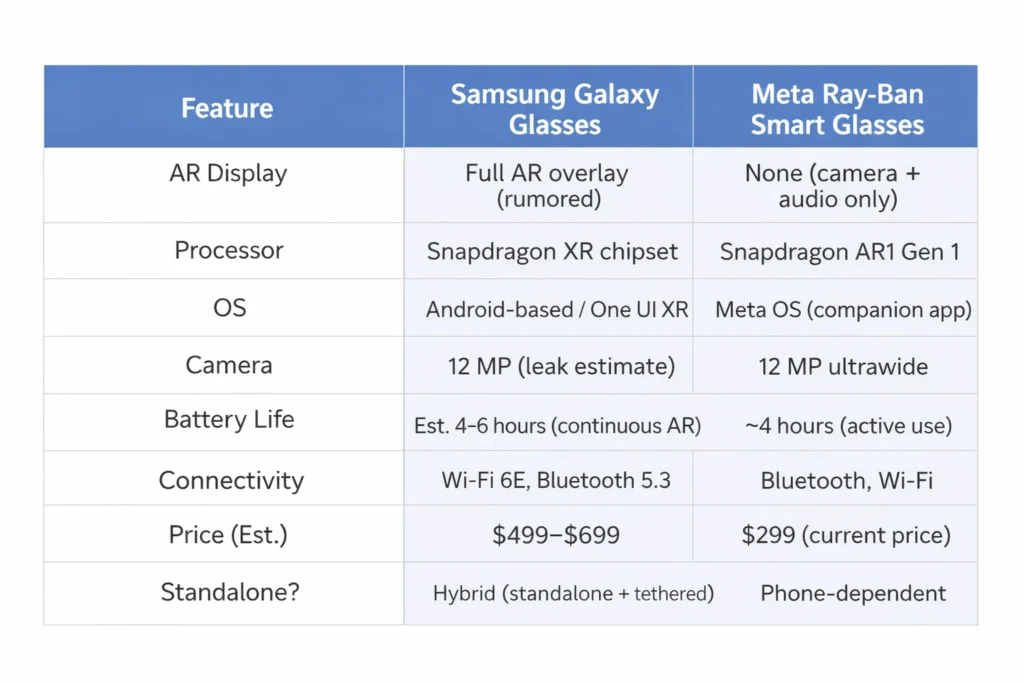
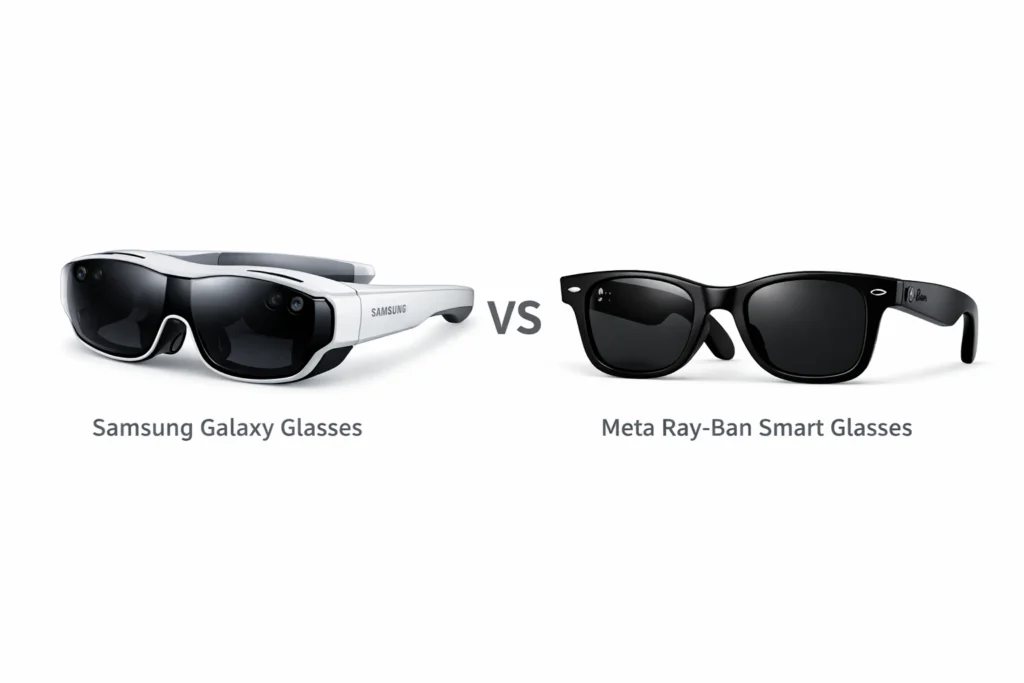
The primary difference between the Samsung Galaxy Glasses and Meta Ray-Ban is the software ecosystem, with Samsung leveraging Google Gemini for deeper contextual AI tasks. While both devices currently lack a traditional visual display in their base models, Samsung’s integration with Android XR promises a more seamless experience for users already embedded in the Google/Samsung ecosystem. Here’s a direct comparison based on leaked specs and current confirmed features:
The Critical Difference: The AR Display
This is where Samsung potentially laps the competition. Meta’s Ray-Ban glasses are, at their core, a camera and speaker system with AI integration, there is no display. Samsung Galaxy Glasses, by contrast, are rumored to include a waveguide-based AR projection system, likely using MicroLED microdisplays, that overlays digital information directly into the wearer’s field of view. That’s not just a spec bump. That’s a fundamentally different product category. A real AR overlay transforms these from ‘smart audio glasses with a camera’ into actual augmented reality eyewear. If Samsung delivers this at a consumer price point, it changes the conversation entirely.
What We Know About the Samsung XR Glasses Third-Pair Rumors
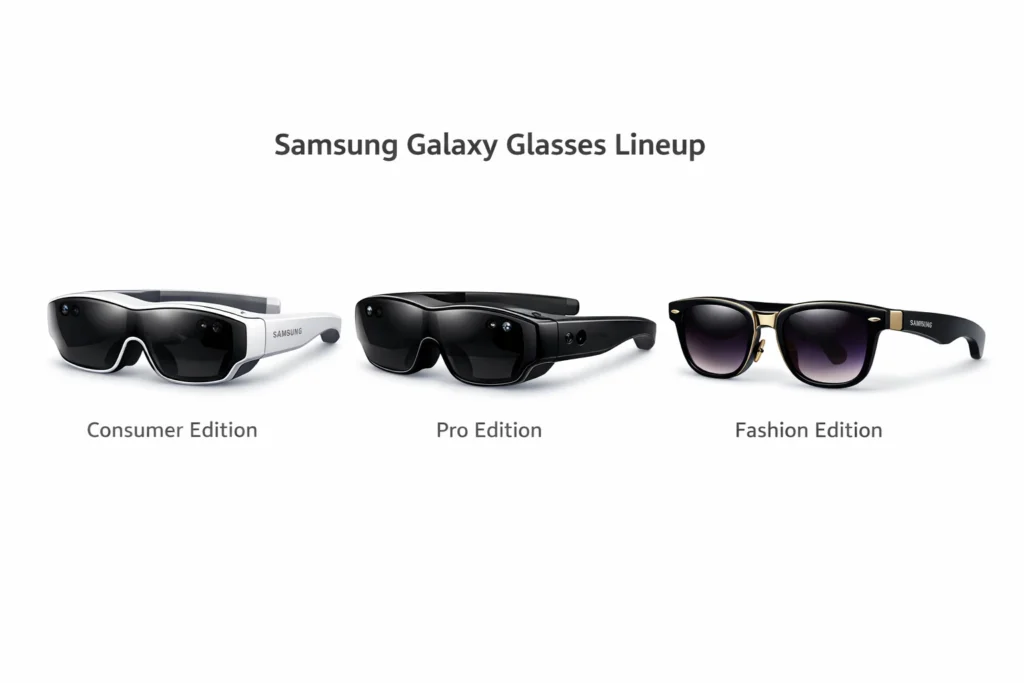
Rumors suggest Samsung is working on a tiered roadmap that includes at least two distinct models: a display less AI pair and a high-end AR version with Micro-LED optics. The “third-pair” whispers often refer to a potential mid-tier prototype or a specialized collaboration with luxury eyewear brands like Gentle Monster and Warby Parker to ensure the tech looks like high-fashion, not a science project.
- Model 1 (Jinju): Display less, focused on audio AI and photo/video capture (Expected late 2025/early 2026).
- Model 2 (Haean): High-end glasses with a built-in display for HUD-style notifications (Rumored for 2027).
- The “Pro” Prototype: A potential developer-focused version designed to seed the Android XR app store before the consumer launch.
Industry whispers suggest collaborations with Gentle Monster and Warby Parker, ensuring the glasses look like high fashion eyewear rather than science projects.
Expected Battery Life and Charging Methods for Samsung Smart Glasses
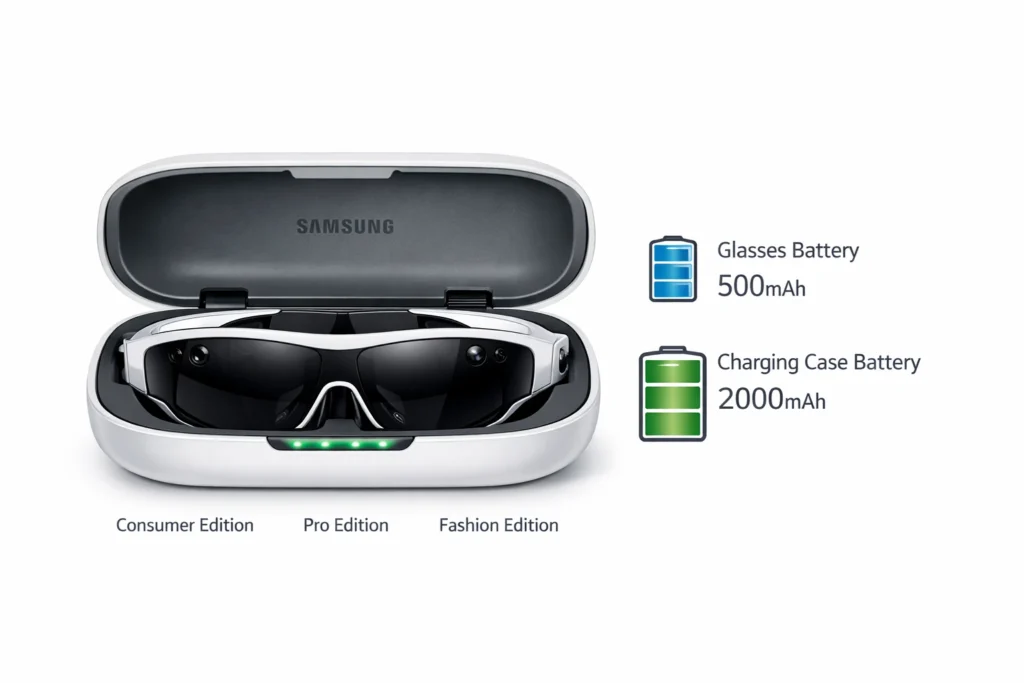
The Samsung Galaxy Glasses are expected to feature a 155mAh battery, providing roughly 2 to 3 hours of active use on a single charge. Much like the Meta Ray-Bans, these glasses will rely on a charging case to provide multi-day power for casual use. Because the glasses lack a power-hungry screen, the 155mAh cell is optimized for “burst” activities like taking photos, asking Gemini for directions, or quick audio translations.
Smart Power Management: Samsung's Key Innovation
Samsung’s XR team has reportedly been working on an adaptive power mode system that automatically scales AR display brightness and processing load based on ambient light and context. Indoors with dim lighting? The AR overlay dims and the processor throttles. Outdoors in bright sun? Full brightness, full processing and the battery drains faster. This adaptive approach is critical. Meta’s Ray-Ban glasses achieve roughly 4 hours of active use with a camera that’s mostly idle. Samsung’s always-on AR display is far more power-hungry. Getting to 4–6 hours with AR active would be a genuine engineering achievement.
- Magnetic charging case: estimated 3–4 full charges
- Full charge time: ~45 minutes (fast charging via USB-C in case)
- Standby time: estimated 48–72 hours with AR display off
- Wireless charging case variant: rumored for a premium SKU
Will Samsung Galaxy Glasses Launch at the Next Unpacked?
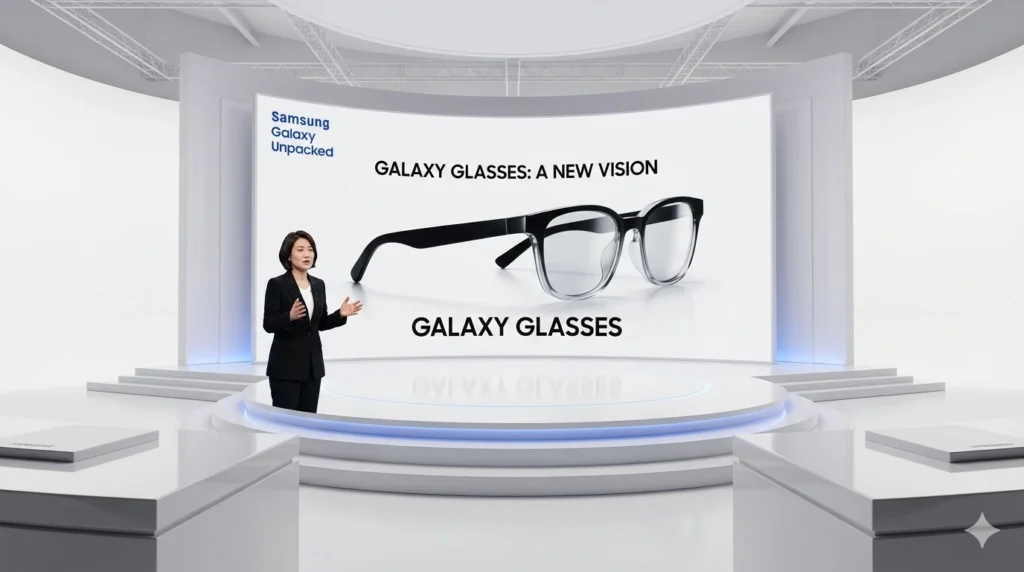
While a full retail launch is likely slated for early 2026, Samsung is expected to tease the Galaxy Glasses at the upcoming Summer Unpacked event in July. Industry insiders suggest that Samsung may follow the “Galaxy Ring” playbook: show a silhouette or a brief teaser in July to build hype, followed by a formal launch alongside the Galaxy S26 series in early 2026. Recent Q4 earnings calls have confirmed that “next-generation AR glasses” are firmly on the official roadmap, signalling that the wait is nearly over.
The Evidence Stack
Several data points align to support a late-2025 announcement:
- Component orders: Korean supply chain sources (The Elec, December 2024) confirmed mass production test runs for MicroLED microdisplay panels matching Samsung’s XR specs began in Q1 2025.
- FCC filing: A Samsung device labeled ‘SM-R990’ with XR-class radio frequency certifications was spotted in an FCC database entry in March 2025 — consistent with pre-launch regulatory clearance timelines.
- Samsung’s own words: At MWC 2025, Samsung’s MX head TM Roh stated that ‘Galaxy XR experiences will expand beyond the headset form factor this year’ — widely interpreted as a glasses reference.
- Google partnership: Samsung confirmed an ongoing collaboration with Google on Android XR, the OS underpinning Galaxy XR devices. Android XR has been specifically engineered for lightweight form factors, not just headsets.
Analyst consensus: IDC predicts the global smart glasses market will reach $10.4 billion by 2027, with Samsung positioned as a top-3 player if it ships a product this year.
What to Expect at Unpacked
If the glasses do debut at Unpacked, Samsung will likely position them as the centrepiece of a broader Galaxy XR ecosystem announcement, linking them to the Galaxy AI suite, Bixby’s new multimodal capabilities, Google Gemini integration, and Samsung Health for real-time biometric overlays. Pricing is the wildcard. Samsung needs to undercut or match Meta’s Ray-Ban price while justifying premium AR hardware. Our best estimate based on component costs and Samsung’s historical margin structure: $499 at launch, with a Pro variant at $699.
Conclusion: Samsung Galaxy Glasses Are the XR Wearable to Watch in 2026
The Samsung Galaxy Glasses design leak has confirmed what many suspected: Samsung is building something genuinely ambitious in the AR wearable space. With a sleek titanium-alloy frame, a rumored full AR waveguide display, hybrid standalone-and-tethered architecture, and a charging ecosystem that mirrors premium audio products, the Galaxy Glasses are shaping up to be the most compelling consumer AR glasses announced yet. They’re not here yet. Leaks are leaks, and the gap between prototype and polished consumer product is wide. But the convergence of supply chain evidence, FCC filings, executive statements, and design credibility suggests Samsung is much closer to launch than at any previous point in their XR journey. Whether they debut at Galaxy Unpacked in early 2026, Samsung Galaxy Glasses represent a pivotal moment for augmented reality.
FAQs
1. Are the Samsung Galaxy Glasses real?
Leaked images have confirmed that Samsung is testing smart XR glasses that look like traditional sunglasses.
2. What can Samsung Galaxy Glasses do?
They are expected to feature AI object recognition, navigation, and seamless integration with Galaxy phones.
3. How are they different from Ray-Ban Meta?
Samsung’s version is rumored to include actual AR displays inside the lenses, not just cameras and speakers.
4. When will Samsung Galaxy Glasses launch?
An official announcement is expected at the Summer 2026 Unpacked event.
5. Do the Galaxy Glasses have a camera?
Yes, they feature small cameras for AI processing and “Circle to Search” functionality.
6. Will Samsung Galaxy Glasses work with iPhone?
Like most Galaxy wearables, they are expected to be optimized specifically for the Android and Galaxy ecosystem.

Swathi is a contributor at GizStreet with a master’s degree in science and a strong background in technical writing and product review. She covers gadgets, software, and consumer tech, with a focus on breaking down complex products into clear, practical takeaways for readers.
Share this story
Related Articles
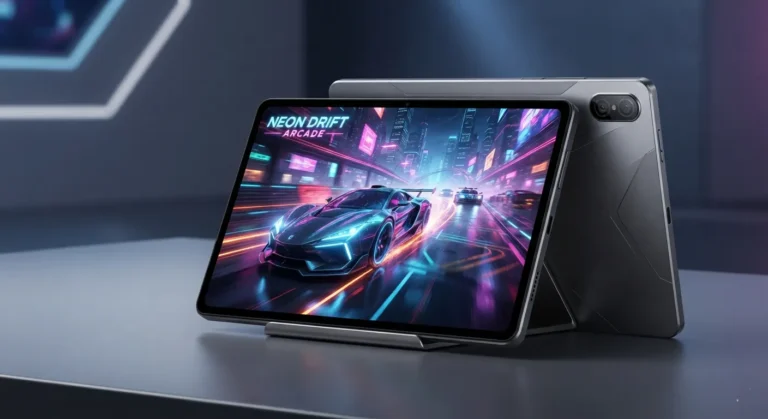
Lenovo Legion Y700 AI Officially Teased With 165Hz OLED Display Ahead of China Launch
Lenovo has revealed key specifications for the Legion Y700 AI, confirming an 8.4-inch 165Hz OLED display, Dolby Vision, 5G connectivity, and an August China launch.
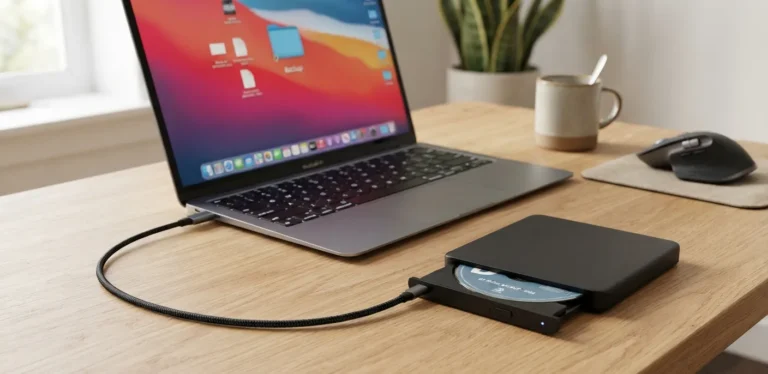
The Amicool BT686 External DVD Drive Shows Why Optical Media Still Has a Place in the USB-C Era
The Amicool BT686 external DVD drive restores CD and DVD functionality to modern laptops with USB-C support, plug-and-play operation and broad operating system compatibility.
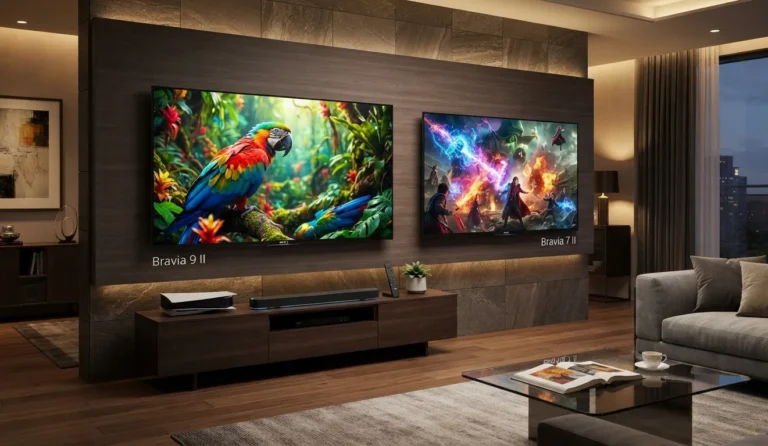
Sony Bravia 9 II and Bravia 7 II Arrive in India: Sony Pushes Premium LED TVs Forward With True RGB Technology
Sony has launched the Bravia 9 II and Bravia 7 II in India with True RGB LED technology, Google TV, Cognitive Processor XR and premium home theatre features.
Comments (0)