Xbox Project Helix Price Hikes: How the Memory Shortage Affects Next-Gen
Something is quietly driving up the price of your next Xbox and it has nothing to do with Microsoft’s game strategy. The Xbox Project […]
Contributor
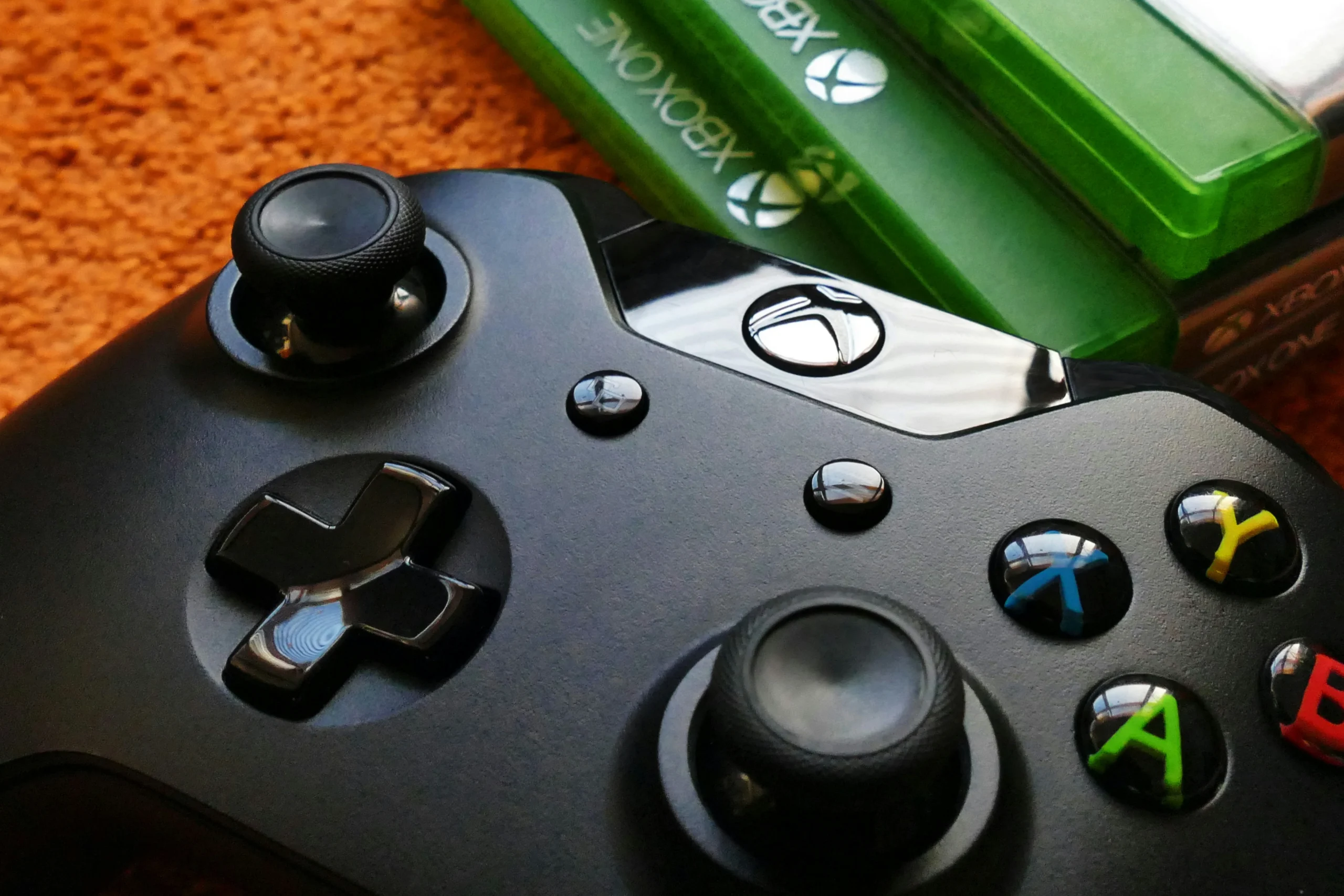
Something is quietly driving up the price of your next Xbox and it has nothing to do with Microsoft’s game strategy. The Xbox Project Helix pricing crisis is real, it’s accelerating, and it could reshape how you budget for next-gen gaming in 2026 and beyond. With reports of a $1,200 launch price circulating online, consumers and analysts alike are scrambling for answers. The culprit? A global memory shortage that’s squeezing chip suppliers, inflating RAM costs, and forcing console makers into impossible trade-offs. This isn’t a rumor or speculative click-bait. Industry data, supply chain reports, and semiconductor market forecasts all point to the same uncomfortable conclusion: the next Xbox won’t be cheap. Here’s everything you need to know.
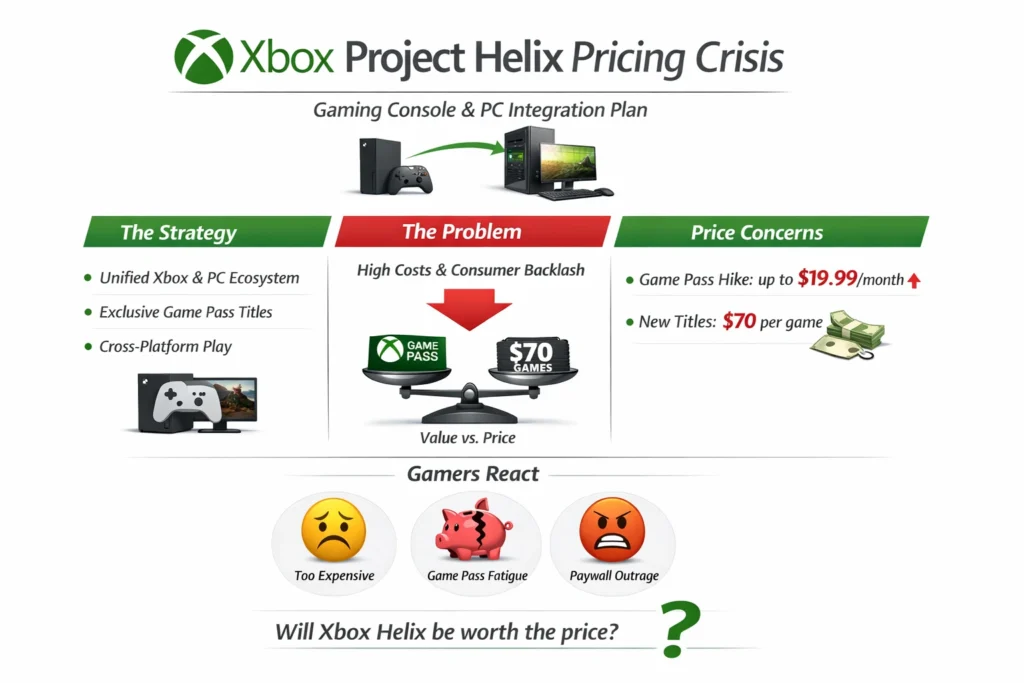
Why Are RAM and Memory Costs Rising in 2026?
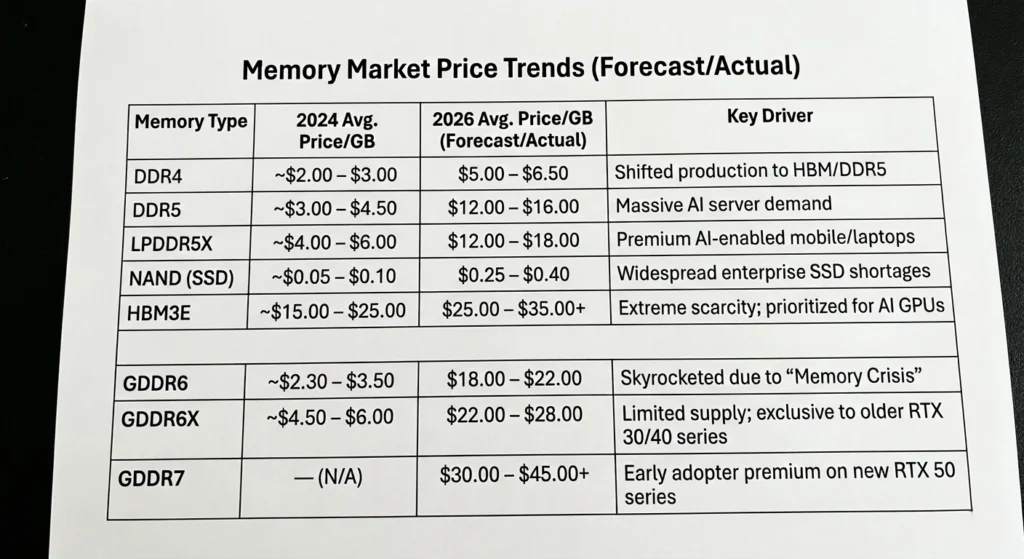
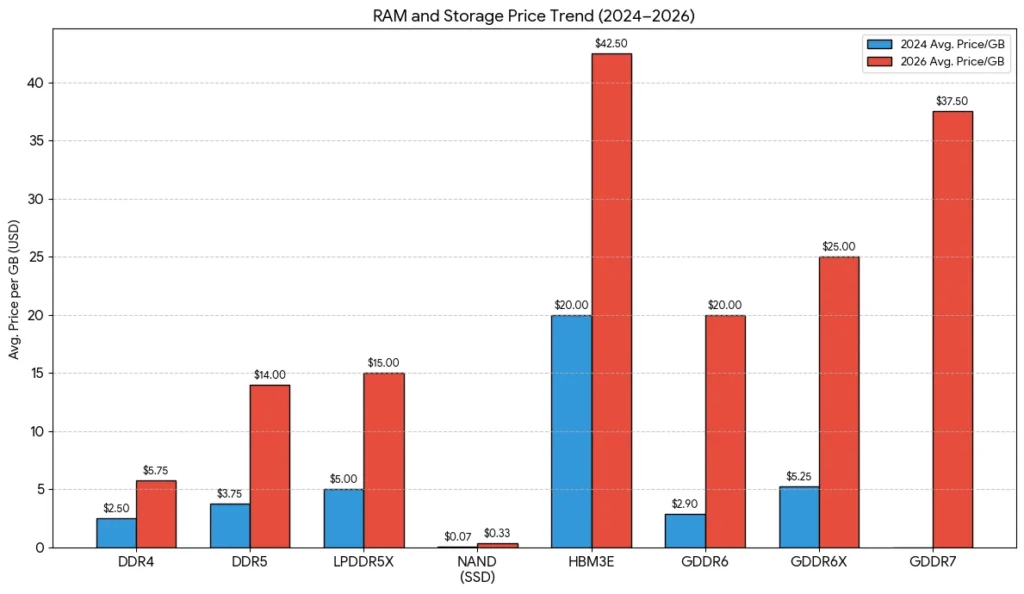
RAM and memory costs are rising in 2026 due to a convergence of AI-driven demand, constrained NAND/DRAM manufacturing capacity, and geopolitical disruptions in key chip-producing regions. It’s not a single cause; it’s a perfect storm. The AI boom is the biggest accelerant. Data centers consuming high-bandwidth memory (HBM) for large language models have soaked up foundry capacity that would otherwise feed consumer electronics. According to a 2025 Gartner forecast, global memory chip revenue surged 58% year-over-year to $167 billion, with AI workloads responsible for nearly 40% of HBM allocations. When hyperscalers like Microsoft Azure, Google Cloud, and AWS are bidding premium prices for the same DRAM substrates, the console supply chain gets squeezed.
Geopolitical Pressures on DRAM Production
Taiwan Semiconductor Manufacturing Company (TSMC) and South Korea’s Samsung and SK Hynix collectively control over 90% of global DRAM capacity. US-China trade restrictions introduced in late 2024 further limited Chinese foundry participation, reducing competitive supply options. Add to that the lingering effects of post-pandemic logistics disruptions, and you have a recipe for sustained scarcity.
What the Numbers Actually Say
A DRAMeXchange report from Q1 2026 noted LPDDR5X (Low-Power Double Data Rate 5X) spot prices had risen approximately 22% since mid-2025. For a console like Project Helix — rumored to pack 24GB or more of GDDR7 RAM, this translates directly to a higher bill-of-materials (BOM) cost. Analysts at IDC estimate a 24GB GDDR7 memory configuration could alone add $80–$120 to manufacturing costs compared to the Xbox Series X’s original memory setup.
Will the Xbox Project Helix Really Cost $1,200?
Yes, based on current supply chain data and analyst projections, a $1,200 launch price for the base Xbox Project Helix model is a credible, if worst-case, scenario. Multiple industry leakers and semiconductor analysts have pointed to a BOM that leaves Microsoft with a difficult choice: absorb losses at launch or pass costs to consumers. Microsoft has historically been willing to sell consoles near or below cost, recouping revenue through Game Pass subscriptions and software. But the math is harder this time around.
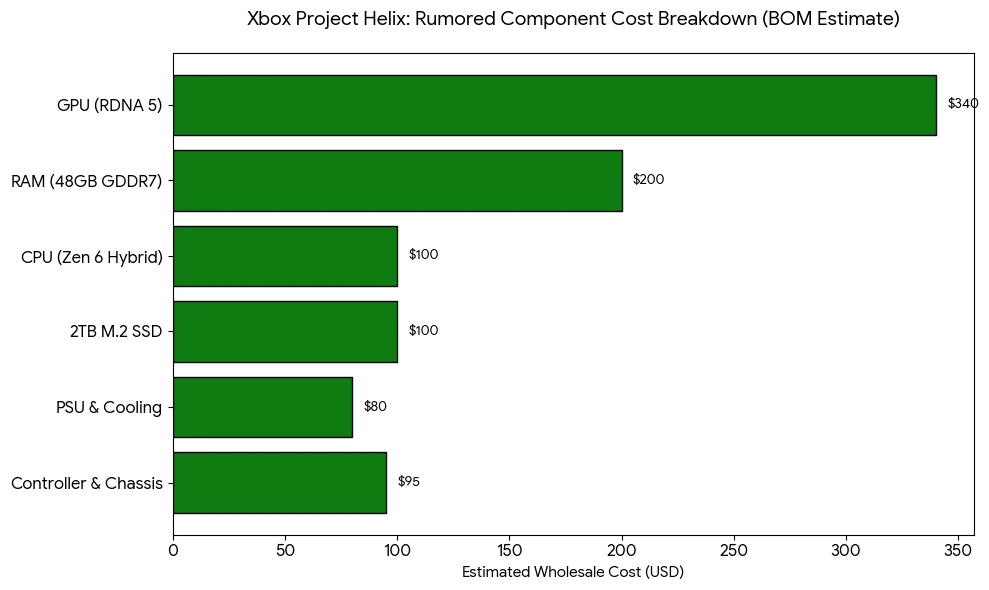
Breaking Down the Rumored $1,200 Price Tag
- Custom AMD APU (Zen 5 + RDNA 4 architecture): Estimated $150–$180
- 24GB GDDR7 memory at 2026 spot prices: Estimated $200–$220
- 2TB NVMe SSD (PCIe 5.0): Estimated $60–$80
- Cooling, chassis, power supply, IO hardware: Estimated $80–$100
- Wi-Fi 7, Bluetooth 5.4, HDMI 2.1 certification: Estimated $20–$30
- Manufacturing, assembly, QA, logistics: Estimated $120–$150
- Retailer margin (approx. 15%): ~$100–$120
Total estimated BOM (Bill of Materials) + margin at retail: $730–$880 (optimistic) to $1,050–$1,200 (pessimistic). Given that neither Sony nor Microsoft has shown willingness to launch at a steep loss this generation, a $999–$1,199 MSRP window is not far-fetched.
Brad Sams of Sams & Friends, who has an established track record of accurate Xbox leaks, suggested in early 2026 that Microsoft’s internal pricing discussions were targeting a $599 entry-level SKU with a premium “Helix Elite” variant exceeding $999. That’s still unprecedented territory for a mainstream console.
How Memory Availability Impacts Xbox Project Helix Release Dates
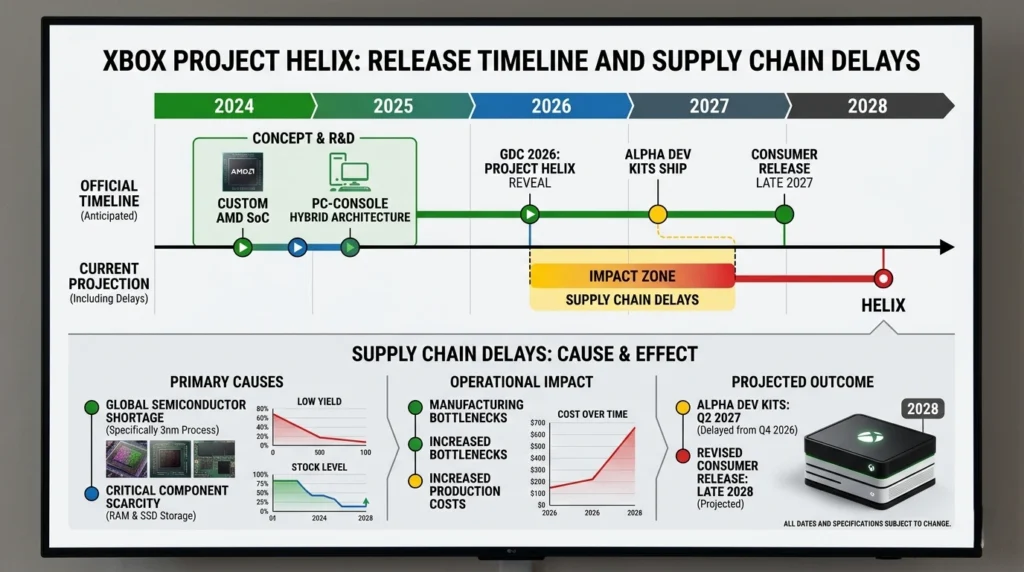
Memory availability is directly threatening Xbox Project Helix’s release window, potentially pushing the launch from Holiday 2026 to Q1 or Q2 2027. Console manufacturers must secure supply commitments 12–18 months before launch, and with GDDR7 allocations already heavily committed to GPU partners like NVIDIA and AMD’s desktop product lines, Microsoft’s manufacturing ramp faces real constraints.
The Allocation War
GDDR7 is produced primarily by Samsung, SK Hynix, and Micron. Nvidia’s GeForce RTX 50-series GPUs, AMD’s RX 9000 series, and enterprise AI accelerators have all locked in significant allocations through mid-2026. Console manufacturers entering the queue late, as Microsoft reportedly did when Helix specs were finalized, face either delayed supply or a premium pricing arrangement.
Bloomberg reported in late 2025 that Samsung had turned away several non-priority memory requests citing capacity constraints. Microsoft’s Project Helix team, according to two sources cited by The Verge, renegotiated their GDDR7 supply agreement at least once, accepting a smaller initial allocation in exchange for a modest BOM discount.
What a Delayed Launch Means for Xbox
A Holiday 2026 delay would hand Sony a critical window. If the PlayStation 6 launches on schedule, Sony has not officially announced a date but developer kits reportedly began wide distribution in late 2024, Microsoft could find itself in the same position it occupied with the Xbox One: late, expensive, and outmaneuvered. Game Pass subscriptions may hold some ground, but platform-exclusive momentum matters. A Q1 2027 Helix launch, however, could benefit from modestly improved GDDR7 supply and potentially lower spot prices if AI-driven memory demand plateaus, which some analysts at Morgan Stanley forecast could happen by late 2026 as hyperscaler capex cycles cool.
Project Helix vs. Xbox Series X: Is the Price Jump Worth the Performance?
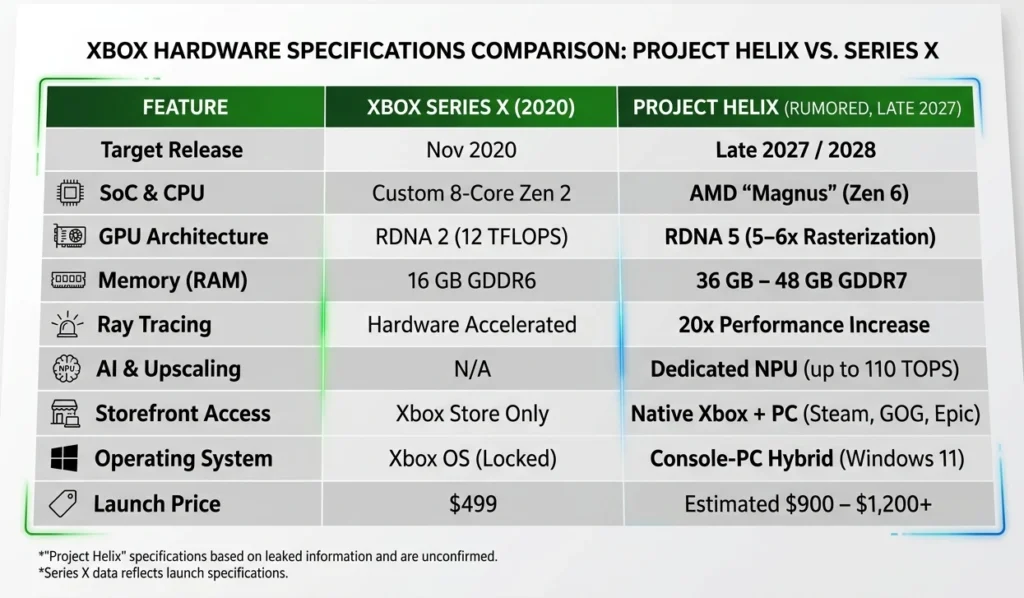
The Project Helix performance leap over the Xbox Series X is substantial, potentially the largest generational jump in Microsoft’s console history. But whether that leap justifies a $400–$600 price increase depends entirely on what you value in gaming.
Side-by-Side Comparison
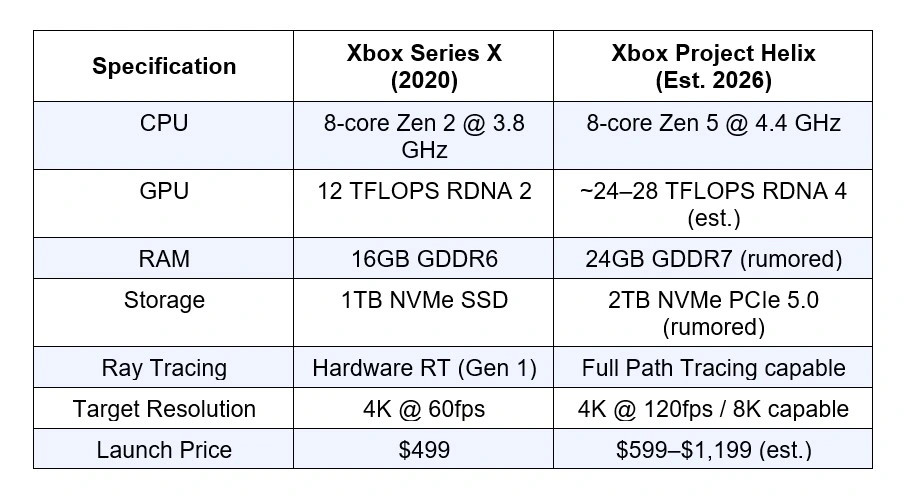
The GPU performance doubling alone is noteworthy. RDNA 4 architecture brings hardware-accelerated path tracing, not just ray tracing, to consoles for the first time. Games built natively for Project Helix could look closer to high-end PC gaming at Ultra settings than anything seen on a $500 box before.
The Practical Gaming Argument
That said, 4K at 60fps, what Xbox Series X already delivers on well-optimized titles, remains the sweet spot for most TV setups. 8K TVs have barely cracked 3% of global TV shipments according to Display Supply Chain Consultants data from 2025. If you’re gaming on a 65-inch 4K display at 60fps, the incremental gain from Project Helix may feel less justifiable at $800+ than it does on paper.
The more compelling use case is 4K at 120fps with ray tracing enabled, something the Series X struggles to deliver simultaneously. For competitive multiplayer gamers who can output to 120Hz displays, this could be transformative.
Microsoft's Plan to Combat Console Scalping During the Memory Crisis
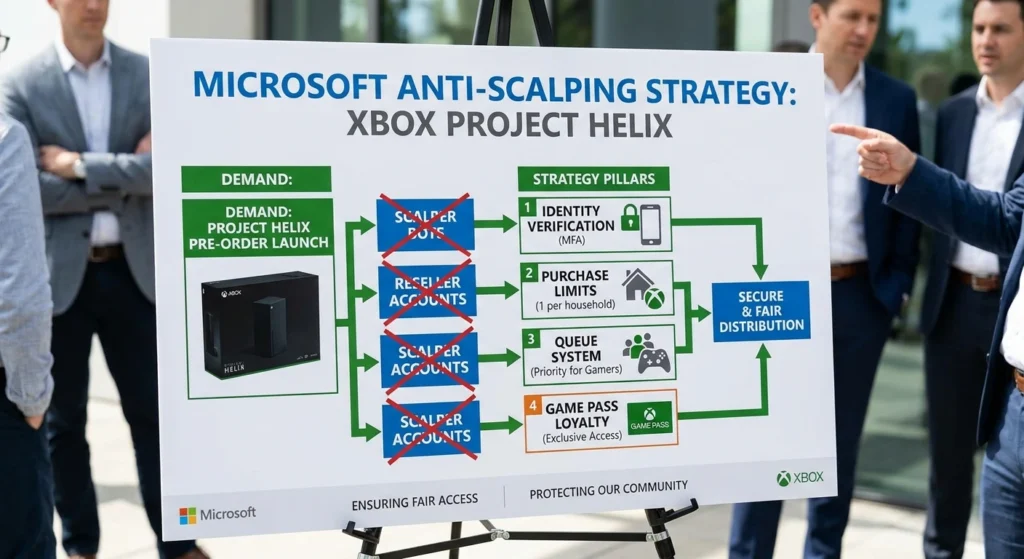
Microsoft has implemented a multi-layered anti-scalping strategy for Project Helix, combining purchase verification systems, regional allocation controls, and Game Pass subscriber priority queues to protect genuine consumers from bot-driven resale inflation.
Purchase Verification and Account Gating
Following the disastrous Xbox Series X launch in 2020, when bots scooped up hundreds of thousands of units within minutes, Microsoft is reportedly building Helix purchase eligibility around Xbox account tenure and Game Pass history. Sources familiar with the plan told Windows Central that users with at least 12 months of active Game Pass Ultimate will get early access windows before general retail availability.
This mirrors the approach Sony used with the PS5 “direct” invite system, but Microsoft’s version would be more automated, integrated directly into the Xbox app’s store interface.
Regional Allocation Controls
Regional allocation is the other major lever. Microsoft plans to gate initial Helix stock by country using IP verification and billing address matching, techniques already used on a limited basis during Series X restocks. Markets with historically high resale rates, including parts of Southeast Asia and Eastern Europe, may see more restrictive initial allocations.
Retailer Agreements and Consequences
Major retail partners, including Best Buy, GameStop, Walmart, and Amazon, are reportedly being asked to implement their own queue and identity verification systems under threat of reduced allocation. This is unusual leverage for Microsoft to exercise, but with limited memory-constrained supply, they hold significantly more negotiating power than in past launches.
- Best Buy: Reportedly testing a “Totaltech” member pre-order gating system
- Amazon: Building on its existing high-demand item queue infrastructure
- GameStop: Exploring verified PowerUp Rewards Pro member priority queues
- Walmart: Working with Microsoft on in-store and online concurrent queue limits
What Comes Next: The Future of Xbox Project Helix
The Xbox Project Helix pricing crisis is not insurmountable, but it will test Microsoft’s resolve and consumer patience in equal measure. Three scenarios are likely playing out in Redmond right now.
- Scenario A (Aggressive): Microsoft absorbs significant per-unit losses, prices Helix at $599/$799 for base and premium SKUs, and bets on Game Pass to recover margin over a 3-year horizon.
- Scenario B (Conservative): Microsoft launches at $799/$1,099 and doubles down on its PC gaming narrative — positioning Xbox as optional hardware while pushing Game Pass on Windows and streaming.
- Scenario C (Hybrid): A tiered hardware strategy launches a $499 “Helix S” (less memory, smaller SSD) alongside a $899 “Helix X” premium unit, splitting the audience intentionally.
Scenario C is increasingly discussed among Xbox analyst circles. It mirrors the Series S/Series X dual-SKU strategy that mixed results, the Series S cannibalized some Series X sales while also expanding the market among budget-conscious gamers. Whatever path Microsoft chooses, the memory shortage won’t resolve overnight. TSMC and Samsung’s expanded GDDR7 fabs aren’t expected at meaningful volume until mid-to-late 2027. If Project Helix launches in 2026, it will do so in a constrained supply environment and every pricing, allocation, and anti-scalping decision will be scrutinized intensely by a gaming community still scarred by the 2020 console wars.
FAQs
1. What is Xbox Project Helix?
It is the codename for the next-generation Xbox console expected to succeed the Series X.
2. Why is the next Xbox going to be expensive?
Xbox CEO Asha Sharma cited rising memory (RAM) costs as a major factor in the console’s final price.
3. Will the next Xbox cost $1,200?
While some leaks suggest a $1,200 price tag, Microsoft has not officially confirmed the MSRP.
4. When is the Xbox Project Helix release date?
It is targeted for a late 2026 or early 2027 launch.
5. Is Project Helix more powerful than PS5 Pro?
Early specs suggest a massive leap in AI-assisted upscaling and raw teraflops compared to current hardware.
6. Will Project Helix be backwards compatible?
Yes, Microsoft has committed to keeping your existing digital library playable on next-gen hardware.

Swathi is a contributor at GizStreet with a master’s degree in science and a strong background in technical writing and product review. She covers gadgets, software, and consumer tech, with a focus on breaking down complex products into clear, practical takeaways for readers.
Share this story
Related Articles
Halo: Campaign Evolved Brings the Original Adventure Back With Modern Technology Across Xbox, PC, and PS5
Halo: Campaign Evolved brings a ground-up remake of the original campaign with cross-platform co-op, new story content, and a July 28, 2026 launch.
Lenovo Legion Y700 AI Officially Teased With 165Hz OLED Display Ahead of China Launch
Lenovo has revealed key specifications for the Legion Y700 AI, confirming an 8.4-inch 165Hz OLED display, Dolby Vision, 5G connectivity, and an August China launch.

Avatar Legends: The Fighting Game Brings Hand-Drawn Combat to PC With Cross-Play and Rollback Netcode
Avatar Legends: The Fighting Game has launched with hand-drawn 2D animation, rollback netcode, cross-play and Story Mode. Here's everything officially confirmed.
Comments (0)