The French Appeal Ruling Behind Marine Le Pen’s Latest Political Campaign — and Why Nigel Farage Is Part of the Conversation
Marine Le Pen's appeal ruling has reshaped the political conversation. Here's what changed, why Nigel Farage is part of the debate, and what readers should know.
Contributor

Executive Summary
A French appeals court has upheld Marine Le Pen’s conviction for misusing European Union funds while modifying parts of the original sentence, including reducing the effective period during which she is barred from holding elected office. The ruling also requires one year of home detention under electronic monitoring.
The judgment has since become part of a broader political debate examined by CNN, which draws parallels between Le Pen’s messaging and that of UK politician Nigel Farage. Rather than presenting legal scrutiny as a routine judicial process, both figures are portrayed as arguing that they are being targeted by political and institutional elites.
Although the story appeared in technology coverage because it explores digital political communication and online influence, it is fundamentally a political and legal story—not a technology product announcement. As a result, there are no product releases, software updates, technical specifications, or developer documentation associated with this event.
What Happened?
Marine Le Pen’s legal case reached another important stage when a French appeals court upheld her conviction for the misuse of European Union funds.
The court:
- Upheld the underlying conviction.
- Reduced the effective period during which she is prevented from holding elected office.
- Ordered one year of home detention under electronic monitoring.
Following the ruling, Le Pen said she still intends to run in France’s 2027 presidential election.
Beyond its legal significance, the decision quickly became part of a wider political conversation about how court rulings are interpreted and communicated to voters.
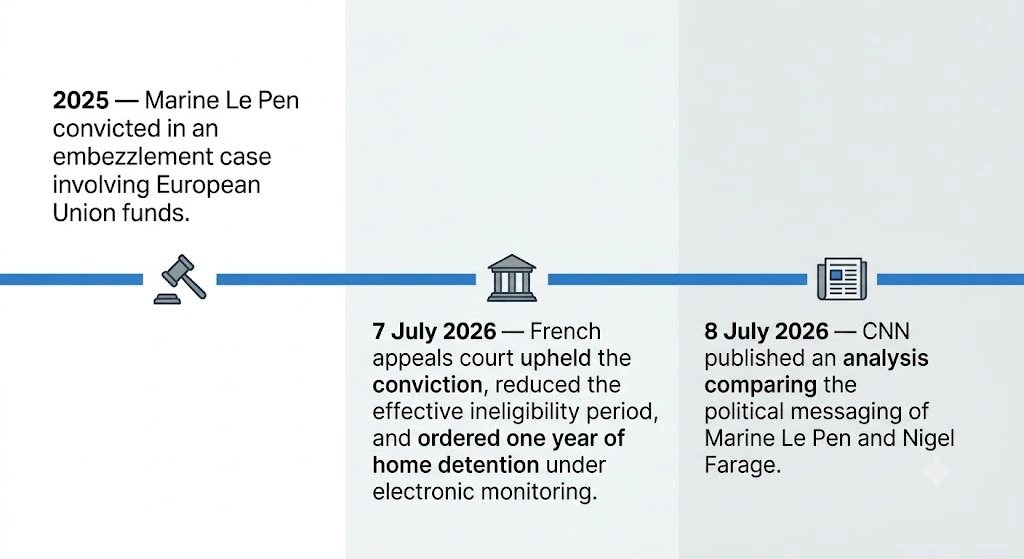
Timeline of the Verified Events
| Date | Event |
|---|---|
| 2025 | Marine Le Pen was convicted in an embezzlement case involving European Union funds. |
| 7 July 2026 | A French appeals court upheld the conviction, reduced the effective ineligibility period, and imposed one year of electronic monitoring. |
| 8 July 2026 | CNN published an analysis comparing the political messaging of Marine Le Pen and Nigel Farage. |
Why Is Nigel Farage Part of the Discussion?
The comparison made in CNN’s analysis is rooted in political messaging rather than legal similarities.
The article argues that both Le Pen and Farage frame legal scrutiny as an effort by political or institutional elites to override the will of voters. In that narrative, court proceedings become part of a broader political argument rather than simply a legal process.
That distinction is important. The available research does not establish any shared legal case or coordinated political strategy between the two politicians. The comparison reflects CNN’s editorial analysis of their public messaging.
Important: The verified research package does not support claims of collaboration or coordinated legal action between Marine Le Pen and Nigel Farage.
Why This Matters
High-profile legal cases no longer play out only in courtrooms. They also unfold across television broadcasts, news websites, social media platforms, and political campaign channels.
That shift changes how legal decisions are received. Supporters and critics often encounter political interpretations of a ruling almost as quickly as the ruling itself.
As a result, judicial decisions can shape public debate well beyond their legal consequences, influencing political campaigns and public opinion through digital communication

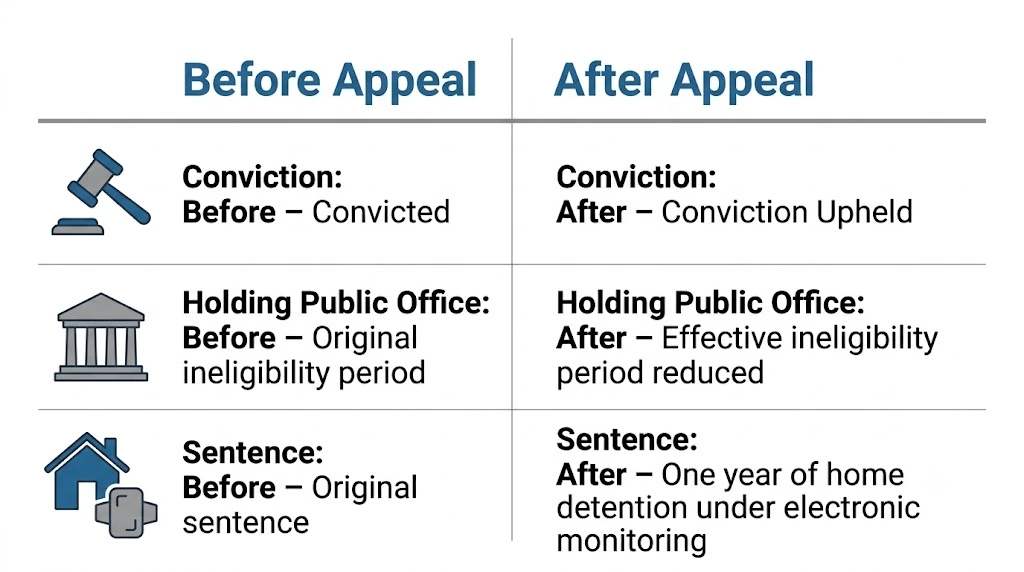
What Changed After the Appeal?
The appeal did not overturn Marine Le Pen’s conviction. Instead, it changed elements of the sentence while leaving the conviction itself intact.
| Before Appeal | After Appeal |
|---|---|
| Conviction | Upheld |
| Holding public office | Effective period of ineligibility reduced |
| Sentence | Includes one year of home detention under electronic monitoring |
In practical terms, the appeal altered the consequences of the sentence without changing the court’s finding of guilt.
Why Did This Story Appear in Technology Coverage?
At first glance, the case is political rather than technological. It entered technology coverage because it highlights the growing role of digital communication in modern politics.
The research package identifies several related themes:
- Digital political messaging
- Online audience engagement
- Digital branding
- Political communication
One point deserves clarification. Although cryptocurrency appears in the metadata accompanying the original article, the verified research package does not provide evidence that cryptocurrency funding played a role in the events described.
Note: Metadata and article tags should not be treated as verified reporting. Only facts supported by the available research have been included here.
What Readers Should Watch Next
Several questions remain unanswered and are likely to shape future coverage:
- Will there be additional legal proceedings?
- How will the appeal ruling affect Le Pen’s political campaign?
- Will the decision influence public opinion ahead of France’s 2027 presidential election?
- How will debates over judicial independence continue to evolve?
At this stage, the available evidence does not provide definitive answers.
Conclusion
The appeal ruling leaves Marine Le Pen’s conviction intact while changing key elements of her sentence, including the effective period of ineligibility for elected office. She has also reaffirmed her intention to contest France’s 2027 presidential election.
The wider discussion extends beyond the courtroom. As the CNN analysis highlights, legal decisions increasingly become part of political campaigns through digital communication, where competing narratives can shape public perception almost as quickly as the rulings themselves. For readers, the story illustrates how legal developments, political strategy, and online messaging are becoming more closely intertwined in modern public life.
Frequently Asked Questions
1. Was Marine Le Pen’s conviction overturned?
No. The appeals court upheld the conviction.
2. What changed after the appeal?
The court reduced the effective period preventing her from holding elected office while ordering one year of home detention under electronic monitoring.
3. Is Marine Le Pen still planning to run for president?
Yes. Following the appeal ruling, she said she intends to run in France’s 2027 presidential election.
4. Why is Nigel Farage mentioned in the story?
CNN’s analysis compares how both politicians publicly frame legal scrutiny in their political messaging.
5. Is this a technology product announcement?
No. It is a political analysis that explores the role of digital communication in modern politics.
6. Did cryptocurrency funding play a role?
The verified research package does not provide evidence supporting that claim.
7. Are there official technical documents related to this story?
No. Because this is not a technology product or software release, there are no product pages, release notes, developer resources, or technical documentation.
8. What was Marine Le Pen convicted of?
The conviction relates to the misuse of European Union funds.
9. Why is electronic monitoring significant?
It forms part of the sentence imposed by the appeals court and remains one of the legal restrictions following the upheld conviction.
10. What developments should readers follow next?
Future legal proceedings, Le Pen’s preparations for the 2027 presidential election, and the continuing political debate surrounding the appeal ruling.
Comments (0)