Understanding What Air Purifiers Actually Catch—and Why Filtration Alone Isn’t Enough
HEPA air purifiers are excellent at removing airborne particles, but they aren't a complete indoor air quality solution. Here's what they remove—and what they don't.
Contributor

Executive Summary
Air purifiers have become a familiar fixture in many homes, particularly in areas affected by wildfire smoke, seasonal allergies, and growing concerns about indoor air quality. Demand surged during the COVID-19 pandemic, bringing greater attention to these devices—and a fair share of misconceptions about what they can actually do.
Guidance from the U.S. Environmental Protection Agency (EPA) makes one point clear: high-quality HEPA (High Efficiency Particulate Air) filters are highly effective at capturing airborne particles, including fine particulate matter (PM2.5). But filtration is only one piece of the puzzle. Reducing pollutants at their source and ensuring adequate ventilation remain the most effective ways to improve the air inside a home.
Understanding that distinction can help consumers make better decisions and avoid expecting more from an air purifier than it is designed to deliver.
Why Air Purifiers Have Become More Popular
Portable air cleaners have gained widespread attention over the past several years as more households look for ways to reduce exposure to smoke, dust, pollen, and other airborne particles.
Several trends have fueled that growth:
- Larger and more frequent wildfire seasons in some regions
- Increased awareness of indoor air quality during the COVID-19 pandemic
- Growing concerns about allergies and respiratory health
- Wider availability of consumer air purification products
Events such as the January 2025 Eaton and Palisades fires in Southern California also underscored how quickly outdoor pollution can affect the air inside homes.
What Does a HEPA Filter Actually Remove?
HEPA stands for High Efficiency Particulate Air.
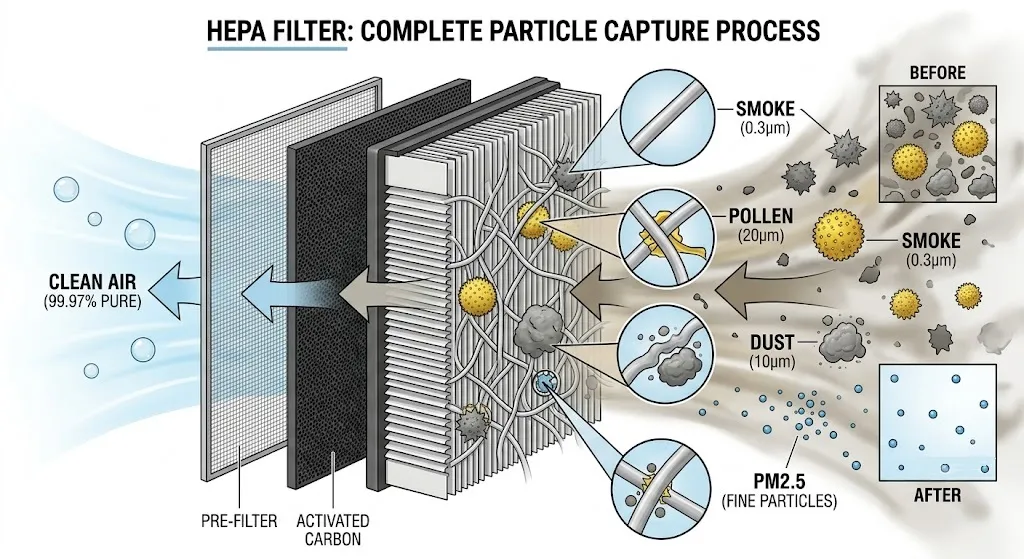
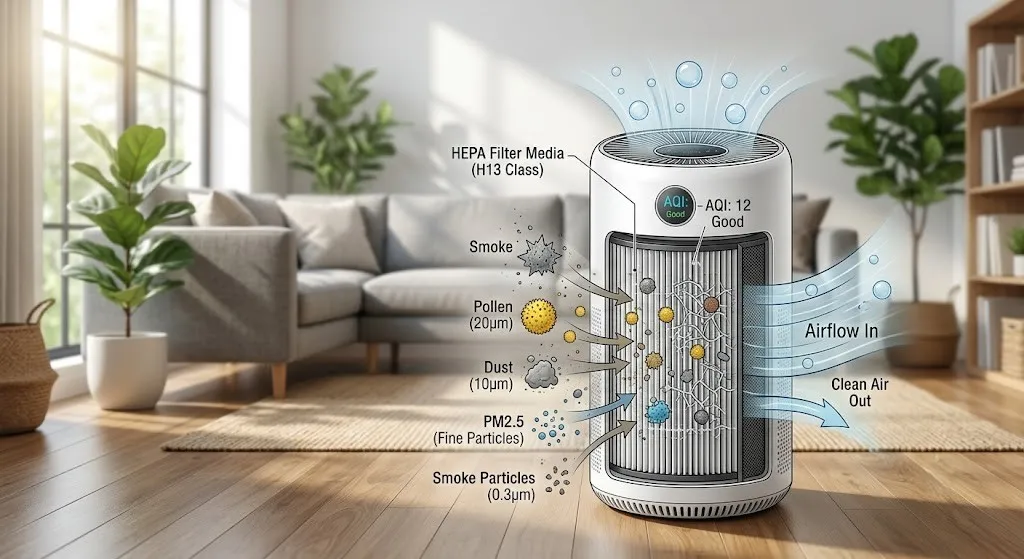
The EPA states that a true HEPA filter is designed to remove at least 99.97% of airborne particles measuring 0.3 microns under standardized testing conditions.
That makes HEPA filters highly effective at capturing many common airborne pollutants, including:
- PM2.5 (fine particulate matter)
- Smoke particles
- Dust
- Pollen
- Mold spores
- Some airborne allergens
These particles remain suspended in the air until they pass through the filter, where they are trapped within the filter media.

Technical Overview
| Specification | Details |
|---|---|
| Filter Type | HEPA (High Efficiency Particulate Air) |
| Minimum Efficiency | At least 99.97% at 0.3 microns |
| Primary Target | Airborne particulate matter |
| Common Performance Metric | Clean Air Delivery Rate (CADR) |
Important: A HEPA filter captures airborne particles but does not destroy them. They remain inside the filter until it is replaced.
What a Standard HEPA Filter Can't Remove
This is where expectations often diverge from reality.
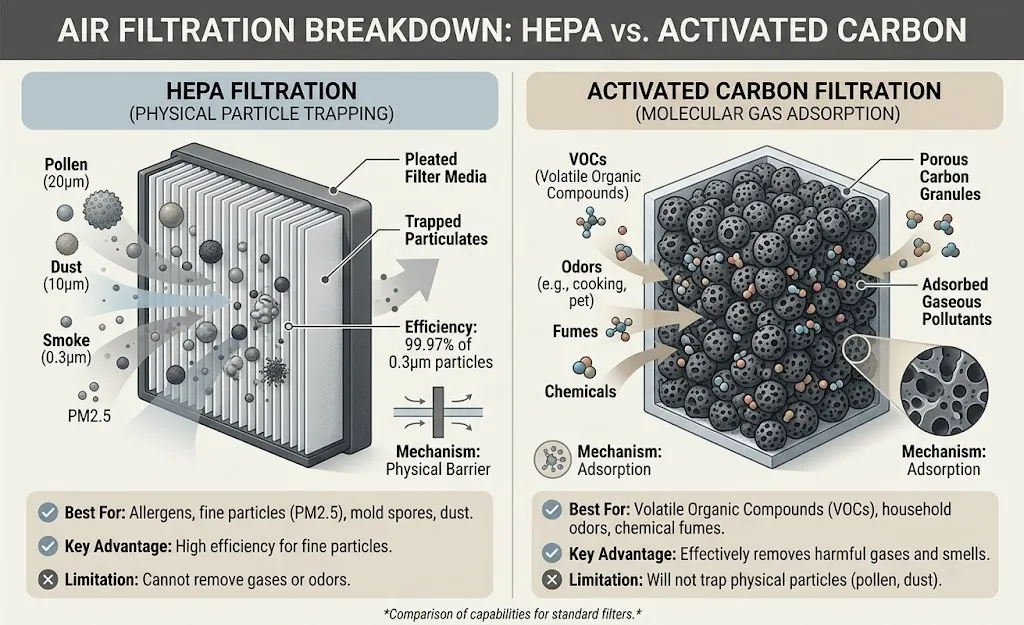
Although HEPA filters excel at removing airborne particles, they are not designed to eliminate every indoor pollutant.
A key example is volatile organic compounds (VOCs)—gases released from products such as:
- Paints
- Cleaning products
- Some furniture
- Building materials
- Certain household chemicals
Because VOCs exist as gases rather than particles, a standard HEPA filter cannot effectively capture them.
Some air purification systems include additional technologies, such as activated carbon filters, to help reduce gaseous pollutants. Their effectiveness depends on the purifier’s overall design and filtration system.
Why Source Control Matters More Than Filtration
One of the EPA’s most consistent recommendations is that air filtration should support—not replace—other indoor air quality measures.
Source control means reducing or eliminating pollutants where they originate. That can include:
- Removing smoke sources
- Limiting indoor chemical emissions
- Properly storing household chemicals
- Preventing mold growth
- Reducing dust buildup
Ventilation is equally important when outdoor air quality permits, helping dilute indoor pollutants with cleaner outdoor air.
Best Practice: Filtration works best when combined with source control and proper ventilation rather than used as a standalone solution.
Portable Air Cleaners Have Practical Limits
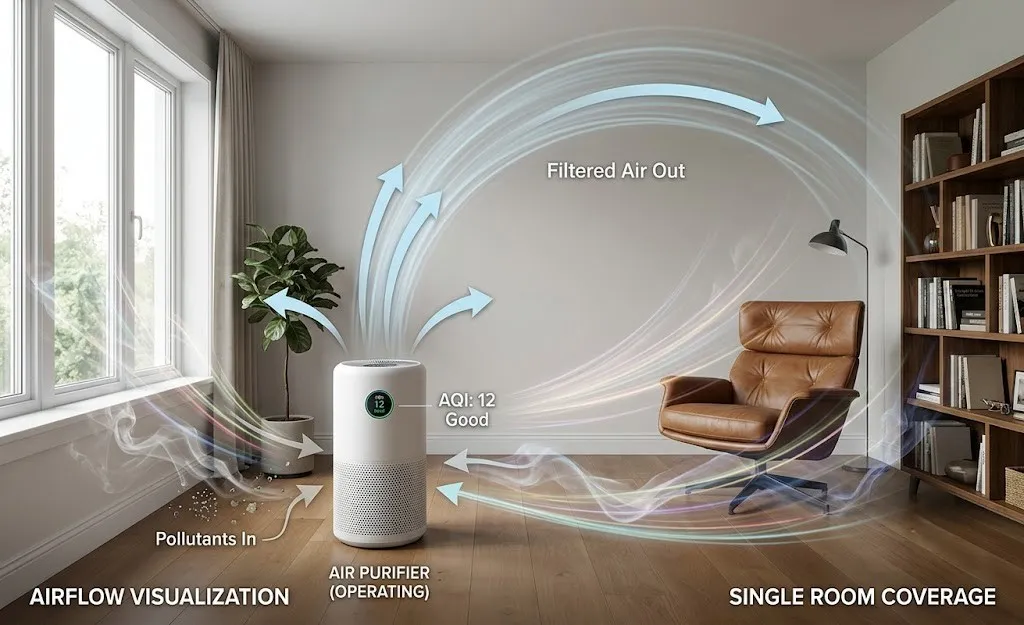
Portable air cleaners are intended to improve the air within a specific room or defined indoor space—not an entire house.
Their performance depends on several factors, including:
- Room size
- Air cleaner capacity
- Airflow
- Routine filter maintenance
- Continuous operation during pollution events
Even a high-performance purifier cannot remove every indoor contaminant. During wildfire events, for example, smoke particles may continue entering a home through doors, windows, and ventilation systems, making it difficult for any single device to completely clean the indoor air.

Understanding PM2.5
PM2.5 is one of the pollutants most commonly discussed during wildfire events and periods of poor air quality.
The term refers to particulate matter measuring 2.5 micrometers or smaller. Because these particles are extremely small, they can remain suspended in the air for long periods and be inhaled deep into the respiratory system.
When properly sized for a room and operated correctly, HEPA filtration is particularly effective at reducing airborne PM2.5 indoors.
Practical Steps to Improve Indoor Air Quality
An air purifier is most effective when it’s part of a broader indoor air quality strategy.
A practical approach includes:
- Reduce pollution sources whenever possible.
- Improve ventilation when outdoor air quality is acceptable.
- Choose a portable air cleaner that matches the size of the room.
- Replace filters according to the manufacturer’s recommendations.
- Consider systems designed to reduce both airborne particles and gases if VOCs are a concern.
Why This Matters
As concerns about indoor air quality continue to grow, many consumers are investing in air purification without fully understanding the strengths and limitations of the technology.
Knowing what a HEPA filter can—and cannot—do helps set realistic expectations. It also encourages a more effective approach to improving indoor air quality, one that combines filtration with source control and ventilation instead of relying on a single device.
Industry Perspective
The residential air purification market has expanded rapidly in recent years, with manufacturers offering products that combine multiple filtration technologies.
HEPA filtration remains the standard for capturing airborne particles, while additional filtration media may be included to help reduce odors and certain gaseous pollutants. Each technology serves a different purpose, and no single filter is designed to address every type of indoor contaminant.

Conclusion
Air purifiers are valuable tools for reducing airborne particulate matter indoors, particularly during wildfire smoke events or periods of poor outdoor air quality. HEPA filtration remains one of the most effective technologies for capturing fine particles such as PM2.5, but it is not a complete solution for every indoor air quality challenge.
The most effective strategy combines air filtration with source control and appropriate ventilation. Understanding how these approaches work together allows homeowners to make informed decisions, choose equipment that fits their needs, and build a more effective plan for maintaining cleaner indoor air.
Frequently Asked Questions
1. What does HEPA stand for?
HEPA stands for High Efficiency Particulate Air.
2. How effective is a true HEPA filter?
The EPA states that a true HEPA filter can theoretically remove at least 99.97% of airborne particles measuring 0.3 microns.
3. Can a HEPA filter remove wildfire smoke?
It can capture many of the particulate components of wildfire smoke, including PM2.5, but it does not remove every pollutant associated with smoke.
4. What are VOCs?
Volatile Organic Compounds (VOCs) are gases released from products such as paints, cleaning supplies, furniture, and building materials.
5. Can a standard HEPA filter remove VOCs?
No. Standard HEPA filters are designed to capture particles, not gases.
6. Are portable air cleaners meant for an entire home?
Generally, no. Most portable units are intended to improve air quality within a single room or defined indoor space.
7. What is PM2.5?
PM2.5 refers to fine particulate matter measuring 2.5 micrometers or smaller.
8. Is an air purifier enough to improve indoor air quality?
No. Official guidance recommends combining air filtration with source control and appropriate ventilation.
9. What is source control?
Source control involves reducing or eliminating pollutants where they originate, such as limiting indoor chemical emissions or preventing mold growth.
10. What is CADR?
CADR, or Clean Air Delivery Rate, is a commonly used metric for comparing the performance of portable air cleaners.
Share this story
Related Articles

macOS 27 Golden Gate and DVD Playback: What Apple Has Actually Confirmed
Apple has not confirmed DVD Player removal in macOS 27 Golden Gate. Explore what Apple has announced, current DVD support, and what Mac users should expect.

Huawei MatePad Pro Max Compact Variant “Dali”: What We Know About the Reported Smaller Flagship Tablet
Huawei’s reported MatePad Pro Max compact variant “Dali” remains unconfirmed, but the existing flagship tablet reveals Huawei’s premium tablet strategy.

Hisense E8S ULED Mini-LED TV Series Arrives in India: 144Hz Display, Price, Features
Hisense has launched the E8S ULED Mini-LED TV series in India with a native 144Hz display, Dolby Vision IQ, Devialet audio, VIDAA Smart OS, and prices starting at Rs. 57,990.
Comments (0)