Gaming Journalism, Google Discover, and the Limits of Verifiable Evidence
A review of official Google documentation separates verified facts about Google Discover from unverified claims about changing editorial strategies in gaming journalism.

Contributor

Executive Summary
A recent opinion piece argued that gaming journalism has shifted away from traditional reporting toward an algorithm-driven publishing model focused on speed and search visibility. A review of official sources, however, does not substantiate that claim. No public statements from GameRant, IGN, or Polygon confirm such an editorial strategy.
What can be verified is Google’s documentation explaining how Google Discover works for publishers. Those resources describe how content becomes eligible for Discover, how publishers can measure Discover traffic, and the features Google has introduced to help readers follow publishers and creators.
The distinction matters. Google’s documentation explains how its discovery platform operates, but it does not validate broader conclusions about how individual news organizations choose to run their editorial operations.
What Can Actually Be Verified?
The original analysis raises broader questions about the direction of gaming journalism. While those observations may resonate with ongoing discussions about digital publishing, they remain interpretations rather than officially documented facts.
The following information can be verified through official sources:
| Topic | Verified Status | Official Source |
|---|---|---|
| Google Discover exists as a content discovery platform | ✓ Verified | |
| Indexed websites can appear in Discover without special markup | ✓ Verified | |
| Discover has its own content policies | ✓ Verified | |
| Publishers can monitor Discover traffic through Search Console | ✓ Verified | |
| Users can follow publishers and creators in Discover | ✓ Verified | |
| GameRant officially announced an algorithm-first editorial strategy | ✗ Not verified | — |
| IGN officially confirmed a shift away from traditional journalism | ✗ Not verified | — |
| Polygon officially confirmed a maximum-output publishing strategy | ✗ Not verified | — |
Understanding Google Discover

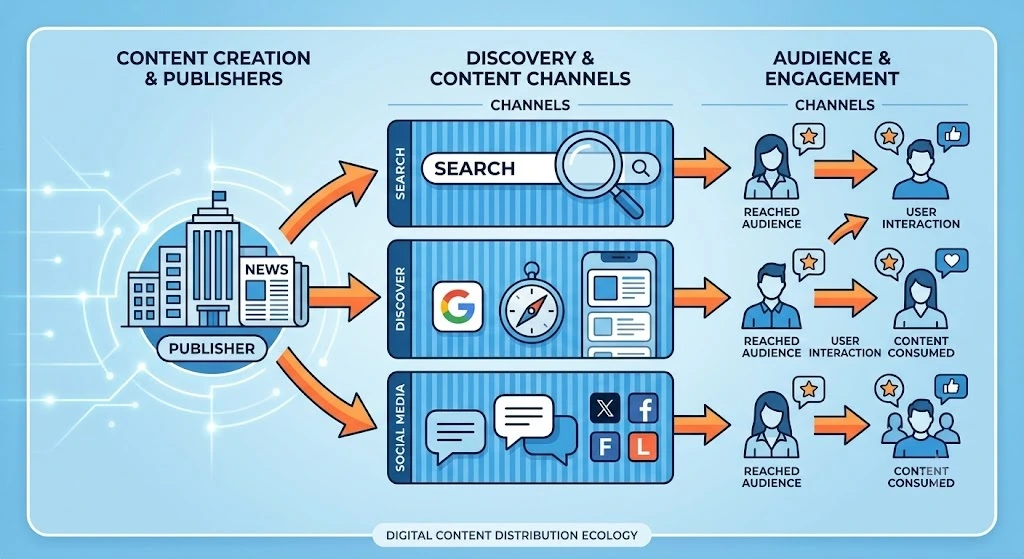
Google Discover is a personalized content feed available through Google Search and the Google app. Unlike traditional search, where users type specific queries, Discover recommends articles based on a person’s interests and activity.
Google’s documentation outlines several key points:
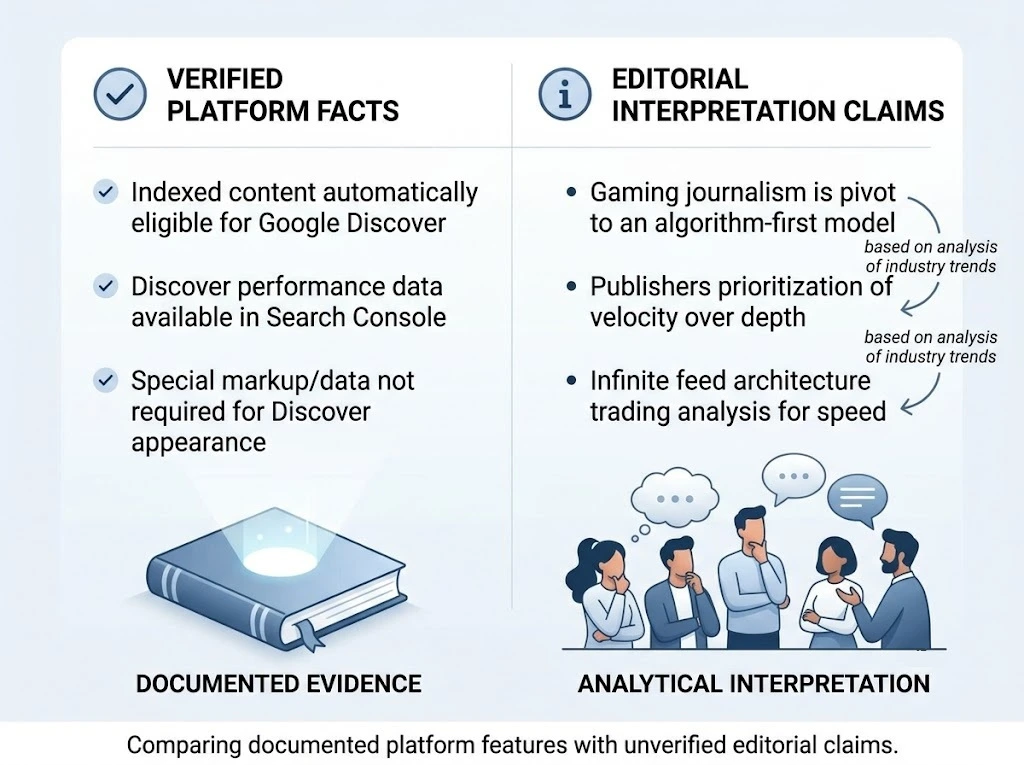
- Pages do not require special structured data to appear in Discover.
- Any indexed page that complies with Discover’s content policies may be eligible.
- Google recommends publishing helpful, reliable, people-first content.
- Publishers with sufficient traffic can review Discover performance in Google Search Console.
The platform is designed to surface relevant content proactively rather than respond to a specific search.
Important
Google notes that Discover traffic is generally less predictable than traditional Search traffic because recommendations are based on user interests rather than keywords.
Recent Changes Google Has Introduced
Google has continued expanding Discover and related publisher tools.
Search Profiles
Search Profiles allow publishers and creators to showcase their work more effectively within Google Search, making it easier for readers to identify and follow trusted sources.
Follow Features
Google has also expanded the ability for users to follow publishers and creators. Instead of relying solely on recommendations, readers can choose to receive more content from sources they already trust.
Together, these updates reflect Google’s ongoing investment in helping publishers connect with audiences through its ecosystem.
Why This Matters for Publishers
Although the original opinion piece cannot be verified through official statements, Google’s documentation illustrates why Discover has become an increasingly important source of traffic for many publishers.
Among its potential benefits are:
- reaching readers who are not actively searching for a topic
- generating traffic beyond traditional Search
- allowing publishers to measure Discover performance through Search Console
- enabling audience growth through Follow features
At the same time, Google makes clear that Discover traffic can fluctuate because recommendations depend on changing user interests rather than fixed search rankings.
Separating Analysis from Evidence
Media analysis often blends observable trends with interpretation. The original article argues that gaming websites increasingly prioritize publishing speed and algorithmic discovery.
That conclusion cannot be verified through official documentation.
The available evidence confirms only that:
- Google Discover operates as a personalized recommendation platform.
- Eligible publishers can appear in Discover without special markup.
- Google provides reporting tools through Search Console.
- Google has introduced new ways for readers to follow publishers.
Whether individual gaming publications have intentionally reshaped their editorial strategies around these systems remains an analytical conclusion, not an officially documented fact.
A Broader Industry Perspective
Digital publishing has changed dramatically over the past decade, and gaming journalism has evolved alongside the wider media industry.
Several long-term developments have influenced online publishers, including:
- mobile-first readership
- personalized recommendation systems
- social media distribution
- audience analytics
- subscription-based business models
- ongoing changes to search platforms
These trends are well established across digital media. What cannot be established from the available evidence is whether any specific gaming publication has officially embraced the editorial philosophy described in the opinion piece. Demonstrating that would require direct statements, newsroom policies, or executive interviews, none of which were available.

Timeline of Verified Developments
| Date | Verified Event |
|---|---|
| September 17, 2025 | Google expanded Discover with features allowing users to follow publishers and creators. |
| March 9, 2026 | Google updated its Discover documentation for publishers. |
| June 4, 2026 | Google introduced Search Profiles for publishers and creators. |
The Key Takeaway
The evidence supports Google’s published documentation describing how Discover works and the tools available to publishers. It does not, however, verify claims that GameRant, IGN, Polygon, or other gaming publications have formally adopted an algorithm-first editorial strategy.
For readers, the distinction is straightforward: platform documentation explains how content distribution works, while broader conclusions about newsroom strategy require separate evidence.

Conclusion
Google’s official documentation provides a clear picture of how Discover works, how publishers become eligible, and what tools are available to measure performance and build audiences. Those facts are well documented.
What remains unverified are the broader claims about editorial strategy made in the original opinion piece. Until publishers themselves provide evidence through official statements or documented newsroom policies, those conclusions should be treated as analysis rather than established fact.
Frequently Asked Questions
1. Is Google Discover the same as Google Search?
No. Google Search responds to user queries, while Discover recommends content based on a user’s interests and activity.
2. Does a website need special markup to appear in Discover?
No. Google states that indexed pages complying with Discover’s content policies are automatically eligible.
3. Can publishers measure Discover traffic?
Yes. Publishers that meet Google’s reporting thresholds can view Discover performance in Google Search Console.
4. Has GameRant officially announced an algorithm-first editorial strategy?
No official announcement confirming this was identified.
5. Has IGN publicly stated that it changed its editorial model?
No verified official statement supporting that claim was found.
6. Has Polygon confirmed the publishing strategy described in the opinion article?
No official confirmation was identified.
7. What are Google Search Profiles?
They are profiles that help publishers and creators present their work in Google Search and make it easier for users to follow them.
8. Is Discover traffic predictable?
No. Google explains that Discover traffic is generally less predictable than keyword-based Search traffic because recommendations depend on user interests.
9. Can users choose to follow publishers in Discover?
Yes. Google has introduced Follow features that allow users to receive more content from publishers and creators they select.
10. Does the available evidence prove that gaming journalism has fundamentally changed?
No. The official documentation explains Google’s content discovery systems but does not independently verify claims about the editorial strategies of individual gaming publications.
Share this story
Related Articles

Lumio Project Neo Explained: What the AI-Powered WhatsApp Assistant Actually Does
Lumio Project Neo brings AI-powered content discovery to compatible Vision TVs and Arc Projectors through WhatsApp and Instagram. Here's what is officially confirmed.

What is Multimodal AI? A Complete Beginner’s Guide to AI That Understands Text, Images, and Voice
Imagine you are showing a photo of a broken dishwasher to a friend. You don’t just show the picture; you explain the clunking sound […]

Top Smart Gadgets in 2026: AI-Powered Devices Changing Everyday Life
In 2026, your home doesn’t just wait for your command; it anticipates your needs. Welcome to the world of smart gadgets 2026, where artificial intelligence […]
Comments (0)