Lumio Project Neo Explained: What the AI-Powered WhatsApp Assistant Actually Does
Lumio Project Neo brings AI-powered content discovery to compatible Vision TVs and Arc Projectors through WhatsApp and Instagram. Here's what is officially confirmed.
Contributor

Executive Summary
Lumio has introduced Project Neo, an AI-powered conversational content discovery experience for its entertainment ecosystem—not a traditional smart home controller. Currently available in public beta for compatible Lumio Vision TVs and Lumio Arc Projectors, the feature lets users discover and play content by messaging Lumio through WhatsApp or Instagram.
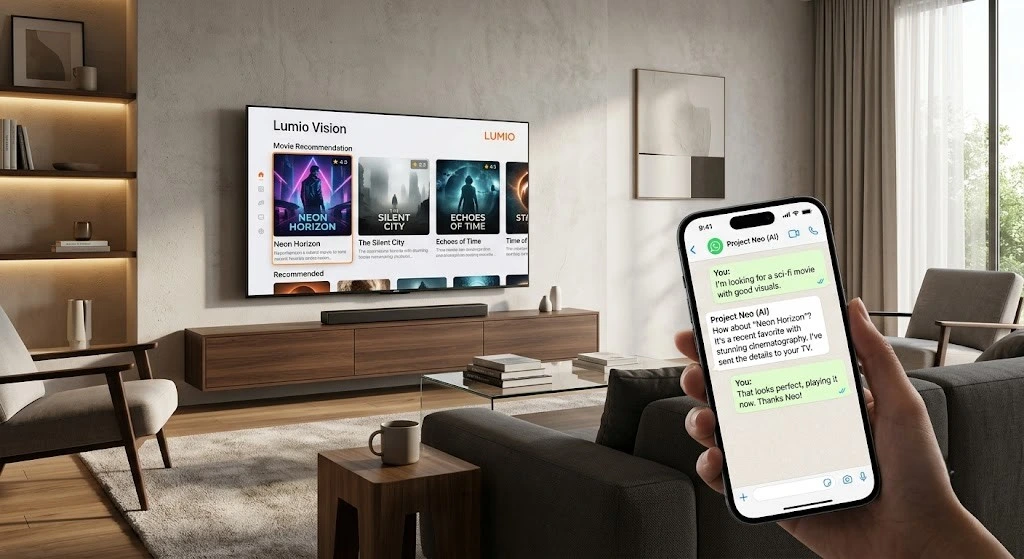
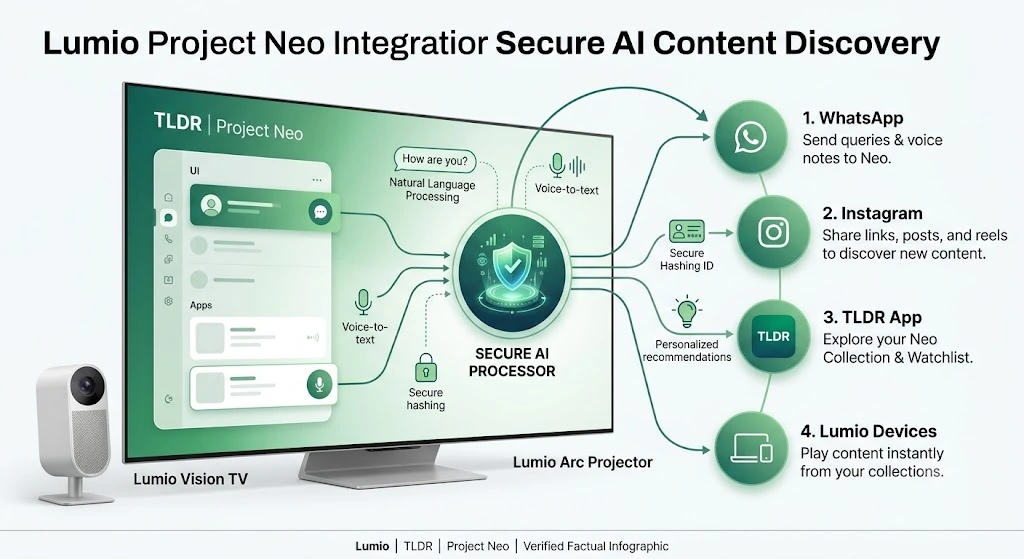
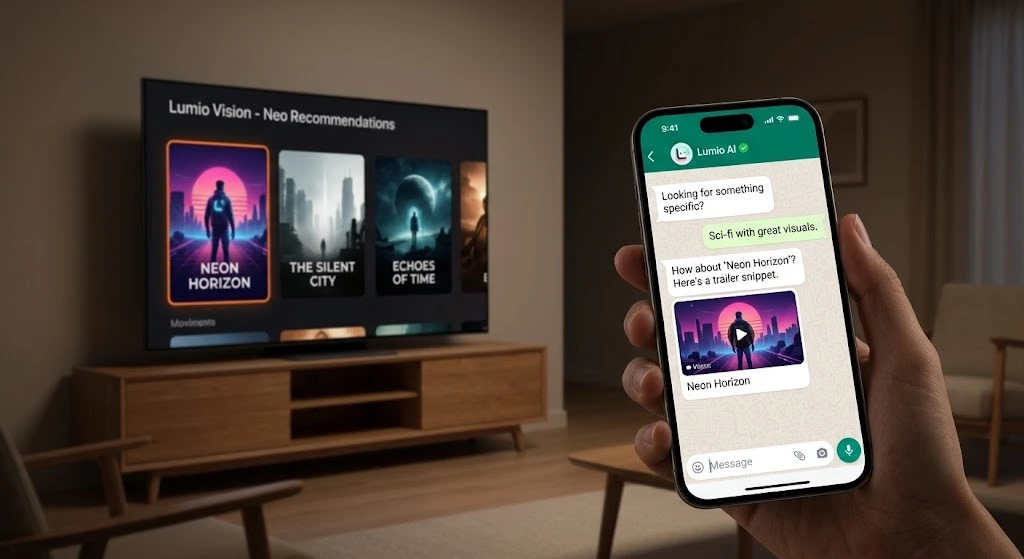
That distinction is important. Some early reports portrayed Neo as a WhatsApp-based TV remote with smart home controls, but Lumio’s own documentation describes something different. Officially, Neo is a conversational content discovery assistant integrated with the company’s TLDR application. Users can send text messages, voice notes, images, links, posts and reels to receive entertainment recommendations and launch content on paired Lumio devices.
For anyone trying to understand what Project Neo actually is, the official documentation points to a clear answer: it’s designed to simplify finding something to watch, not to replace your TV remote or manage your smart home.
What Is Project Neo?
Project Neo is Lumio’s conversational AI feature that lets users interact with their entertainment system through familiar messaging apps instead of navigating traditional television menus.
Rather than opening an app and manually browsing streaming catalogs, users can message Lumio on WhatsApp or Instagram with natural requests. Neo interprets those conversations and helps find and play content on supported Lumio devices.
The experience is integrated with Lumio’s TLDR application, making it part of the company’s entertainment platform rather than a standalone AI service.
What Can Project Neo Do?
The features confirmed by Lumio are centered on making content discovery quicker and more conversational.
Users can:
- Search for movies and TV shows using everyday language
- Start conversations through WhatsApp or Instagram
- Send voice notes instead of typing
- Share screenshots, web links, social posts and Instagram reels for recommendations
- Save discovered content to the Neo Collection or watchlist
- Use the service in nine Indian languages during the public beta
Instead of jumping between streaming apps and scrolling through endless menus, users can simply describe what they’re looking for in a chat.

Feature Overview
| Feature | Description |
|---|---|
| Conversational search | Find movies and shows using natural language |
| WhatsApp support | Interact with Neo through WhatsApp |
| Instagram support | Share posts, reels, screenshots and links |
| Voice notes | Voice messages are converted into searchable text |
| Neo Collection | Save content for later viewing |
| Multilingual support | Available in nine Indian languages |
Supported Devices and Platforms
At launch, Project Neo is limited to Lumio’s own hardware ecosystem.
| Component | Support |
|---|---|
| Lumio Vision TVs | Yes |
| Lumio Arc Projectors | Yes |
| Yes | |
| Yes | |
| TLDR app | Required |
Lumio has not announced compatibility with televisions from other manufacturers or with third-party streaming hardware.
Important
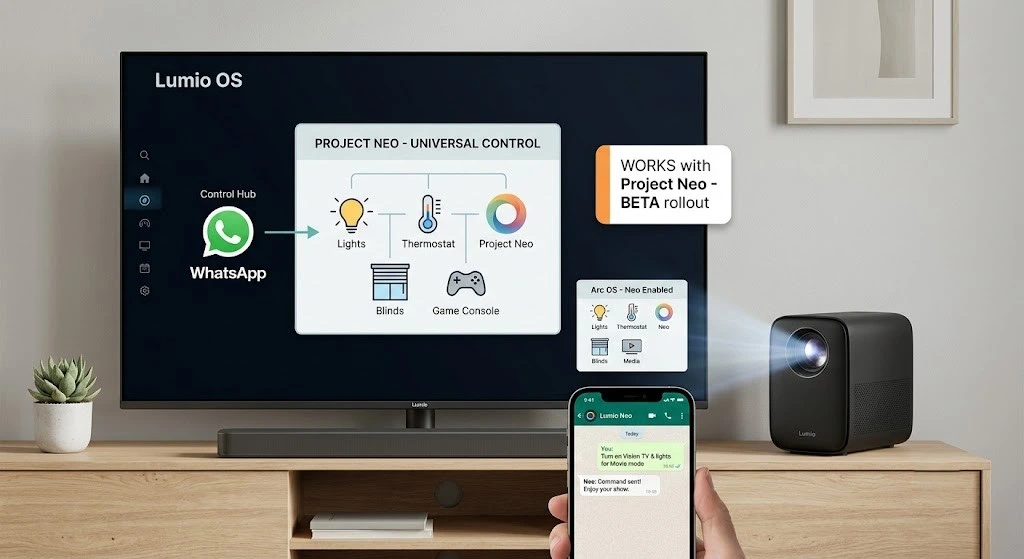
Lumio has not published official documentation describing Project Neo as a universal TV remote or a smart home automation platform.

What Changed Compared to Early Reports?
The biggest takeaway from Lumio’s official documentation is that it narrows the scope of what Project Neo actually does.
Some early reports described Neo as a WhatsApp-powered TV remote capable of:
- Controlling television power
- Changing channels
- Adjusting volume
- Managing smart home devices
- Automating lighting and security systems
Lumio’s published documentation does not describe those capabilities.
Instead, Neo is consistently presented as:
- An AI-powered content discovery experience
- A conversational entertainment assistant
- A feature integrated with the TLDR application
- A way to discover and launch entertainment through messaging apps
For readers, that clarification matters because it separates verified functionality from early speculation.
Why This Matters
Finding something to watch has become surprisingly time-consuming. Streaming libraries continue to grow, while viewers often jump between multiple services before settling on a movie or show.
Traditional TV interfaces typically require users to:
- Open different streaming apps
- Browse categories
- Type with an on-screen keyboard
- Compare recommendations across platforms
Project Neo approaches the problem differently. Rather than navigating menus, users can simply describe what they want—or even share a screenshot, link or social media post—to receive relevant suggestions.
It’s another example of conversational AI moving beyond chatbots and into everyday consumer technology.
Privacy and Security
Lumio has shared several details about how Project Neo processes user information.
Its privacy documentation states that:
- WhatsApp and Instagram identifiers are hashed after receipt.
- Phone numbers and social media handles are not stored in readable form.
- Personalization is enabled by default but can be turned off.
- Messages are processed using third-party AI and content providers.
These disclosures offer a clearer picture of how conversational requests are handled, although Lumio has not published a separate technical security whitepaper.

What Hasn't Been Announced Yet?
Despite the public beta, several details remain unavailable through official sources.
Lumio has not published information about:
- Pricing
- Developer documentation
- API documentation
- Release notes
- Version history
- GitHub repositories
- Compatibility with third-party televisions
- Compatibility with non-Lumio streaming devices
- A dedicated Project Neo product page
Until those details are released, claims extending beyond the documented feature set should be treated with caution.
Industry Perspective
Project Neo reflects a broader shift in consumer technology toward conversational interfaces.
Rather than asking users to learn yet another application, companies are increasingly building services around platforms people already use daily. Messaging apps such as WhatsApp and Instagram have become natural entry points for AI-powered experiences because they remove much of the friction associated with traditional interfaces.
Lumio is applying that idea to entertainment discovery. Instead of reinventing the TV interface, the company is experimenting with moving the search experience into everyday conversations.
Timeline
| Date | Event |
|---|---|
| July 2, 2026 | Project Neo public beta announced |
| July 3, 2026 | Lumio updated its Privacy Policy with Neo Conversational Discovery Service information |
Future Outlook
Based on currently available information, Project Neo remains focused on conversational content discovery.
Lumio has not announced plans for:
- Smart home automation
- Universal remote control functionality
- Third-party IoT integration
- Developer APIs
Those features could emerge in future updates, but no official roadmap currently outlines such plans.
Conclusion
Project Neo introduces a different approach to entertainment discovery by moving the search experience into messaging apps that many users already rely on every day. Official information confirms that the feature is designed to help users discover and launch content on compatible Lumio devices through WhatsApp and Instagram, with support for voice notes, multimedia sharing and multiple Indian languages.
Just as important are the limits of what’s been announced. Lumio has not confirmed smart home automation, universal TV remote functionality, public APIs or developer tools. For now, Project Neo should be viewed as a conversational entertainment assistant, with any broader capabilities remaining outside the scope of the company’s published documentation.
Frequently Asked Questions
1. What is Lumio Project Neo?
Project Neo is an AI-powered conversational content discovery feature that helps users find and play entertainment on compatible Lumio devices through WhatsApp or Instagram.
2. Is Project Neo a TV remote?
Based on Lumio’s official documentation, Neo is a content discovery assistant. It is not officially described as a universal TV remote.
3. Which devices support Project Neo?
The public beta is available for compatible Lumio Vision TVs and Lumio Arc Projectors.
4. Which messaging platforms work with Neo?
Project Neo currently supports WhatsApp and Instagram.
5. Can I use voice commands?
Yes. Users can send voice notes, which are converted into text for processing.
6. How many languages are supported?
The public beta supports nine Indian languages.
7. Do I need a separate Project Neo app?
No. Neo is integrated with Lumio’s TLDR application, while interactions take place through WhatsApp or Instagram.
8. Has Lumio announced pricing?
No. The company has not published any official pricing information for Project Neo.
9. Are developer APIs available?
No official developer documentation or public APIs have been announced.
10. How does Lumio handle user data?
Lumio says messaging platform identifiers are hashed, readable phone numbers or social media handles are not retained, and conversations are processed using third-party AI and content providers as outlined in its privacy documentation.
Share this story
Related Articles

OpenAI Shifts Gears: Greg Brockman Takes Over Product Strategy in Push for ‘Agentic’ Future
OpenAI co-founder Greg Brockman is consolidating product efforts, merging ChatGPT and Codex as the company pivots toward AI agents and a unified 'super app'.

Google Gemini Proactive Assistance: The Future of AI Anticipation
Imagine your phone nudging you to review a presentation before your boss even sends the calendar invite. That’s not science fiction anymore. Google Gemini […]

What is Edge Computing? A Complete Guide to Faster and Smarter Data Processing
Edge computing moves data processing away from centralised cloud servers and places it closer to where data is actually generated on devices, local servers, […]
Comments (0)