Friday, July 17, 2026 Trending:GPT-5iPhone 17Quantum Computing
Technology

Worldwide PC Shipments Fall for the First Time in Two Years as Memory Shortages Slow Market Growth

IDC reports global PC shipments fell 4.9% to 68.2 million units in Q2 2026, ending nine quarters of growth as memory shortages constrained supply.
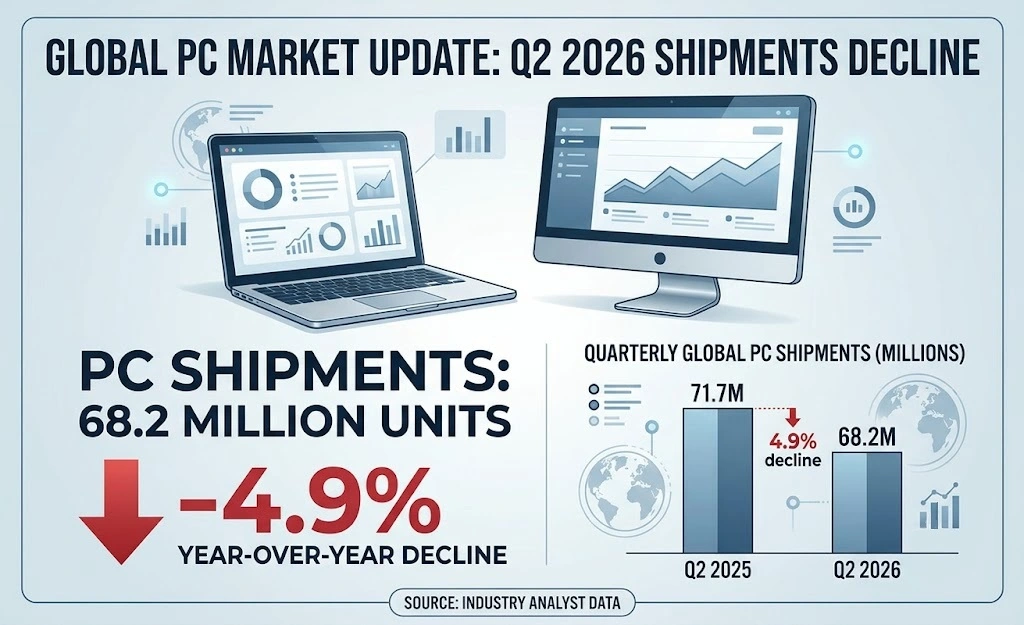
Infographic showing worldwide PC shipments declining 4.9% in Q2 2026.

Executive Summary

The global PC market has posted its first year-over-year shipment decline in two years. IDC reports that worldwide PC shipments fell 4.9% to 68.2 million units in the second quarter of 2026, bringing an end to nine consecutive quarters of growth.

Rather than pointing to weakening demand, IDC says the slowdown is primarily the result of memory supply shortages that limited manufacturers’ ability to ship systems. While some industry observers have linked stronger hardware revenues to the growing popularity of premium AI PCs, IDC’s official findings do not make that connection.

The latest figures suggest that the PC market remains active, but component availability continues to play a major role in determining how many systems reach customers.

What Happened?

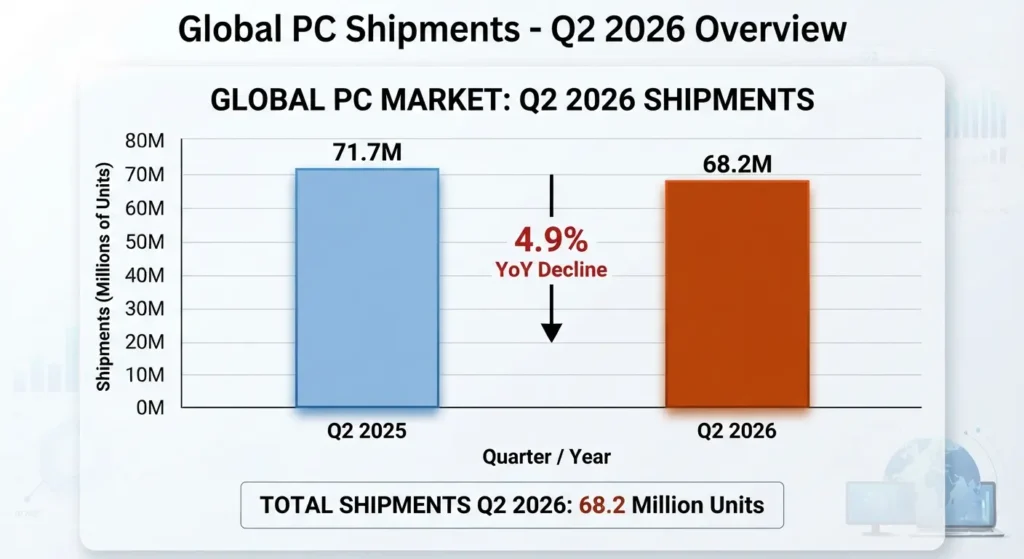
Chart illustrating worldwide PC shipment decline in Q2 2026.
IDC reported 68.2 million PC shipments worldwide during Q2 2026.

IDC’s latest quarterly market report shows that 68.2 million PCs were shipped worldwide in Q2 2026, representing a 4.9% year-over-year decline.

The drop is notable because it ends a recovery that had lasted for nine straight quarters following the post-pandemic slowdown. Instead of signaling a sharp fall in demand, IDC says the market has been constrained by an ongoing shortage of memory components.

PC Shipment Snapshot

MetricQ2 2026
Worldwide PC Shipments68.2 million units
Year-over-year change-4.9%
Growth streak endedNine consecutive quarters
Primary reason cited by IDCMemory supply shortage

Why Did Shipments Decline?

IDC attributes the slowdown primarily to a shortage of memory components.

Memory chips are essential to every laptop and desktop PC. When supplies tighten, manufacturers may struggle to complete systems on schedule, reducing the number of units that can be shipped during a quarter even if customer demand remains relatively stable.

That distinction matters. Shipment data reflects how many computers leave manufacturers, not necessarily how many customers are willing to buy.

Important: IDC’s official report identifies memory supply constraints as the primary cause of the shipment decline. It does not state that AI PCs were responsible for increased hardware revenues.

Shipments and Revenue Are Not the Same Thing

Shipment figures and revenue often move in different directions.

Shipments measure the number of PCs delivered during a specific period. Revenue reflects the total value of those sales.

A manufacturer can generate higher revenue while shipping fewer systems if customers purchase more expensive models or if the overall product mix shifts toward premium devices.

Industry commentary has suggested that AI-enabled PCs could contribute to this trend. However, IDC’s official shipment report does not attribute higher industry revenues to AI PCs.

What Is an AI PC?

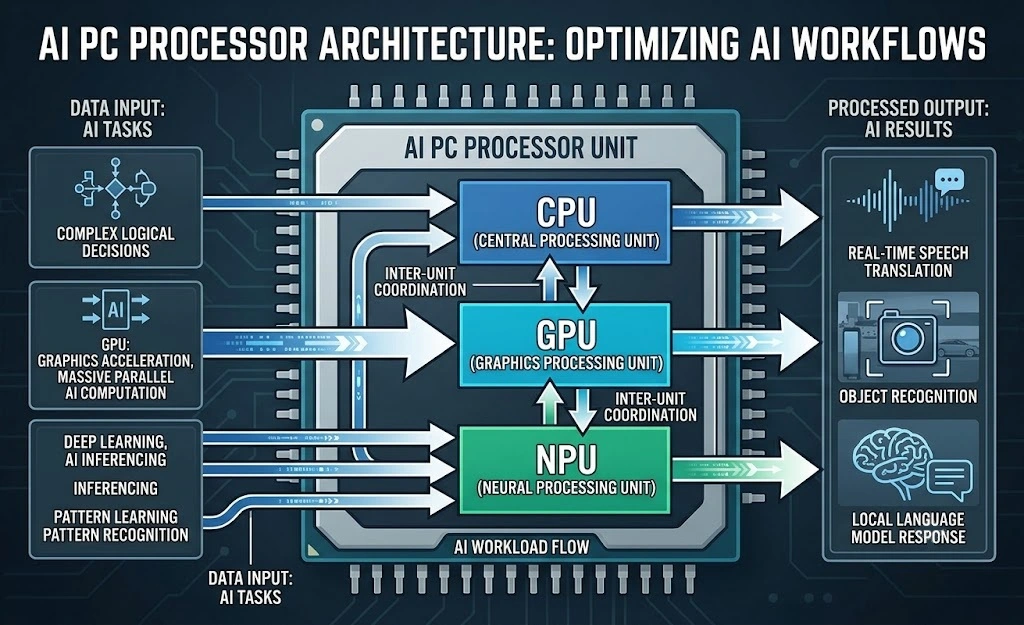
An AI PC is a personal computer designed to accelerate artificial intelligence tasks using dedicated hardware.

Many newer systems include a Neural Processing Unit (NPU) alongside the central processing unit (CPU) and graphics processing unit (GPU). The NPU is designed specifically for AI workloads, allowing certain tasks to run more efficiently while using less power.

Examples include:

  • AI-assisted productivity tools
  • Local language models
  • Image generation
  • Real-time audio processing
  • Background effects during video calls

Although AI PCs remain a major focus for chipmakers, IDC’s report does not identify them as the reason for the latest shipment trends.

Diagram showing CPU, GPU and NPU inside an AI PC.
AI PCs combine traditional processors with dedicated AI acceleration hardware.

Why This Matters

The latest shipment figures show that supply chain challenges continue to influence the PC industry even years after the pandemic disrupted global electronics manufacturing.

For businesses, component shortages can delay hardware refresh cycles. Consumers may notice longer delivery times, limited hardware configurations, or reduced availability of certain models depending on regional inventory.

The report also serves as a reminder that shipment data should not be viewed in isolation. A decline in shipments does not automatically indicate a weak market if manufacturing constraints are limiting supply.

What Changed This Quarter?

The biggest change is the end of an unusually long period of sustained shipment growth.

For nine consecutive quarters, the global PC market expanded. Q2 2026 interrupted that trend with a modest decline driven primarily by supply-side issues.

Whether this proves to be a temporary setback or the beginning of a broader slowdown will depend on future component availability and subsequent quarterly results.

Industry Perspective

Several long-term trends continue to shape the PC market:

  • AI features are becoming a greater priority for hardware manufacturers.
  • Businesses continue refreshing aging computer fleets.
  • Component availability remains a key factor in production planning.
  • Premium devices are attracting increasing attention across both consumer and enterprise markets.

Even so, the official IDC data does not establish a direct link between these trends and the Q2 2026 shipment decline or overall hardware revenue performance.

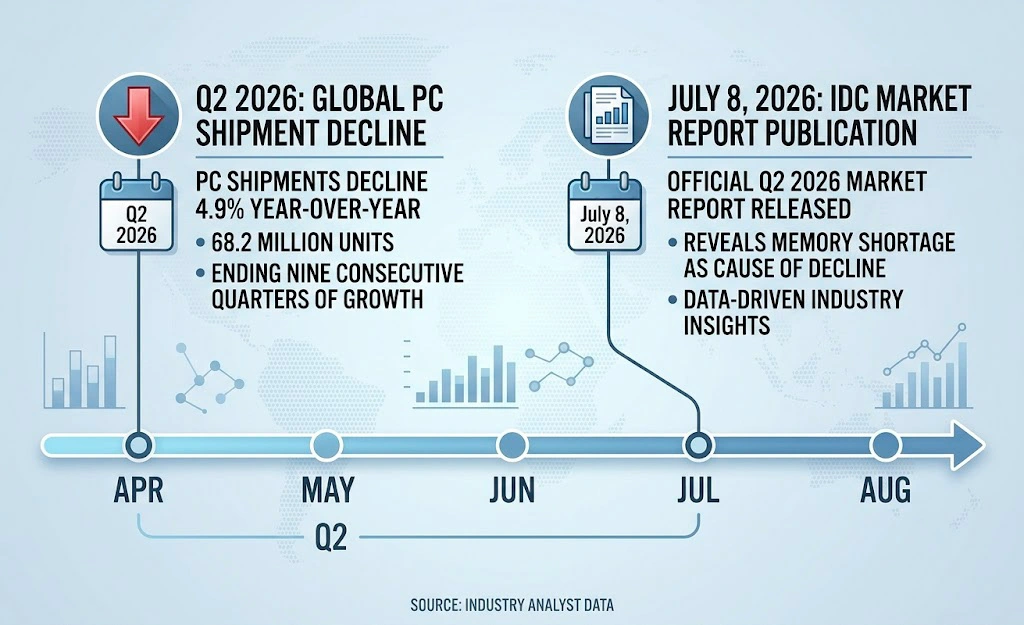
Timeline

DateEvent
Q2 2026Worldwide PC shipments reach 68.2 million units
Q2 2026Shipments decline 4.9% year over year
July 8, 2026IDC releases its official Q2 2026 worldwide PC market report
Timeline of IDC's Q2 2026 PC market report.
Key milestones from IDC's Q2 2026 worldwide PC shipment report.

What to Watch Next

The next few quarters will provide a clearer picture of where the market is headed. Areas worth monitoring include:

  • Improvements in memory supply.
  • IDC’s upcoming quarterly shipment reports.
  • Enterprise PC replacement cycles.
  • Continued adoption of AI-enabled PCs.
  • Broader semiconductor supply conditions.

Together, these factors will help determine whether the latest decline was a temporary disruption or the start of a longer market adjustment.

Conclusion

IDC’s latest quarterly report marks the first decline in global PC shipments after two years of steady growth, with worldwide shipments falling 4.9% to 68.2 million units in Q2 2026. The research points to memory supply shortages—not a sudden drop in demand—as the main reason for the slowdown.

Although discussions around AI PCs continue to shape broader conversations about the industry’s future, IDC’s official findings stop short of linking them to higher hardware revenues. For now, the report underscores how component availability remains a critical factor in the health of the global PC market, making future quarterly updates an important measure of whether this decline proves temporary or signals a more lasting shift.

Frequently Asked Questions

1. How much did worldwide PC shipments decline?

IDC reported a 4.9% year-over-year decline in Q2 2026.

2. How many PCs were shipped globally during Q2 2026?

Worldwide PC shipments totaled 68.2 million units.

3. What caused the decline?

IDC says the primary reason was an ongoing shortage of memory components.

4. Did this end the market’s growth streak?

Yes. The decline ended nine consecutive quarters of shipment growth.

5. Does lower shipment volume mean demand has weakened?

Not necessarily. Shipment numbers can fall because manufacturers are unable to build or deliver enough systems, even when customer demand remains steady.

6. Did IDC say AI PCs increased industry revenue?

No. IDC’s official shipment report does not make that claim.

7. What is an AI PC?

An AI PC is a computer equipped with dedicated hardware, such as a Neural Processing Unit (NPU), to accelerate artificial intelligence workloads.

8. What does an NPU do?

An NPU is a specialized processor designed to handle AI tasks efficiently while reducing power consumption.

9. Was a new PC product announced with this report?

No. The report focuses on quarterly market shipment data rather than a product launch.

10. What should readers watch in future reports?

Future updates on memory supply, enterprise purchasing activity, AI PC adoption, and shipment volumes will offer a better indication of the market’s direction.

0 Comments

Related Articles

Comments (0)

Share your thoughts

Your email address will not be published. Required fields are marked *