AMD Helios AI Rack: Why AMD Is Moving the AI Race Beyond Individual Chips
AMD Helios is a rack-scale AI infrastructure solution designed for frontier AI workloads, combining AMD GPUs, CPUs, networking, and ROCm software.
Contributor
Executive Summary
The AI hardware race is entering a new phase. For years, the competition centered on individual accelerators — the GPUs that provide the raw computing power behind large AI models. AMD Helios takes a different approach by focusing on the entire AI system.
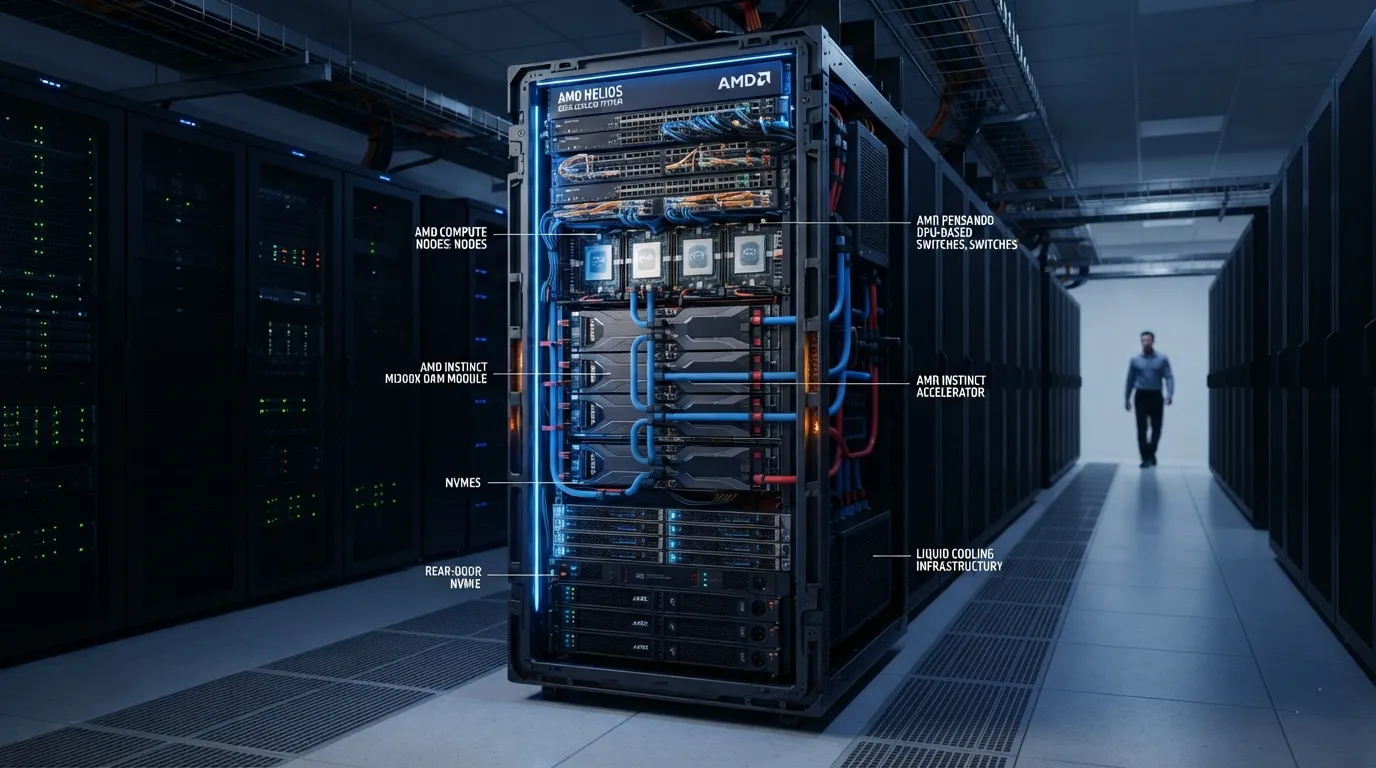
AMD Helios AI Rack , Helios is a rack-scale AI infrastructure solution designed for frontier AI training, inference, and fine-tuning. Instead of treating GPUs, CPUs, networking, and software as separate pieces, AMD is bringing them together into a unified architecture built for large-scale AI deployments.
The shift reflects a growing challenge in AI computing. As models become larger, performance depends not only on the speed of individual chips but also on how efficiently thousands of components communicate, share memory, and operate as one system.
What Is AMD Helios and Why Did AMD Build It?
The biggest AI systems today are no longer limited by a single processor. Training and running advanced models requires massive clusters of interconnected hardware, where communication between components can become just as important as raw compute power.
AMD Helios is designed around that reality.
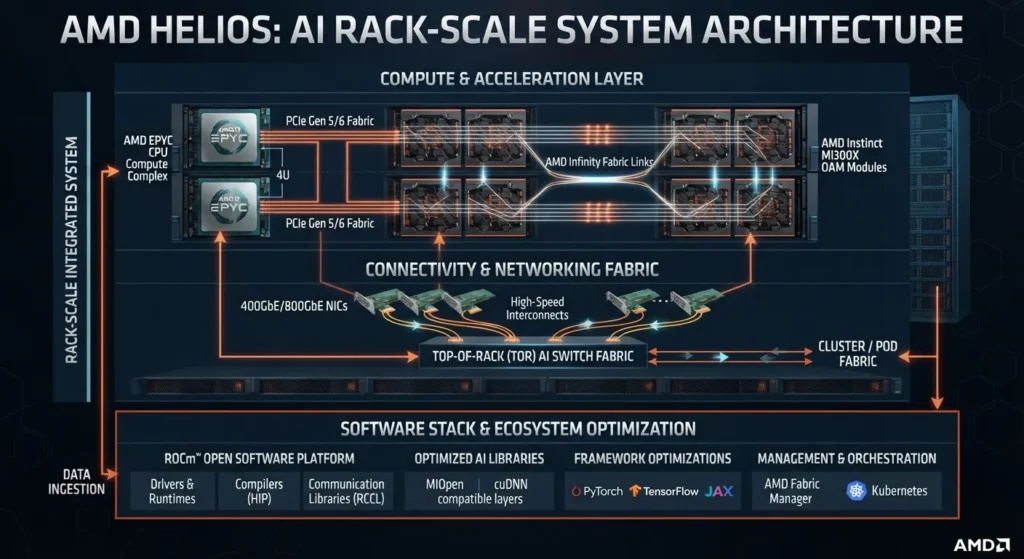
A rack-scale AI system is a complete computing platform built by combining multiple hardware layers into one architecture. Instead of organizations separately selecting accelerators, servers, networking equipment, and other infrastructure components, the rack-scale approach provides a more integrated foundation.
AMD describes Helios as an open rack-scale AI infrastructure solution designed for frontier AI and sovereign computing workloads.
The system combines:
- AMD Instinct GPUs
- AMD EPYC server CPUs
- AMD Pensando networking components
- AMD ROCm software ecosystem support
Together, these components are designed to support large-scale AI workloads that require substantial computing capacity.
How Is Helios Different From Traditional AI Hardware?
The Move From Chips to Complete AI Systems
Traditional AI hardware discussions often focus on accelerator performance. However, large AI deployments depend on far more than a powerful GPU.
When thousands of accelerators operate together, organizations must solve difficult infrastructure problems:
- Moving data quickly between chips
- Managing large memory pools
- Maintaining reliable networking
- Scaling systems efficiently
Helios represents AMD’s move toward solving these system-level challenges rather than competing only at the chip level.
The architecture focuses on:
- High-bandwidth connections between accelerators
- Large memory capacity
- Open networking standards
- Integrated system design
This approach aims to simplify the process of building large AI clusters.
Why Open Standards Matter
AMD is building Helios around open infrastructure standards instead of a fully closed ecosystem.
The design uses:
| Technology | Purpose |
|---|---|
| OCP Open Rack Wide (ORW) | Rack infrastructure standard |
| Ultra Accelerator Link (UALink) | High-speed accelerator communication |
| Ultra Ethernet Consortium (UEC) | AI-focused networking standards |
Using open standards could make it easier for hardware partners to develop systems based on the Helios architecture while maintaining compatibility with broader industry technologies.
AMD Helios Technical Specifications
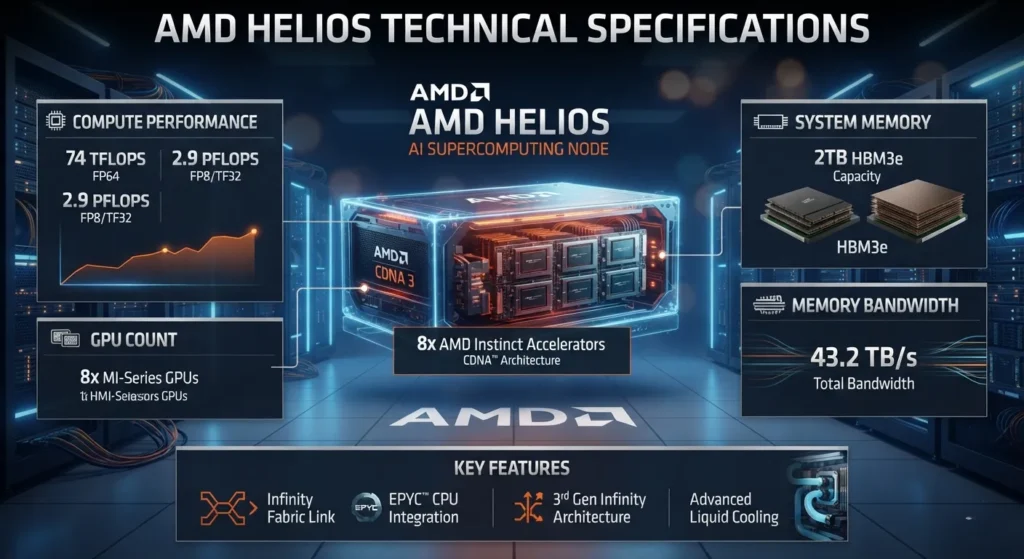
AMD has disclosed several specifications for the Helios rack-scale solution.
| Specification | Details |
|---|---|
| GPU configuration | 72 AMD Instinct MI455X GPUs |
| FP4 performance | Up to 2.9 EFLOPS |
| FP8 performance | Up to 1.4 EFLOPS |
| HBM4 memory capacity | 31 TB |
| Memory bandwidth per GPU | 19.6 TB/s |
| Scale-up bandwidth | 260 TB/s |
| Scale-out bandwidth | 43 TB/s |
| Rack architecture | Double-wide OCP Open Rack Wide (ORW) |
These specifications place Helios firmly in the category of large-scale AI infrastructure. It is designed for organizations running advanced AI workloads rather than everyday computing environments.
What Challenges Is AMD Helios Designed to Address?
AI Infrastructure Is Becoming More Complex
Building advanced AI systems involves much more than installing faster processors.
Organizations must balance:
- Accelerator communication
- Memory availability
- Network performance
- System reliability
- Data movement efficiency
- Infrastructure scaling
As AI models grow, these engineering challenges become increasingly important.
Helios addresses this by combining multiple infrastructure layers into a single reference architecture.
Reducing the Complexity of AI Cluster Design
Large AI clusters traditionally require organizations to integrate components from multiple suppliers and ensure that everything works together efficiently.
AMD’s reference design approach is intended to reduce some of that complexity for system builders.
Rather than starting from individual components, partners can build systems around a predefined architecture.
How Does AMD Helios Fit Into the AI Hardware Competition?
The AI accelerator market has been heavily shaped by Nvidia’s GPU ecosystem and software platform.
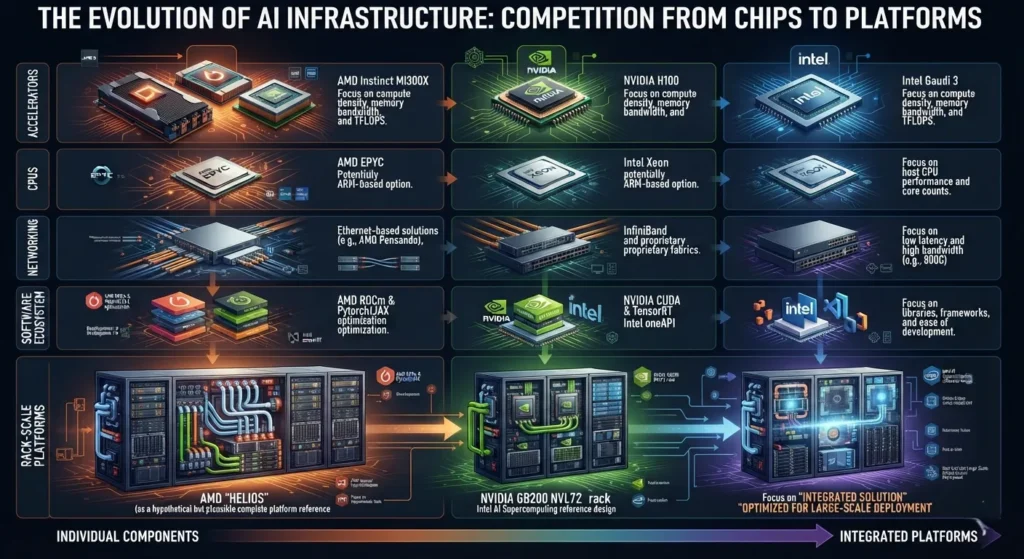
AMD’s Helios strategy expands the competition beyond individual accelerators. The company is targeting the broader infrastructure layer required to build and operate large AI systems.
| Area | AMD Helios Approach |
|---|---|
| Main focus | Rack-scale AI infrastructure |
| Compute components | AMD Instinct GPUs and EPYC CPUs |
| Networking | AMD Pensando and open standards |
| Software | AMD ROCm ecosystem |
| Target workloads | Frontier AI training, inference, and fine-tuning |
The competition is increasingly moving from “which chip is fastest” toward “which complete platform can support the largest and most efficient AI workloads.”
Who Could Benefit From AMD Helios?
Cloud Providers
Cloud companies need infrastructure capable of supporting increasingly demanding AI services.
Rack-scale systems like Helios are designed for environments where large AI clusters must be deployed and managed efficiently.
AI Developers
Hardware choices increasingly influence AI development because software frameworks, optimization tools, and deployment systems depend on the underlying infrastructure.
Helios includes support for AMD ROCm, the company’s software ecosystem for accelerated computing.
Enterprise AI Users
Organizations building private AI infrastructure may benefit from more standardized approaches to deploying large-scale computing systems.
However, Helios is not designed as a consumer product or a small-business AI solution.
When Will AMD Helios Be Available?
AMD Helios is a reference design rather than a product sold directly by AMD.
The company expects Helios-based systems to reach volume deployments in the second half of 2026. The architecture is intended for OEM and ODM partners that can create their own systems based on AMD’s design.
No official pricing information has been announced.
| Information | Status |
|---|---|
| Product availability | Reference design available |
| Direct AMD purchase | Not announced |
| Volume deployments | Expected in 2H 2026 |
| Pricing | Not announced |
Why AMD Helios Matters for the AI Industry
The AI Competition Is Moving Up the Stack
The next stage of AI infrastructure competition will not be decided only by accelerator speed.
Large-scale AI systems depend on:
- Faster communication between chips
- Efficient memory systems
- Advanced networking
- Simplified deployment
Helios shows AMD is competing at the system level, where infrastructure design becomes just as important as processor performance.
AI Platforms Are Becoming More Important Than Individual Components
The AI industry is gradually shifting away from a simple hardware comparison.
The question is no longer only:
“Which GPU is the fastest?”
It is becoming:
“Which complete AI platform can deliver the right combination of performance, scalability, software support, and deployment flexibility?”
Helios represents AMD’s effort to compete in that broader market.
What Should the Industry Watch Next?
The long-term impact of Helios will depend on what happens after the announcement.
Important areas to watch include:
- Real-world deployments from AMD partners
- Production performance results
- Growth of the ROCm software ecosystem
- Competition from other rack-scale AI platforms
- Availability of Helios-based systems
For large AI infrastructure projects, specifications matter, but adoption often determines success.
Conclusion
AMD Helios represents a broader change in the AI hardware market. The competition is moving beyond individual accelerators toward complete systems capable of supporting the massive computing demands of modern AI models.
With 72 AMD Instinct MI455X GPUs, large-scale memory capacity, high-bandwidth networking, and support for open standards, Helios is designed for organizations building some of the largest AI systems.
The next phase of the AI infrastructure race will depend on more than specifications. Real-world deployments, software maturity, and ecosystem adoption will determine whether Helios becomes a significant alternative in the evolving AI hardware landscape.
Frequently Asked Questions
What is AMD Helios?
AMD Helios is a rack-scale AI infrastructure solution designed for frontier AI model training, inference, and fine-tuning.
Is AMD Helios a GPU?
No. Helios is a complete rack-scale system design that includes GPUs, CPUs, networking components, and software support.
Which GPUs are used in AMD Helios?
AMD Helios uses 72 AMD Instinct MI455X GPUs.
How much memory does AMD Helios provide?
AMD Helios provides 31 TB of HBM4 memory capacity.
Who can purchase AMD Helios?
Helios is a reference design intended for OEM and ODM partners rather than a direct retail product from AMD.
When will Helios-based systems be available?
AMD expects volume deployments of Helios-based systems in the second half of 2026.
What workloads is AMD Helios designed for?
Helios is designed for frontier AI training, inference, and fine-tuning workloads.
Does AMD Helios support ROCm?
Yes. Helios is supported by AMD’s ROCm software ecosystem.
Is AMD Helios a replacement for Nvidia AI systems?
Helios provides an alternative AI infrastructure approach, but direct comparisons depend on future deployments and benchmarks.
Has AMD announced Helios pricing?
No. AMD has not announced official pricing information for Helios.

Swathi is a contributor at GizStreet with a master’s degree in science and a strong background in technical writing and product review. She covers gadgets, software, and consumer tech, with a focus on breaking down complex products into clear, practical takeaways for readers.
Share this story
Related Articles

Haier HQLED P7 Pro Series Arrives in India With Built-In 50W Audio, Google TV and Gemini Integration
Haier's HQLED P7 Pro Series arrives in India with Google TV, Gemini integration, Dolby Atmos, gaming features and prices starting at ₹35,990.
AMD’s Next-Generation EPYC “Venice” Explained: How Zen 6 and 256 Cores Push the Data Center Forward
AMD has unveiled the EPYC 9006 server platform based on Zen 6 with up to 256 cores, PCIe Gen 6 and TSMC's 2nm process. Here's what the official announcements reveal.

Substack Adds AI Writing Detection Powered by Pangram to Help Readers Understand How Content Is Created
Substack has launched an AI detection feature powered by Pangram, allowing readers to estimate AI involvement in newsletters, posts, comments and replies.
I just like the helpful information you provide in your articles
For the reason that the admin of this site is working, no uncertainty very quickly it will be renowned, due to its quality contents.
You’re so awesome! I don’t believe I have read a single thing like that before. So great to find someone with some original thoughts on this topic. Really.. thank you for starting this up. This website is something that is needed on the internet, someone with a little originality!
Pretty! This has been a really wonderful post. Many thanks for providing these details.
I’m often to blogging and i really appreciate your content. The article has actually peaks my interest. I’m going to bookmark your web site and maintain checking for brand spanking new information.
Very well presented. Every quote was awesome and thanks for sharing the content. Keep sharing and keep motivating others.
naturally like your web site however you need to take a look at the spelling on several of your posts. A number of them are rife with spelling problems and I find it very bothersome to tell the truth on the other hand I will surely come again again.
Good post! We will be linking to this particularly great post on our site. Keep up the great writing
naturally like your web site however you need to take a look at the spelling on several of your posts. A number of them are rife with spelling problems and I find it very bothersome to tell the truth on the other hand I will surely come again again.