Runway Launches Media Router to Simplify AI Model Selection for Developers
Runway has introduced Media Router in Runway Dev, giving developers a unified way to route AI image, video, and audio requests based on quality, cost, and latency.

Contributor

Executive Summary
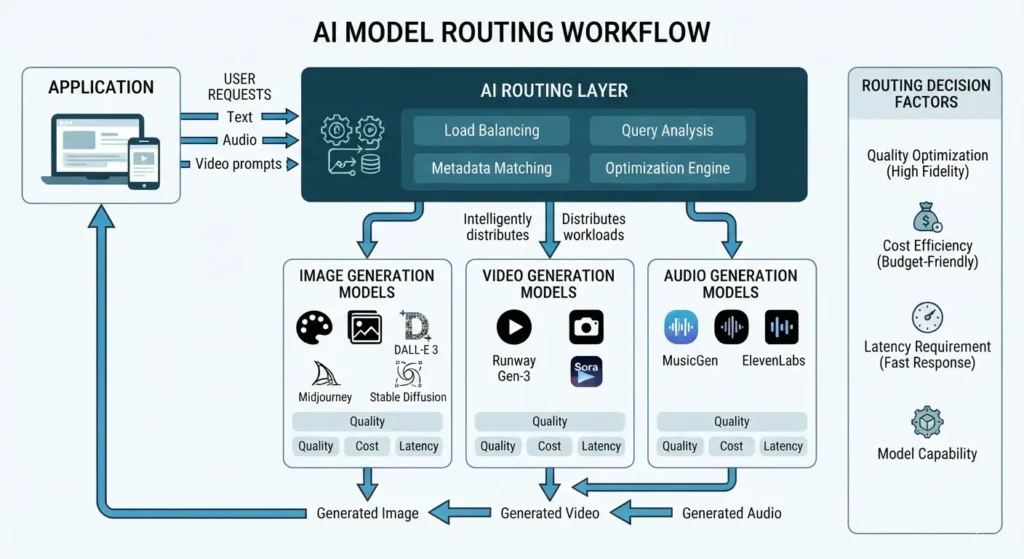
Runway has expanded its developer platform with Runway Media Router, a new orchestration layer designed to simplify how developers work with generative AI media models. Announced on July 23, 2026, the service is built into Runway Dev and automatically routes image, video, and audio generation requests to the most suitable AI model based on configurable priorities such as quality, latency, or cost.
The release signals a broader strategic shift. Rather than relying solely on its own frontier AI models, Runway is investing in infrastructure that helps developers navigate an increasingly crowded and fast-moving generative media ecosystem.
What Is Runway Media Router?
Runway Media Router is a routing service integrated into the company’s Runway Dev platform.
Instead of requiring developers to choose an AI model manually—or update integrations whenever a stronger alternative emerges—the router evaluates available models and selects one that best matches predefined priorities.
Developers can configure routing to optimize for:
- Quality
- Cost
- Latency
The service supports multiple forms of generative media, including:
- Video generation
- Image generation
- Audio generation
Rather than locking developers into a single provider, the routing engine works with both Runway’s own models and supported third-party models through a unified API.
How the Routing System Works
Applications send requests through Runway Dev instead of communicating directly with individual AI providers.
Media Router evaluates the request against the configured routing rules and chooses the model that best fits the selected objective. The idea is to let developers manage policies instead of constantly evaluating and integrating new models themselves.

The platform includes the following routing controls:
| Feature | Purpose |
|---|---|
| Cost optimization | Selects less expensive models when appropriate |
| Quality optimization | Prioritizes higher-quality output |
| Latency optimization | Chooses faster models for time-sensitive tasks |
| Price caps | Prevents requests from exceeding defined spending limits |
| Allow lists | Restricts routing to approved providers or models |
| Deny lists | Excludes selected providers or models |
| Routing metadata | Identifies which model processed each request |
| Dry-run mode | Tests routing decisions without generating media |
Important: Media Router does not replace AI models. It serves as an orchestration layer that determines which available model should process each request based on developer-defined policies.
Built on Runway Dev
Media Router is available through Runway Dev, the developer platform introduced earlier in July 2026.
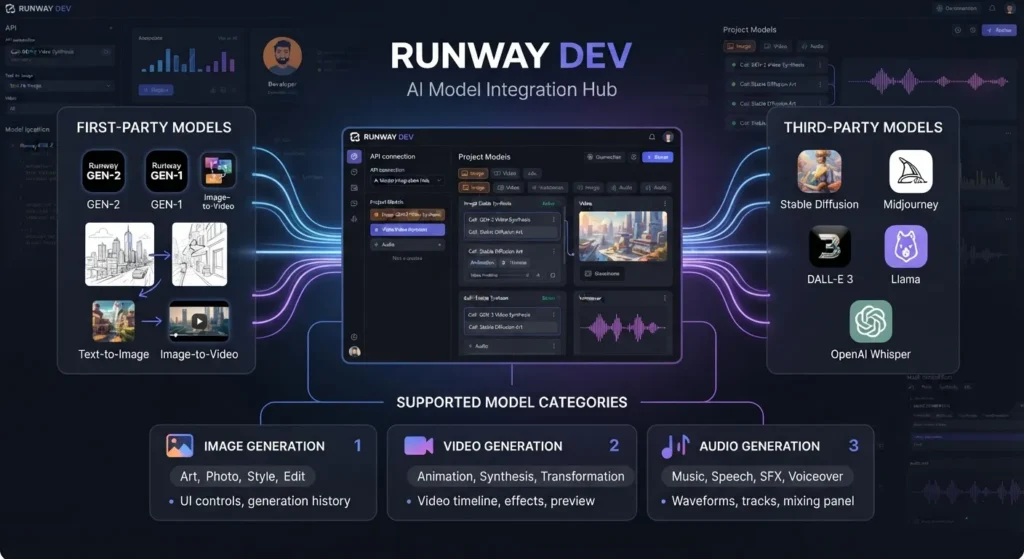
Runway Dev offers a single API for AI-powered media generation, eliminating the need for separate integrations with multiple providers.
The platform supports:
- Image generation
- Video generation
- Audio generation
- Real-time character models
It also brings together both first-party and third-party AI models.
Runway models
- Gen-4.5
- Aleph 2.0
- Act-Two
Third-party models
- Seedance
- GPT Image 2
- ElevenLabs

Why This Launch Matters
The release reflects a growing challenge across the generative AI industry.
New image, video, and audio models are arriving at an increasingly rapid pace. For development teams, keeping up with changing capabilities, pricing, and performance has become a significant engineering task.
Instead of asking customers to commit to one model, Runway is shifting attention toward the infrastructure that sits between applications and AI providers.
For organizations building AI-powered products, that approach could offer several practical advantages:
- Reduced engineering overhead
- Fewer API integrations to maintain
- Faster adoption of new AI models
- Better control over operating costs
- Greater flexibility as the market evolves
As the number of available models continues to grow, selecting the right one may become just as important as developing the application itself.
How It Changes Traditional AI Integrations
Developers have traditionally followed a familiar workflow:
- Choose an AI provider.
- Integrate its API.
- Benchmark competing models.
- Rewrite code when switching providers.
Media Router aims to simplify that process.
Applications continue using the same API while routing policies determine which underlying model is used. If a different model becomes the better choice for a particular task, developers can update routing preferences instead of rebuilding integrations.
That abstraction layer has the potential to reduce long-term maintenance for applications that depend on rapidly evolving AI services.
Technical Highlights
| Specification | Details |
|---|---|
| Release date | July 23, 2026 |
| Product | Runway Media Router |
| Platform | Runway Dev |
| Supported media | Video, Image, Audio |
| Routing priorities | Cost, Quality, Latency |
| API model | Unified API |
| Routing controls | Price caps, allow lists, deny lists |
| Validation mode | Dry-run |
| Metadata | Returns information about the selected model |
What This Means for Developers
Building AI-powered products increasingly involves working with several specialized models rather than relying on one provider.
An application might use one model for image generation, another for speech synthesis, and another for video creation. Each comes with its own API, pricing model, authentication system, and release cycle.
Media Router attempts to reduce that complexity by introducing a common orchestration layer. Developers can spend more time building features and less time evaluating whether a newly released model should replace an existing integration.
Developer Tip: The built-in dry-run mode allows teams to validate routing policies before generating media, helping test workflows without incurring generation costs.
Industry Perspective
The announcement also highlights a broader shift in the AI market.
Competition initially focused on building the most capable foundation model. Increasingly, companies are differentiating themselves through developer tooling, workflow automation, and infrastructure that simplifies the use of multiple AI services.
As organizations adopt multi-model AI strategies, orchestration platforms are becoming an important part of the software stack. Rather than competing directly with every model provider, products like Media Router aim to make those providers easier to use together.
Timeline
| Date | Event |
|---|---|
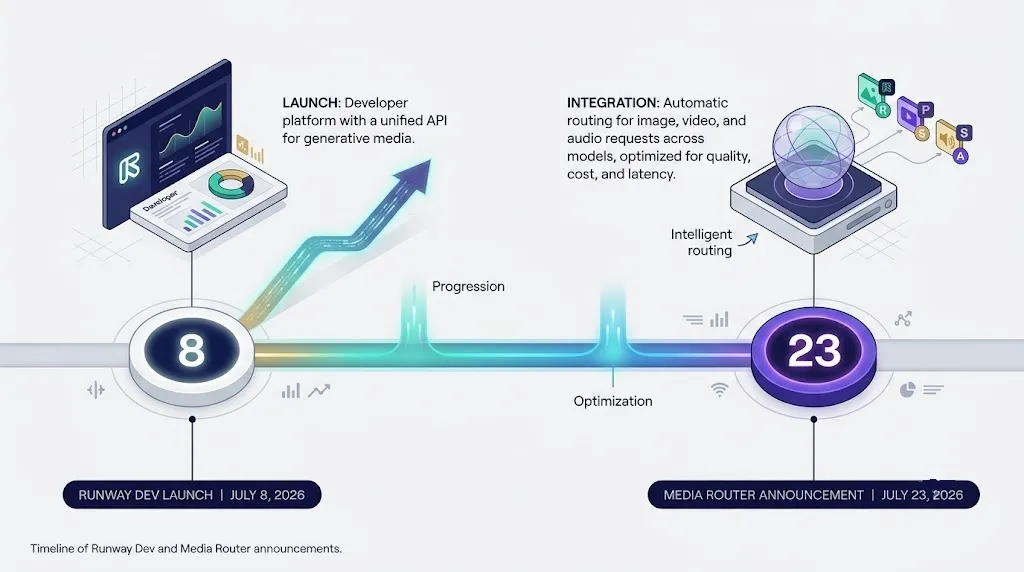
| July 8, 2026 | Runway announced Runway Dev. |
| July 23, 2026 | Runway introduced Media Router. |

What We Still Don't Know
While the official announcement outlines the platform’s core capabilities, several details have not yet been made public, including:
- Public pricing
- Standalone product documentation
- Release notes
- Version history
- GitHub repository
- System requirements
- Supported SDKs
- Security advisories
Those details may emerge as the platform evolves.
Conclusion
Runway’s introduction of Media Router reflects a broader evolution in the generative AI market, where infrastructure is becoming as important as the models themselves. By adding intelligent routing to Runway Dev, the company is aiming to simplify how developers work with a growing ecosystem of AI media models while giving them more control over quality, cost, and latency.
Several questions remain, including pricing and additional technical documentation. Even so, the launch underscores an important trend: as AI ecosystems become more diverse, tools that help developers manage multiple models efficiently are likely to play an increasingly central role.
Frequently Asked Questions
1. What is Runway Media Router?
It is an AI model routing service integrated into Runway Dev that automatically selects an appropriate image, video, or audio model for each request.
2. When was Media Router announced?
Runway introduced Media Router on July 23, 2026.
3. Is Media Router available as a standalone product?
No. Based on the official announcement, it is integrated into the Runway Dev platform.
4. What types of AI models does it support?
It supports image, video, and audio generation models.
5. Can developers optimize for lower costs?
Yes. Cost is one of the configurable routing priorities.
6. Does it support low-latency workloads?
Yes. Developers can configure routing to prioritize latency when response time is important.
7. Can organizations control which AI providers are used?
Yes. The platform supports allow lists and deny lists for both providers and models.
8. Can routing policies be tested before generating media?
Yes. Media Router includes a dry-run mode that validates routing decisions without generating content.
9. Has Runway announced pricing?
No. Public pricing information was not included in the official announcement.
10. Which AI models are specifically mentioned?
The announcement references Runway models Gen-4.5, Aleph 2.0, and Act-Two, along with third-party models including Seedance, GPT Image 2, and ElevenLabs.
Swathi is a contributor at GizStreet with a master’s degree in science and a strong background in technical writing and product review. She covers gadgets, software, and consumer tech, with a focus on breaking down complex products into clear, practical takeaways for readers.
Share this story
Related Articles

Substack Adds AI Writing Detection Powered by Pangram to Help Readers Understand How Content Is Created
Substack has launched an AI detection feature powered by Pangram, allowing readers to estimate AI involvement in newsletters, posts, comments and replies.

Googlebook Explained: How Google Is Reimagining the Laptop for the Gemini AI Era
Googlebook is Google's new AI-first laptop platform powered by Gemini Intelligence. Here's what has been announced, what's coming in Fall 2026, and what remains unknown.

Spotify Talk to Spotify: How a Conversational AI Assistant Could Change Music Discovery
Spotify Talk to Spotify introduces conversational AI for Premium users, allowing voice and text-based music discovery across iOS and Android.
Comments (0)